Announced 16 Oct 2026 · Sources checked
What Anthropic and Harvard reported
Anthropic published Designing more efficient quantum circuits with Claude on 16 October 2026. It describes a project in which Claude Mythos 5 was given plain-language specifications for eight quantum-circuit tasks, plus an automated program that checks each design and scores it, and then worked largely on its own to find better circuits. The full method is in the arXiv paper Discovering state-of-the-art quantum circuits with large language models, submitted on 15 October by Andi Gu, Alek H. Kemeny, Susanne F. Yelin and Mikhail D. Lukin.
Gu led the work through Anthropic's STEM Fellows Program and is affiliated with Harvard; Kemeny is a quantum physicist at Anthropic; Yelin is at Harvard; and Lukin is at Harvard and QuEra Computing, a neutral-atom quantum hardware company. The paper's abstract states the core result plainly: in seven of the eight tasks, the circuits the search found use significantly fewer Toffoli gates and fewer qubits than the best published designs. In the eighth, prime-field modular inversion, it found a new reversible architecture rather than a direct comparison.
Anthropic frames the finding in practical terms. Cheaper circuits shrink the hardware a useful quantum computation needs, so, in the company's words, practical quantum computers could arrive sooner than previously anticipated. That is a forecast, not a measured outcome, and it depends on hardware progress that the paper does not address.
Why circuit cost decides when quantum computers become useful
Today's quantum machines have hundreds to thousands of noisy qubits, too few for most algorithms that promise an advantage over classical computers. Researchers therefore count resources closely. The Toffoli gate is one of the most expensive operations to run on error-corrected hardware, so the number of Toffolis is a standard proxy for runtime, and the number of qubits is a proxy for machine size.
Anthropic's post uses FeMoco, the iron-sulfur cluster at the heart of the nitrogen-fixing enzyme nitrogenase, to show how much circuit design matters. A 2017 estimate put the cost of computing its ground-state energy at about 50 trillion Toffoli gates. Through a string of algorithmic advances that estimate has fallen to about 340 million, roughly a 150,000-fold reduction, which Anthropic describes as a few hours of computation on a future machine with about three million physical qubits. That progress took many research groups about eight years and came mostly from redesigning circuits, not from better hardware.
That history is the pitch for automating the work. If circuit redesign is where the biggest savings have come from, a system that can propose and verify new designs quickly could pull useful applications closer, as long as its designs survive expert scrutiny.
How the closed loop worked
The setup leans on three properties of this class of problem. Quantum circuits can be written as ordinary code, so a coding model can write, run and revise them. The chosen routines map each input to one definite output, so a classical evaluator can check correctness on test inputs. And there is a clear score to minimise: Toffoli count multiplied by peak qubit count, which the paper calls the TQ-cost.
According to the paper, the search runs inside OpenEvolve, an open-source evolutionary coding framework, with Claude Mythos 5 proposing circuit architectures and program rewrites. Each of the eight searches uses a fixed, hand-written task specification, and all share the same generic circuit-building interface. During ideation the model sees only the specification, the circuit model and the correctness criteria, and it has no access to the evaluator beyond the feedback returned after each submission. Starting from a blank program, it chooses the algorithm, the representation and the circuit structure.
To keep different trade-offs alive, the search uses MAP-Elites, which divides the plane of Toffoli count against qubit count into cells and keeps the cheapest circuit in each. A design that saves qubits but costs more gates can survive for later refinement instead of being discarded. Anthropic says the loop ran with no human input between rounds; humans wrote the initial briefs and occasionally prompted Claude to think more broadly.
The headline numbers across eight tasks
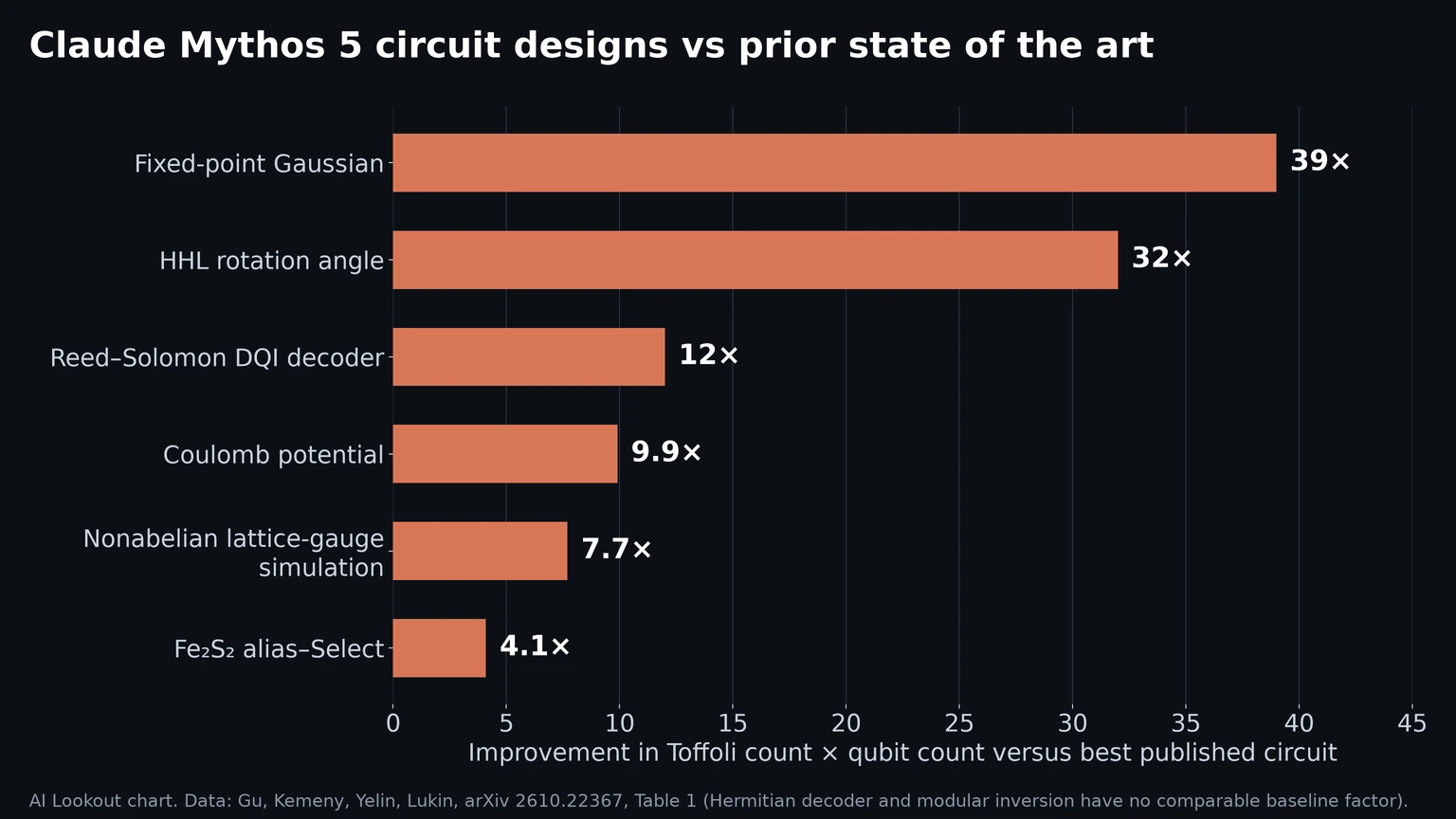
The paper's Table 1 compares each discovered circuit with the strongest published baseline for that task, reporting an improvement factor in TQ-cost. The largest gains are for numerical primitives: a fixed-point Gaussian routine improves by 39 times, from about 24,000 Toffolis and 362 qubits to 1,583 Toffolis and 139 qubits, and the rotation-angle step of the HHL linear-systems algorithm improves by 32 times, from about 16,000 Toffolis and 300 qubits to 1,348 and 115.
Chemistry and simulation tasks show smaller but still large factors. A Coulomb-potential routine improves 9.9 times, a nonabelian lattice-gauge simulation step 7.7 times, and an alias-sampling Select step for an iron-sulfide (Fe2S2) molecule 4.1 times. Anthropic's post says the molecule result came from Claude noticing symmetries and repeated structure that let some results be calculated once and reused. A Hermitian-code decoder has no prior reversible compilation in the literature, so the comparison there is against a naive implementation and the paper gives no factor.
These are the authors' own measurements against their own chosen baselines, scored by their evaluator. The paper notes that where a baseline has free parameters, the authors set them to minimise that baseline's cost, which is the fair way to run the comparison, but independent groups have not yet reproduced the circuits.
A reversible divsteps design for elliptic-curve arithmetic
The most technically striking result concerns elliptic-curve point addition, the core step in quantum algorithms that attack the elliptic-curve discrete logarithm problem. Most of its cost sits in modular inversion, the wraparound version of division. Classical computers do this efficiently with an algorithm called divsteps, but divsteps had never yielded a practical quantum circuit, because a reversible circuit must keep a record of every branch it took so it can run backward, and that record eats qubits.
Anthropic says Claude worked for 53 hours on a one-paragraph brief and arrived at a way to avoid storing the branch history at all: the branch taken at each step can be decoded from the pair of numbers that remains. Early guessed rules worked on small cases but failed on 256-bit numbers, so Claude switched to deriving new algebraic identities about the iteration, produced an exact decoding formula, checked it in large simulations, and formalised the claim in the Lean proof assistant. By choosing when to store rather than decode, it produced a family of designs. One uses 12% more qubits than the smallest previous design but 17 times fewer gates.
The cryptographic context is worth stating carefully. Cheaper point addition lowers estimated resources for a future quantum attack on elliptic-curve cryptography, but no machine today can run such an attack, and the paper is a resource-estimate result, not a demonstration on hardware.
A 12x cheaper decoder for decoded quantum interferometry
The second highlighted result targets decoded quantum interferometry, or DQI, an optimisation algorithm that Anthropic describes as one of the strongest candidates for a superpolynomial quantum speedup. Its most expensive step is a Reed-Solomon decoder. Anthropic cites Google Quantum AI estimates that one particular optimal polynomial intersection problem would take about three months on the Frontier supercomputer, against roughly an hour on a future quantum computer running DQI, with most of that hour spent decoding.
Claude replaced the extended Euclidean algorithm used by the previous design with Berlekamp-Massey decoding, which runs the same kind of step a fixed number of times and suits a circuit's single fixed sequence of gates. It then reconstructed most intermediate values from the circuit's state instead of storing them. A worst-case reserve for exceptional values would have needed 665 qubits, so Claude wrote a fast simulator, ran 403 million sample decodings, found almost every run needed at most one saved value, and reserved 19 qubits. About one run in 10,000 fails, which Anthropic says is within the error rate the task allows. The result is a decoder with 12 times fewer gates than Google's previous construction.
What the researchers say Claude still got wrong
Anthropic is candid that the model needed steering. In early experiments Claude was conservative: it second-guessed apparent improvements, re-checked results that were already well supported, and preferred well-known approaches to novel ones. The team responded by requiring several qualitatively different approaches developed in parallel and by occasionally prompting Claude to broaden its search. The same caution had an upside, Anthropic notes, because it led Claude to write the Lean proofs for its divsteps design.
The paper adds boundaries of its own. Results depend on the objective used to rank circuits, and TQ-cost is one reasonable choice among several. Every task is a classical-reversible primitive whose correctness can be checked on basis states, which is exactly why an automated evaluator works. Many other parts of a fault-tolerant machine, such as error-correcting codes, decoders and hardware control, are outside this study, although Anthropic suggests the same write-check-score approach could apply to them.
What this means and what to check next
The project fits a run of results in which frontier models do verifiable science under tight checks. OpenAI recently released 722 AI math manuscripts with Lean proof artifacts, and Anthropic earlier described how Claude Science inpainted about a third of the ultraviolet sky. Sakana AI's open-source Agentic Scientist shows the same pattern of an agent loop wrapped around a strict evaluator.
What separates the quantum result is that its outputs are concrete circuits with countable costs that experts can audit line by line. The things to watch are whether quantum-algorithm groups reproduce the Table 1 numbers, whether the divsteps construction is adopted in new resource estimates for elliptic-curve and other arithmetic, and whether Anthropic or the Harvard group releases the discovered circuits or evaluator code, which neither the post nor the abstract promises. Without those, outside groups can check the published constructions but cannot easily rerun the search itself.
Common questions
Did Claude run anything on a quantum computer?
No. Claude wrote circuit-generating programs that a classical evaluator checked for correctness and scored by Toffoli count and qubit count. The gains are resource estimates for future error-corrected machines.
How much human help did Claude get?
Humans wrote a fixed task specification for each of the eight searches and occasionally prompted Claude to broaden its search. Anthropic says there was no human input between rounds of the propose-evaluate-improve loop.
Does this make elliptic-curve cryptography easier to break?
It lowers the estimated cost of point addition, a key step in quantum attacks on elliptic-curve discrete logarithms, but no existing quantum computer can run such an attack.
Sources & further reading
How this story was made
Written by Kristian Kostov with AI assistance and checked against the linked sources. Company performance claims are attributed to the company. Analysis reflects AiLookout’s interpretation; we have not independently tested the products discussed. The cover places the companies’ own logos, taken from public-domain or openly licensed files credited in the caption, on a plain background. It is not a product photograph, a screenshot, or an endorsement.
Our editorial standards