Announced 27 Oct 2026 · Sources checked
What Axiom announced
Axiom Math announced on 27 October 2026 that it has formalized the classification of finite simple groups in the Lean proof assistant, calling it the first complete computer-checked proof of CFSG and the longest proof in the history of mathematics.
Over 24 days, engineers and mathematicians at Axiom directed swarms of dozens of AI agents that produced approximately 43.1 million lines of Lean and 2.05 million declarations, with the repository public on GitHub.
Why CFSG matters
The classification of finite simple groups identifies the basic building blocks of finite groups, one of the major achievements of twentieth-century mathematics. The original proof extends across roughly 15,000 pages in more than 500 articles by about 100 mathematicians, which earned it the nickname 'the enormous theorem.'
John Thompson was awarded the Fields Medal in 1970 and the Abel Prize in 2008 for his crucial work on the classification. Groups are fundamental objects across algebra, geometry and physics, and the classification underpins a large body of results.
The scale of the formalization
Formalizing a 15,000-page proof into machine-checked code is a different kind of mathematical work from writing the proof itself. Lean checks every logical step against its kernel, so the formalization is a complete, low-level proof rather than a high-level narrative. Axiom says every logical step is checked by Lean's kernel.
The 43.1 million lines of Lean is roughly three orders of magnitude more code than typical large formalization projects. The project also surfaced 34 noteworthy discrepancies in published records, which a team of human mathematicians plans to review.
What it means for AI mathematics
Axiom's result is a demonstration of what AI agents can do on routine but enormous formalization work when supervised by human mathematicians. The 24-day timeline is remarkably short compared with the decades it took humans to write the original proof.
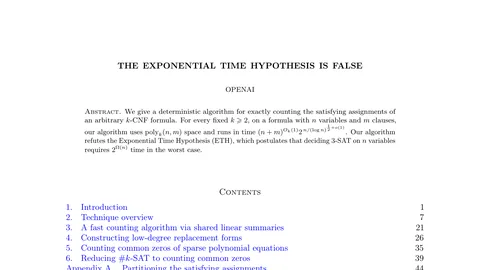
It also extends the pattern of frontier AI labs releasing machine-checked math results: OpenAI recently released hundreds of manuscripts with Lean formalizations, and Axiom's project is the largest single formalization attempt yet. The caveats are the same: the claims are the company's own, and independent verification of the formalization is needed.
What to watch
Watch whether the mathematical community independently checks the formalization and confirms the 34 discrepancies Axiom's agents found.
Watch whether Axiom's approach generalizes to other enormous proofs, and whether the 43-million-line Lean corpus becomes a reusable resource for mathematicians.
Early independent verification and adoption will separate a genuine breakthrough from an impressive announcement.
How Lean formalization works
Lean is an interactive theorem prover: rather than writing a narrative proof, the author builds a proof term that Lean's kernel checks step by step. Every axiom, definition and inference is machine-verified, so a successful compilation is a complete proof. That is why formalization projects are much longer than the papers they encode.
Axiom says its agents produced 2.05 million declarations and that every logical step is checked by Lean's kernel. The 43.1 million lines figure makes this one of the largest machine-checked mathematics projects ever attempted, though line counts are not directly comparable across proof styles.
The 34 discrepancies
Axiom's formalization surfaced 34 noteworthy discrepancies in the published CFSG record. Discrepancies in a formalization context range from typographical errors and missing hypotheses to genuine gaps in reasoning. Axiom says a team of human mathematicians will review them.
Finding gaps in published proofs is not a criticism of the original authors so much as a reality of large proofs: when mathematics depends on cross-references across hundreds of articles, small errors can go unnoticed for decades. Machine-checked proofs make those errors explicit.
Why it matters for formal math
A machine-checked CFSG would finally give mathematicians a verifiable version of the enormous theorem, addressing a long-standing concern: some steps of the human proof were published in scattered articles and were never fully checked by independent readers. Lean's kernel removes that ambiguity for every step Axiom encoded.
It also sets the bar for what AI can do in mathematics: not just proposing conjectures, but doing the grinding, citation-heavy work of formalization that humans find slow and error-prone. If Axiom's agents can formalize 15,000 pages in 24 days, the economics of formal proof change significantly.
Caveats
The biggest caveat is that the claims are Axiom's own. An independent team needs to inspect the repository, confirm the formalization compiles and means what Axiom says it means, and verify that the 34 discrepancies are legitimate. The line count, declarations and 24-day timeline are all company-reported.
There is also a subtle risk with very large formalizations: a proof that compiles in Lean is correct relative to its own definitions and assumptions, so the formalization is only as meaningful as the way CFSG was encoded. Scrutiny of definitions is part of the independent check.
Common questions
What did Axiom formalize?
The Classification of Finite Simple Groups, the longest proof in the history of mathematics, in the Lean proof assistant.
How long did it take?
24 days, using swarms of dozens of AI agents directed by Axiom engineers and mathematicians.
How much code?
Approximately 43.1 million lines of Lean and 2.05 million declarations, released publicly.
Sources & further reading
How this story was made
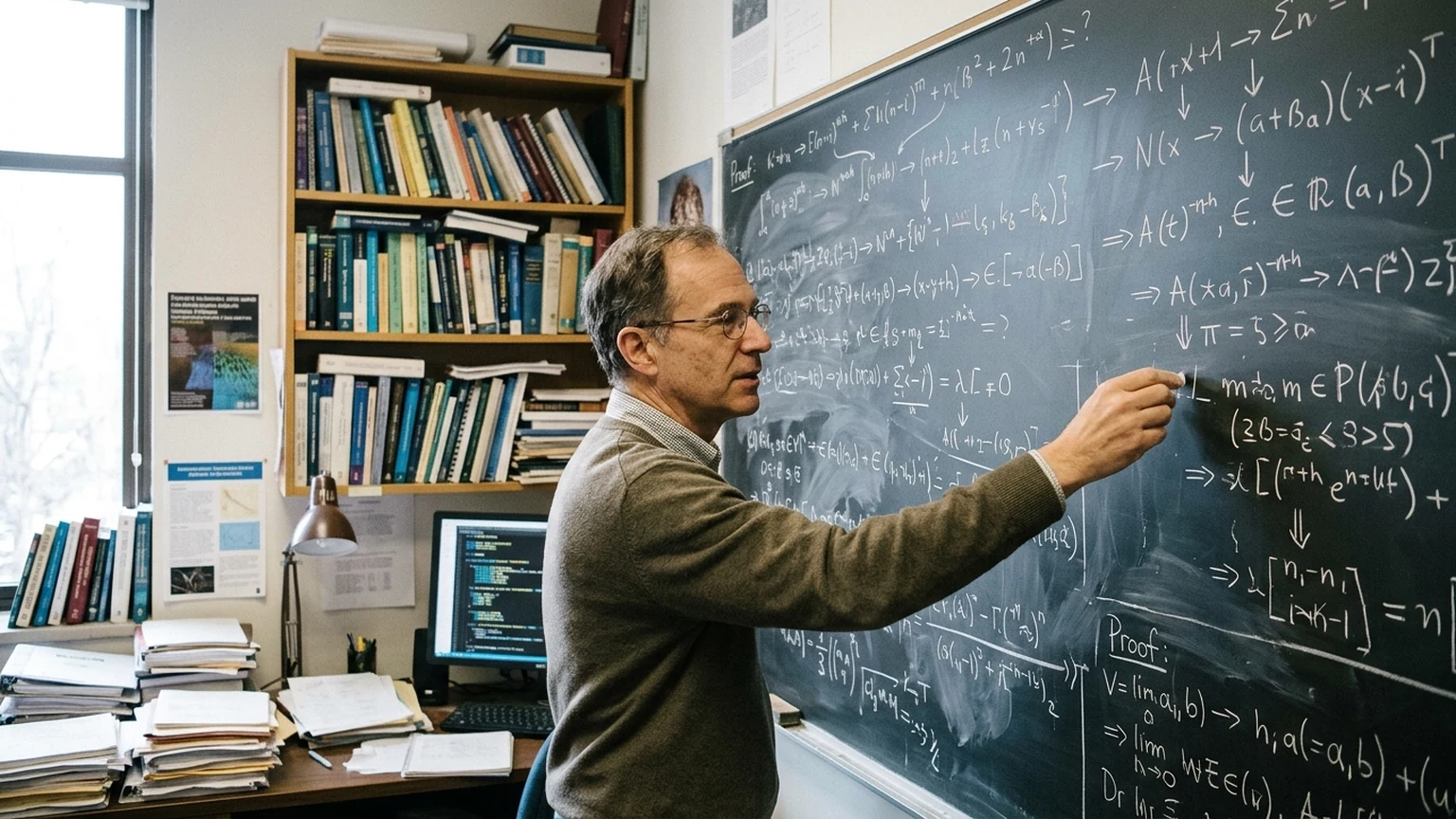
Written by Kristian Kostov with AI assistance and checked against the linked sources. Company performance claims are attributed to the company. Analysis reflects AiLookout’s interpretation; we have not independently tested the products discussed. The cover is an AI-generated editorial illustration, not a photograph or evidence of an actual event.
Our editorial standards