Announced 27 Oct 2026 · Sources checked
The race to refute ETH
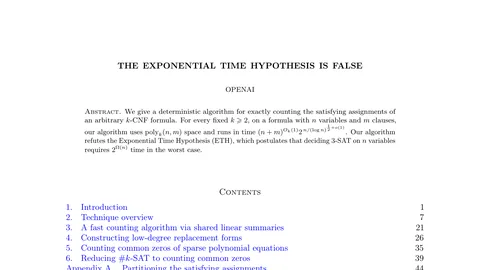
TechCrunch reported that Anthropic released its own refutation of the exponential time hypothesis hours after OpenAI published its claim. The exchange began when Anthropic mathematician Levent Alpöge suggested on X that OpenAI was basing its solution on pre-existing work.
Anthropic subsequently published its own ETH refutation in its formal-math repository on GitHub. The back-to-back releases turn what started as a single lab's announcement into a race between two frontier labs to claim the same foundational result.
Why ETH matters
The exponential time hypothesis is a durable assumption in computer science about what is difficult to compute. It states that certain NP-hard problems, like 3-SAT, cannot be solved in subexponential time. If ETH is false, results built on that assumption across theoretical computer science would need revisiting.
It does not settle P versus NP. But a verified refutation would upend a foundational assumption that underpins decades of work on computational hardness.
ETH was proposed in 1999 by Impagliazzo, Paturi and Zane as a tighter version of the P vs NP question. It formalizes the intuition that some NP-hard problems need exponential time in the worst case. A refutation would mean finding subexponential algorithms for problems thought to be impervious to them, which would ripple through algorithm design, cryptography and complexity theory.
The claim does not mean all NP-hard problems become easy. It would mean the specific assumption that all such problems need exponential worst-case time is false. Researchers would still need to work out which problems remain hard and what the new algorithmic possibilities actually are.
The independent review
MIT professor Ryan Williams, whose work focuses on computational complexity, is organizing the computer science field's response. He agreed to collaborate with the labs to help shepherd the result, along with UC San Diego computer scientists Russell Impagliazzo and Ramamohan Paturi, who first published ETH.
Williams has been openly critical of OpenAI's approach in the past, calling its earlier proof dump a 'DDOS attack on mathematicians.' Despite that, he is helping interpret the new solution. He told TechCrunch that parts of the proof look routine, but that two or three unusual parts need scrutiny.
The labs structured their releases differently by discipline: mathematicians got work dropped on GitHub, computer scientists formed a working group that asked for public proofs and conference funding, and physicists formed a working group to determine how their result will be released.
The organization of the review is itself notable: the scientists who first proposed ETH are now leading the examination of its claimed refutation. That gives the process credibility but also means the bar is high. Impagliazzo, Paturi and Williams know the hypothesis's subtleties better than anyone and will scrutinize every step of the proof.
TechCrunch noted that the two labs' approaches also differ. OpenAI structured its release with separate working groups for mathematics, computer science and physics, while Anthropic published its formal-math repository with the ETH refutation inside it. The scientific community is still absorbing both sets of claims and has not issued any verdict.
What to watch
Watch how quickly the independent review produces a verdict, and whether the two labs' proofs survive scrutiny. Williams has already flagged that a few 'alien-looking parts' of OpenAI's proof need careful checking.
Watch for the broader reaction in theoretical computer science, where any confirmed ETH refutation could force researchers to revisit years of work built on the assumption.
Watch also whether the two proofs turn out to be independent or whether one builds on the other. Alpöge's initial comment suggested OpenAI's work may have drawn on pre-existing mathematics, and if Anthropic's refutation is built on related foundations, the question of credit and precedence will matter as much as the mathematics itself.
How the releases unfolded
The sequence began with OpenAI publishing solutions to three blockbuster problems, including a claimed refutation of ETH. Anthropic mathematician Levent Alpöge then suggested on X that OpenAI's ETH work appeared to build on pre-existing results, rather than being entirely new. Hours later, Anthropic released its own ETH refutation on GitHub.
The rapid back-to-back releases turned what was a single lab announcement into a public race. Both labs are now claiming a result that touches a foundational assumption in theoretical computer science, and the speed of the releases has raised questions about whether the proofs have been fully vetted.
For the scientific community, the unusual part is that the review is being organized collaboratively. Instead of formal peer review papers submitted to journals, the labs are releasing proofs publicly and asking the relevant specialists to examine them. That is a new mode of scientific communication for such a high-stakes result.
What is at stake
If the refutation is correct, it would not automatically change how software is written tomorrow, but it would change the theoretical foundations of computer science. Researchers rely on ETH for results about hardness of approximation, parameterized complexity and other areas. A false ETH would force a reassessment of those results.
It would also make history: the Exponential Time Hypothesis is one of the most widely used assumptions in complexity theory, and a confirmed refutation would be a landmark result from an AI system. It would be a strong data point for the argument that frontier models can contribute original mathematical research.
But the bar is high. Williams' comment that parts of the proof look routine while a few look 'alien' captures where things stand: there is enough substance to take seriously, but not yet enough independent validation to treat as established fact.
Common questions
Did Anthropic also refute ETH?
Anthropic released its own refutation of the exponential time hypothesis hours after OpenAI, after its mathematician suggested OpenAI built on pre-existing work. Neither is peer-reviewed.
Who is reviewing these proofs?
An independent group led by Russell Impagliazzo, Ramamohan Paturi and Ryan Williams, the computer scientists who first published ETH.
Sources & further reading
How this story was made
Written by Kristian Kostov with AI assistance and checked against the linked sources. Company performance claims are attributed to the company. Analysis reflects AiLookout’s interpretation; we have not independently tested the products discussed. The cover is an AI-generated editorial illustration, not a photograph or evidence of an actual event.
Our editorial standards