Announced 27 Oct 2026 · Sources checked
The math manuscript release
OpenAI published a GitHub repository on 27 October 2026 containing 721 mathematical manuscripts across 373 result families, all produced by an unnamed internal OpenAI model. The README describes the work as 'raw research data' rather than polished academic papers, and defers 'completely to the math community on matters of credit, precedence, and concurrent work'.
The repository includes results in mathematics, computer science, and physics. OpenAI says the model was posed approximately 4,000 problems, and each result used about three hours of ChatGPT Pro-level thinking compute with the unreleased model. About 42% of the top-line results have accompanying Lean formal proofs, and OpenAI says it will continue to update the repository with formalizations.
The exponential time hypothesis
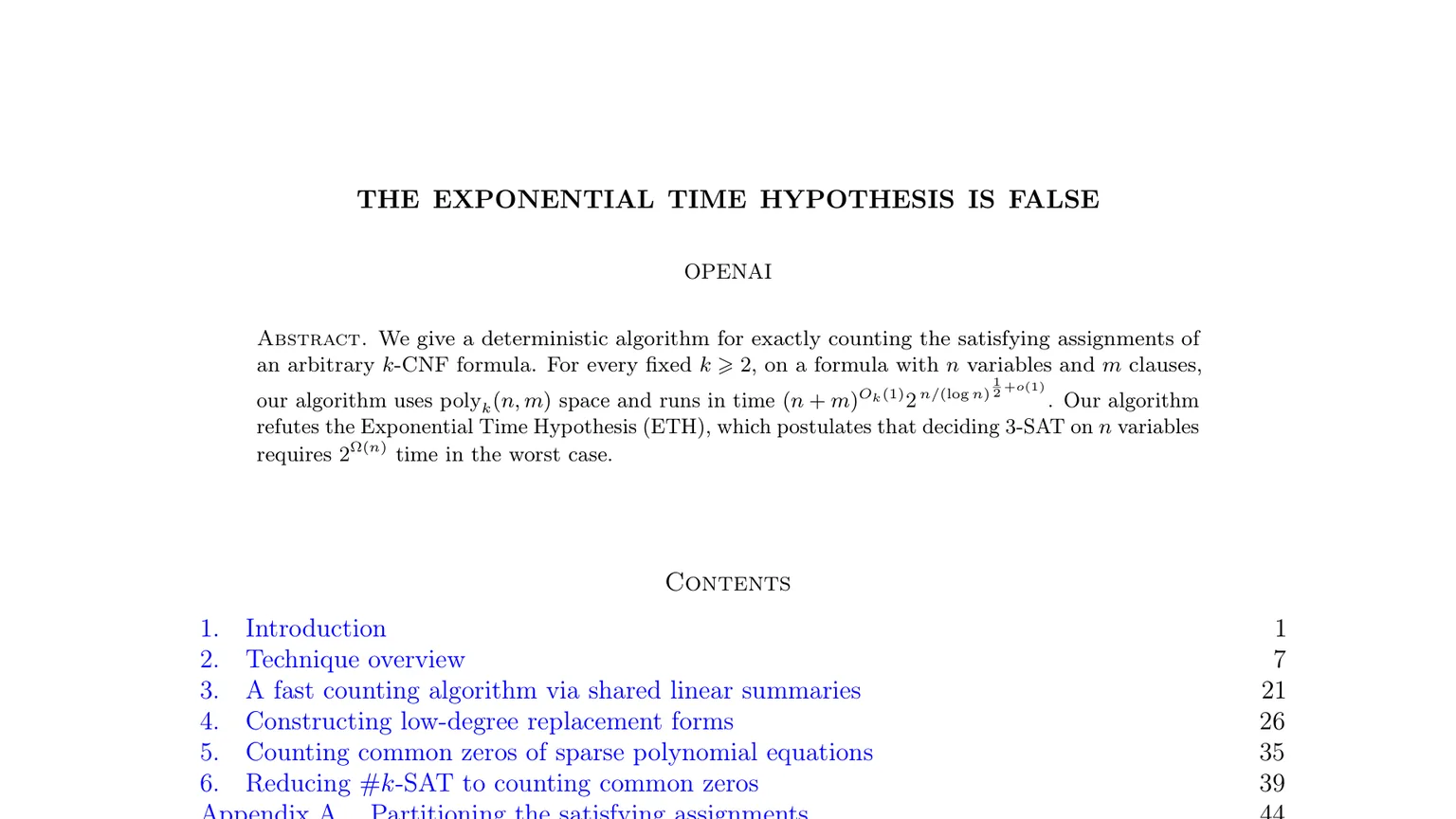
The most striking individual claim is a preprint paper titled 'The Exponential Time Hypothesis is False'. The exponential time hypothesis (ETH) is a foundational conjecture in computational complexity that says certain NP-hard problems require exponential time to solve in the worst case. If ETH is false, it would mean there is a subexponential algorithm for 3-SAT, the classic NP-complete problem.
The preprint says the Lean proof-checking program verified the result. Proof-checking programs can verify formal mathematical reasoning step by step, providing stronger confidence than a traditional peer review. The community discussion on the OpenAI developer forum noted the preprint and its potential implications for computational complexity theory.
It is important to note that formal verification is only as trustworthy as the formalization itself. The mathematical community has not yet independently verified the claim, and ETH's falsity would be a result of extraordinary significance that will require extensive checking.
Local smoothing and QCD
Two other headline results are a proof of the local smoothing conjecture for the Euclidean wave equation (a problem in harmonic analysis and PDEs) and a rigorous QCD (quantum chromodynamics) existence proof, which addresses a long-standing problem in mathematical physics about whether the theory of the strong nuclear force has a consistent mathematical foundation.
The repository also includes a result on the local smoothing conjecture for the three-dimensional wave equation, the smooth metric embedding problem, the ordinary NP-hardness at the basic semidefinite threshold, and hundreds of other manuscripts distributed across mathematics and computer science.
How the results were produced
OpenAI says the vast majority of results came from a single procedure using a single unreleased internal model. On average, each result used three hours of compute with ChatGPT Pro thinking. Over the course of the evaluation, the model was posed approximately 4,000 open problems, and the output was aggregated into result families and manuscripts.
OpenAI names two exceptions: work on a zero-free region for the Riemann zeta function and a proof of the Hodge Conjecture for CM abelian varieties. The Riemann zeta writeup was human edited for readability. The collection also comes with reasoning summaries for 11 of the headline families, including the ETH disproof, the smoothing proof, and results on the irrationality exponent of pi and Kaplansky's direct-finiteness conjecture.
Why it matters
The release is unprecedented in scale. No AI lab has published this many original mathematical manuscripts at once. The closest comparison is DeepMind's work on the cap set problem or the IMO Gold-medal system, which produced a small number of publishable results. This is a full preprint catalogue.
How the mathematical community responds will set a precedent for AI-generated mathematical research. OpenAI is explicit that these are raw model outputs, not peer-reviewed papers, and has left verification to the community. The presence of Lean formal proofs for a subset makes verification easier for those papers, but the majority of results are unformalized and may contain errors — something OpenAI acknowledges it will fix as issues are found.
The central question is how many of the 721 manuscripts hold up to scrutiny. If even a fraction are correct, it represents a major acceleration in mathematical discovery. If most are wrong, it is still a milestone in what models can attempt.
The scale of the release also creates a verification bottleneck. Traditional peer review processes a few results at a time; a batch of 721 manuscripts exceeds what any single institution can check in a reasonable period. OpenAI's Lean formalizations help but only cover 42% of the top-line results, and verifying formalizations is itself a skilled task that takes time.
What to watch
Watch for independent verification of the ETH claim, which would be the highest-impact result if correct. The Lean formalization makes it more tractable to check than a traditional paper, but the formalization itself needs verification.
Watch also whether other labs follow OpenAI's approach and publish their own model-generated preprint catalogues, and whether the mathematical community develops norms around how to handle large volumes of AI-generated results.
Common questions
What did OpenAI release?
A GitHub repository containing 721 mathematical manuscripts across 373 families, all produced by an unnamed internal OpenAI model, covering mathematics, computer science and physics.
What are the biggest claims?
The exponential time hypothesis is false, the local smoothing conjecture for the wave equation is true, and a QCD existence proof has been produced.
Are these results peer-reviewed?
No. OpenAI describes them as raw research data and defers to the mathematical community for verification. About 42% have accompanying Lean formal proofs.
Sources & further reading
How this story was made
Written by Kristian Kostov with AI assistance and checked against the linked sources. Company performance claims are attributed to the company. Analysis reflects AiLookout’s interpretation; we have not independently tested the products discussed. Cover photography is illustrative and does not depict the specific announcement or product.
Our editorial standards