

Announced 4 Nov 2026 · Sources checked
Why is Qualcomm pivoting to data centers?
Qualcomm reported its Q4 2026 earnings on November 4, and the headline number was a sharp decline in its core business. Smartphone sales dropped roughly 20 percent compared to 2025, according to The Verge's coverage of the earnings call. The company's total revenue for fiscal 2026 was $10.4 billion.
Qualcomm's answer to that decline is a major push into data center AI chips. During the earnings call, the company said it expects data center revenue to eventually account for about 30 percent of its total business. That is less aggressive than AMD's stated target of over 80 percent from data centers, but it still represents a dramatic shift for a company built on mobile processors.
Qualcomm has already announced partnerships with Amazon and Meta earlier this year to supply AI inference hardware. The company's data center chip lineup now includes the Cloud AI 100 series, with the new Ultra model as the flagship.
What are the Cloud AI 100 Ultra specifications?
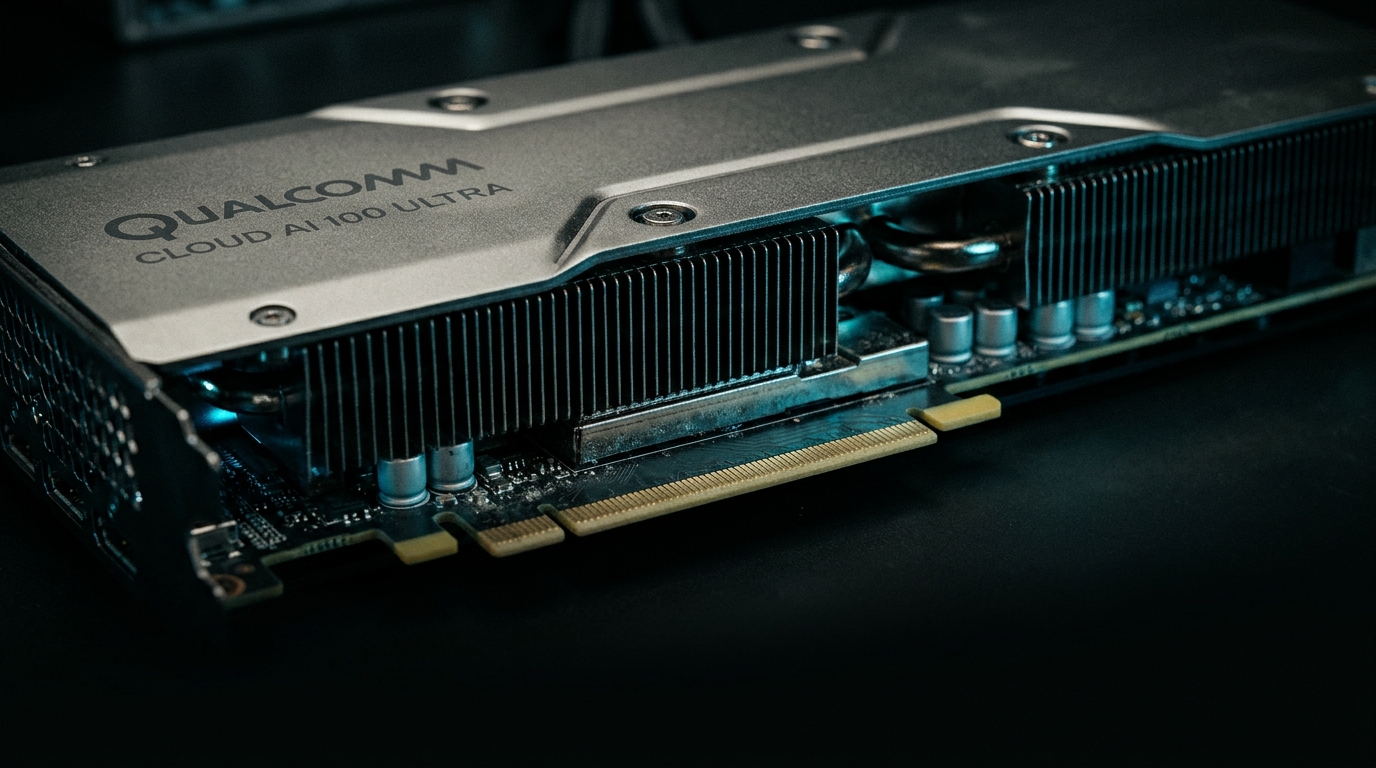
The Qualcomm Cloud AI 100 Ultra is a PCIe Gen 4, full-height, three-quarter-length accelerator card with a 150-watt thermal design power. According to existing spec sheets, today's price and availability for the Ultra variant being discussed on Hacker News appears to be a reference to a 128GB memory configuration, with the card carrying 64 AI cores and 576 MB of on-die SRAM at 9 MB per core.
The official product brief rates the card at up to 870 INT8 TOPS. Memory is 128 GB of LPDDR4X with 548 GB/second of bandwidth, which puts it in the same class as Apple's M4 Max unified memory bandwidth but in a discrete PCIe form factor. The card supports generative AI inference workloads including large language models, computer vision, and natural language processing.
The Cloud AI 100 Ultra is designed for a specific niche: cost-efficient inference at low power. Its 150W TDP is dramatically lower than Nvidia's data center GPUs, which can draw 700 watts or more per card. Qualcomm's pitch is that the Ultra can deploy a 100-billion-parameter model on a single card at a fraction of the power cost while maintaining useful inference throughput.
What are Qualcomm's data center revenue targets?
Qualcomm's earnings call laid out an aggressive growth trajectory for its data center business. The company forecast approximately $650 million in data center chip revenue during the first quarter of fiscal 2027 alone. By the end of calendar 2027, it expects that figure to reach $5 billion. Its long-term target is $15 billion in annual data center revenue by 2029.
Those numbers represent a steep ramp from a near-zero base. Qualcomm's data center business was negligible in 2025 and early 2026, making the $5 billion target for next year all the more ambitious. The company is betting that its efficiency advantage — delivering competitive inference performance at a fraction of Nvidia's power draw — will win it a slice of the AI infrastructure buildout.
The timing aligns with a broader trend. AI inference workloads are growing faster than training workloads as deployed models enter production, and inference benefits more from cost-efficient, lower-power hardware than from raw compute density. Qualcomm's mobile heritage in power-efficient chip design gives it a credible angle in that market.
How does the Cloud AI 100 Ultra compare to Nvidia?
The direct comparison is not straightforward: Nvidia's data center GPUs target both training and inference at much higher power envelopes, while Qualcomm's Cloud AI 100 Ultra is an inference-only card at 150W. Nvidia's H200 and B200 GPUs draw 700W and 1000W respectively, and its RTX Spark laptop platform is a different form factor entirely.
Qualcomm's advantage is efficiency for inference-only workloads. A single 150W card handling a 100-billion-parameter model uses roughly one-fifth the power of an equivalent Nvidia solution. For large-scale inference deployments where thousands of cards run around the clock, that power difference translates into significant operational savings. Qualcomm's product brief emphasizes cost-optimized inference rather than raw throughput leadership.
The Cloud AI 100 Ultra also supports multi-card scaling, meaning several cards can be linked for larger models. Qualcomm's software stack includes support for standard AI frameworks, though its ecosystem is considerably less mature than Nvidia's CUDA platform, which remains the industry standard.
What does this mean for the AI hardware market?
Qualcomm's entry into data center AI hardware adds another competitor to a market currently dominated by Nvidia, with AMD and Intel also vying for share. The company's focus on low-power inference differentiates it from Nvidia's high-power training-and-inference approach and could appeal to cloud providers looking to optimize inference costs.
The earnings call's revenue projections — from $650 million to $5 billion in one year — will test Qualcomm's ability to execute in a market where it has limited experience. Its partnerships with Amazon and Meta provide a distribution channel and credibility, but winning broader adoption means convincing data center operators to integrate a non-CUDA inference stack into their workflows.
If Qualcomm hits its $15 billion target by 2029, it would represent roughly one-seventh of Nvidia's current data center revenue — a meaningful share that would reshape the competitive landscape for AI inference hardware.
Common questions
What is the Qualcomm Cloud AI 100 Ultra?
It is a 150W PCIe Gen 4 accelerator card with 64 AI cores, 576 MB on-die SRAM, 128 GB LPDDR4X memory at 548 GB/s, and 870 INT8 TOPS, designed for generative AI inference workloads.
How much data center revenue does Qualcomm expect?
Qualcomm forecast $650 million for Q1 2027, $5 billion by end of 2027, and $15 billion by 2029, with data centers eventually representing 30 percent of its total business.
Sources & further reading
How this story was made
Written by Kristian Kostov with AI assistance and checked against the linked sources. Company performance claims are attributed to the company. Analysis reflects AiLookout’s interpretation; we have not independently tested the products discussed. The cover is an AI-generated editorial illustration, not a photograph or evidence of an actual event.
Our editorial standards