Announced 3 Nov 2026 · Sources checked
A record quarter with a hole in it
AMD's third quarter, covering the three months to 26 September, produced revenue of $13.377 billion, up 45% from $9.246 billion a year earlier and ahead of the high end of its own guidance. GAAP gross margin was 54%, operating income $2.832 billion, net income $2.428 billion and diluted earnings per share $1.46. On a non-GAAP basis the company reported $3.923 billion of operating income and earnings per share of $2.09, up 74%.
Buried in the GAAP numbers is the item that matters most for anyone watching how the AI buildout is being financed. AMD recorded a $1.07 billion non-cash charge, equal to 66 cents a share, to account for the warrants it handed to OpenAI and Meta under their chip supply agreements, according to Reuters coverage carried by Channel NewsAsia. Non-cash means no money left the bank. It means the company marked the cost of paying customers in equity rather than cash.
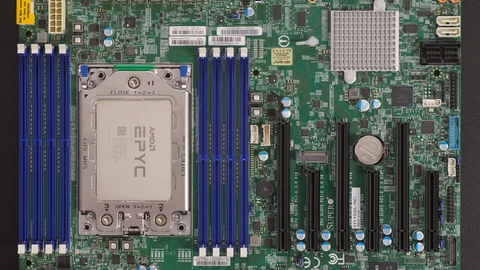
The charge landed in the same quarter that AMD's data center segment posted its best result ever: $8.5 billion of revenue, up 97% year over year, driven by EPYC server processors and the launch of Instinct MI450 Series GPUs. Client and gaming revenue was $3.7 billion, down 8%, with gaming down 40% to $773 million on weaker semi-custom and graphics sales. Embedded revenue rose 29% to $1.1 billion.
What the warrants actually are
The structure is simple to describe and awkward to price. In February, AMD agreed to sell up to $60 billion of AI chips to Meta over five years and granted the company warrants that could let it buy as much as 10% of the chipmaker if it hits milestones, per Reuters. A similar agreement with OpenAI, struck last year, gives the startup the option to buy roughly 10% of AMD. Both are conditional on shipment and commercial targets.
Reuters reports that the warrants could eventually let OpenAI and Meta own a large stake for as little as a penny apiece if they fully vest and are exercised. OpenAI's warrant also carries AMD share-price thresholds; Meta's does not. The ultimate value depends on where AMD's stock trades when the options are exercised, which is why the accounting charge moves with the share price and the shipping schedule rather than with any cash transfer.
AMD chief financial officer Jean Hu said on the analyst call that dilution begins once OpenAI and Meta satisfy the vesting and exercise conditions, which include shipment volumes and other commercial requirements. AMD expects to give more guidance in 2027 on when those conditions could be met, she said. Until then, investors are carrying an unknown number of future shares.
This is becoming the standard way to buy chips
AMD is not alone. Cerebras granted OpenAI warrants against a $20 billion commitment. Marvell issued warrants to Google that give the search giant the right to buy a stake worth a potential $12.2 billion, according to Reuters. Qualcomm gave Amazon warrants inside a $60 billion deal for AI data-center chips. The pattern is consistent: a small number of buyers account for enormous order books, and the suppliers pay for those orders with a slice of themselves.
That is a rational response to a market where a handful of labs and hyperscalers decide who gets scale. It is also a way of booking revenue that is partly funded by the customer's future ownership of the seller. When the same companies are customers, suppliers and investors in each other, the reported growth rate stops being a clean signal of end demand.
AI Lookout has tracked the same financing pattern in the broader market: [US tech giants' hidden AI debt has swelled to $3.2 trillion](/blog/us-tech-giants-hidden-ai-debt-swells-to-3-2-trillion/) and in [Nvidia's move to cap Chinese data center business at 49%](/blog/nvidia-tells-data-center-clients-to-cap-china-business-at-49-percent/) as export rules reshape who can buy what.
Helios, MI450 and the 2027 promise
The operational story is stronger than the accounting one. AMD said Anthropic, Meta, Microsoft, OpenAI and Oracle Cloud Infrastructure are running models and workloads on the first Helios rackscale systems, powered by Instinct MI450 Series GPUs and 6th Gen EPYC CPUs. HPE said Vultr will deploy the first Helios systems from HPE. Oracle Cloud Infrastructure said its OCI Compute E7 instances will run on 6th Gen EPYC.
AMD also released ROCm 10, its AI software stack, with an AI-native developer experience and updated libraries, compilers and framework support. The EuroHPC JU selected Instinct MI430X GPUs and 6th Gen EPYC to power the LUMI-AI supercomputer. On the corporate side, AMD announced agreements to acquire World Labs for model research and Taalas for specialised inference silicon.
Chief executive Lisa Su framed the quarter as a scaling problem rather than a demand problem: "We delivered a record quarter with revenue exceeding the high end of our guidance as Data Center segment sales nearly doubled year-over-year," she said in the results release, adding that AMD expects growth to accelerate in the fourth quarter as it scales Helios and "Venice" production. Jean Hu put the same point in margin terms, saying non-GAAP earnings per share grew 74% and demonstrating what she called the significant operating leverage in the business model.
The bull case and the dilution case
The bull case is straightforward. AMD shares rose 8% in extended trading after the results, and the stock moves lifted Intel, Nvidia and Broadcom with it, according to Reuters. The company forecast faster-than-expected growth for 2027 on surging data center sales. If the warrant milestones are hit, that means tens of billions of dollars of committed AMD silicon shipping into named customers, which is exactly the visibility a chipmaker wants when it is spending heavily on capacity and packaging.
The bear case is about what the customer is really paying. TECHnalysis Research chief analyst Bob O'Donnell pushed back on the idea that the deals are purely incentives: "While I do believe incentives played a role in some of their sales, I believe the bigger issue is that there is pent-up demand for a serious alternative to Nvidia and AMD's products are now starting to compete on price/performance metrics," he told Reuters. That is a more flattering read, and it may well be right for the current order book.
Both can be true. Demand for a second source of AI accelerators is real, and so is the dilution. A shareholder who bought AMD for the data center growth is also underwriting a transfer of up to a tenth of the company to two customers at a price that has nothing to do with market value. The charge AMD just booked is the first visible instalment of that transfer, and it will grow as shipments grow.
What to watch next
Three things will settle the argument. First, the fourth-quarter guide and the 2027 outlook: AMD said growth should accelerate as Helios and Venice ramp, and the market has now priced that in. Second, disclosure on warrant vesting. Jean Hu promised more detail in 2027, which means the dilution schedule is currently a black box for anyone modelling share count. Third, whether the equity-for-orders model spreads further. Every supplier that copies it makes the sector's revenue look larger and its per-share economics look smaller.
AMD's quarter is a good quarter. Data center revenue doubling year over year is not a soft number, and the customer list on Helios is the list that matters. But the $1.07 billion charge is the part of the story that will still matter in three years, because it is the first hard figure for what AMD is paying to be chosen.
Common questions
How big was AMD's warrant charge in the third quarter of 2026?
AMD recorded a $1.07 billion non-cash charge, equal to 66 cents a share, to account for warrants granted to OpenAI and Meta under its chip supply agreements, according to Reuters coverage of the results.
Did AMD's revenue beat expectations?
AMD reported revenue of $13.377 billion, up 45% year over year, and said it exceeded the high end of its own guidance. Data center revenue was a record $8.5 billion, up 97%, while gaming revenue fell 40% to $773 million.
Are the OpenAI and Meta warrants diluting AMD shareholders yet?
Not yet. Chief financial officer Jean Hu said dilution begins once OpenAI and Meta satisfy vesting and exercise conditions, including shipment and other commercial requirements, and that AMD expects to give more guidance in 2027 on when those conditions could be met.
Sources & further reading
How this story was made
Written by Kristian Kostov with AI assistance and checked against the linked sources. Company performance claims are attributed to the company. Analysis reflects AiLookout’s interpretation; we have not independently tested the products discussed. The cover is an AI-generated editorial illustration, not a photograph or evidence of an actual event.
Our editorial standards