Announced 30 Oct 2026 · Sources checked
The speech
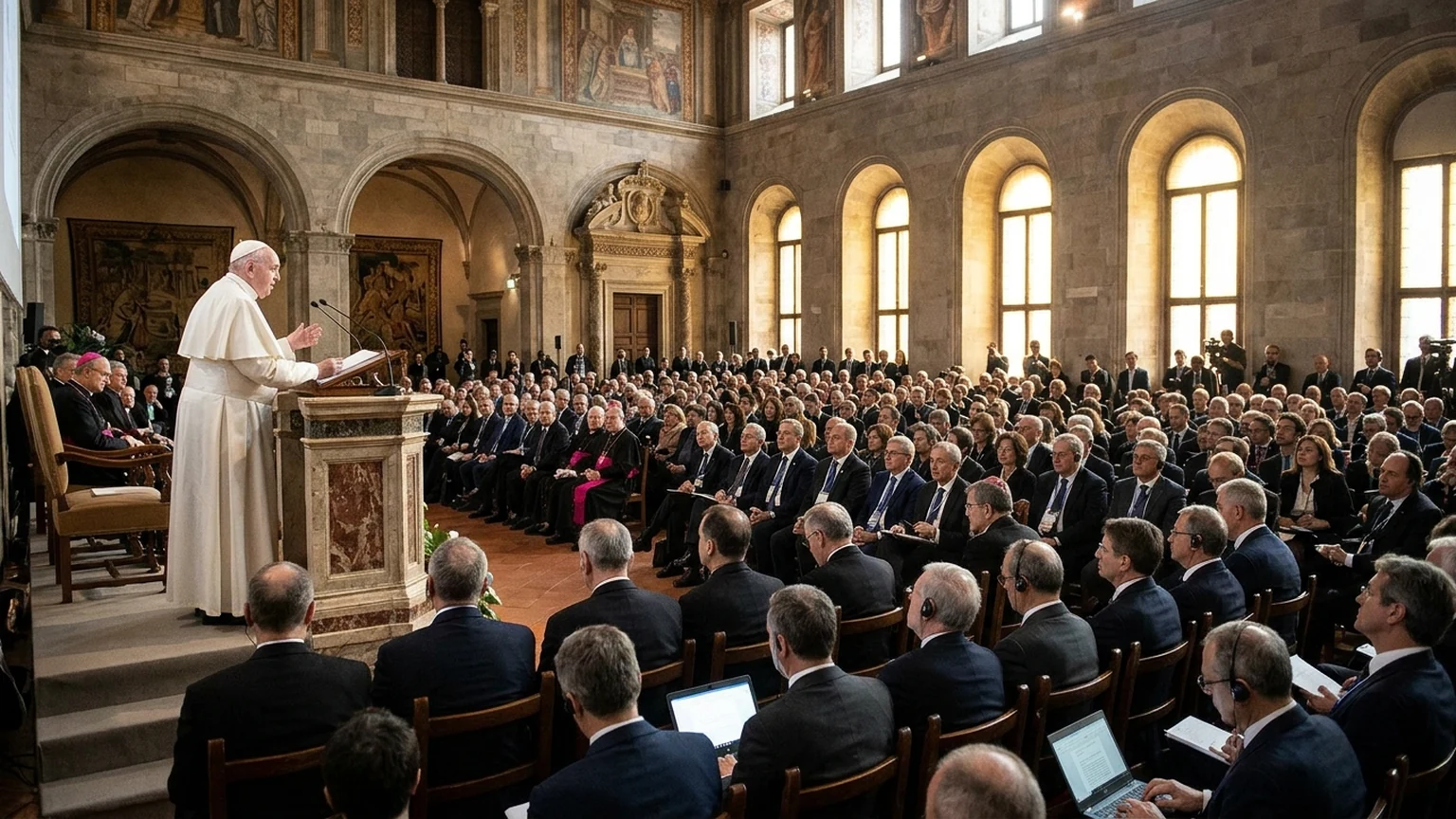
Pope Leo XIV addressed a Vatican gathering on 30 October 2026 titled 'The Future of AI: A Dialogue Between the Vatican and the Scientific World on the Developments and Applications of Intelligent Technologies.' The event was co-organized by the Pontifical Academy for Life and the Future of Life Institute — the Cambridge-based organization founded by MIT cosmologist Max Tegmark that has become a leading voice in AI safety research.
In his speech, released by the Vatican press office and covered by the Associated Press, the Pope described AI as a tool, not a person, and said decisions affecting human life must never be delegated to AI. The most urgent challenge, he said, is identifying — and building — the international institutions that can put ethical principles into practice.
From principles to practice
The Pope's framing is notable for shifting the Vatican's position from abstract moral commentary — the kind of statements about technology and human dignity that have been a consistent feature of papal addresses — to a concrete institutional demand. The speech does not merely warn about AI risks; it asks who will enforce the guardrails.
The choice of co-organizer is significant. The Future of Life Institute has been funding AI safety research and policy work since 2015, and its partnership with the Vatican's Pontifical Academy for Life connects the secular AI safety movement with one of the world's most influential moral authorities. The event signals that AI governance is no longer a niche concern for technologists but a mainstream global institutional priority.
What the Vatican brings
The Vatican has a unique convening power in global ethics conversations. It speaks to 1.4 billion Catholics worldwide, maintains diplomatic relations with most countries, and has a centuries-long institutional memory of navigating the tension between technological change and moral order. The Pope's AI intervention is the latest in a tradition that includes statements on nuclear weapons, climate change and bioethics.
What is different this time is the speed of the technology's development. The Vatican's AI timeline — from its first significant AI document in 2020 to the Future of Life co-convened summit in 2026 — is compressed relative to the decades the institution spent deliberating on other technologies. That compression is itself a signal that the AI debate is moving faster than traditional ethical institutions can adapt.
Caveats
The Pope's speech is a statement of principles and an institutional challenge, not a policy proposal with specific institutional design. No commitments to fund or create such institutions were announced. The partnership with the Future of Life Institute is new and its practical impact remains to be seen.
AI Lookout covered the AP and Vatican press reporting; it did not attend the summit.
Why this summit matters
The meeting was not the Vatican's first AI engagement. Pope Francis had addressed AI ethics in his 2020 encyclical and subsequent statements. But the Leo XIV summit goes further by co-organizing with the Future of Life Institute — an organization founded by MIT professor Max Tegmark that has funded AI safety research for a decade — and by framing the institutional gap as the most urgent problem.
The shift from 'AI needs ethics' to 'AI needs institutions to enforce ethics' is a meaningful escalation in the Vatican's position. It acknowledges that voluntary principles, industry self-regulation and academic guidelines are not enough — a position that aligns with the direction of the EU AI Act, the Canadian national security strategy, and the US midterm debate on AI oversight. The question, as the Pope put it, is who will do the enforcing.
What comes next
The Vatican has not announced plans to create or host such institutions. The Pope's challenge is addressed to the broader international community — governments, multilateral organizations, researchers and companies — to build the governance infrastructure the AI era needs. The summit serves as a convening moment rather than a launch event.
For AI companies and policy watchers, the signal is that the governance conversation is widening beyond the usual forums. More Vatican-backed statements on AI governance are expected in the coming months, along with formal engagement with the EU and UN institutional design processes. When the Vatican — an institution that has been navigating moral and technological change for two millennia — says the institutional gap is the most urgent problem, it reinforces the message from every major government and intergovernmental body that has examined the issue. More Vatican-backed statements on AI governance are expected in the coming months, along with formal engagement with the EU and UN institutional design processes. The question is no longer whether AI governance institutions are needed, but who builds them and how they are held accountable. More Vatican-backed statements on AI governance are expected in the coming months, along with formal engagement with the EU and UN institutional design processes. Expect more Vatican-backed statements on AI governance in the coming months, and likely formal engagement with the EU and UN processes on AI institutional design. More Vatican-backed statements on AI governance are expected in the coming months, along with formal engagement with the EU and UN institutional design processes.
Common questions
What did Pope Leo XIV say?
That the most urgent AI challenge is creating international institutions that can enforce ethical principles, not just state them.
Who organized the summit?
The Pontifical Academy for Life and the Future of Life Institute.
What is new about this?
The Vatican shifts from abstract AI moral commentary to demanding concrete institutional governance.
Sources & further reading
How this story was made
Written by Kristian Kostov with AI assistance and checked against the linked sources. Company performance claims are attributed to the company. Analysis reflects AiLookout’s interpretation; we have not independently tested the products discussed. The cover is an AI-generated editorial illustration, not a photograph or evidence of an actual event.
Our editorial standards