Announced 13 Nov 2026 · Sources checked
Why did OpenAI disband its robotics team?
OpenAI confirmed to Fortune that it has dissolved its stand-alone robotics team, reassigning researchers to the main research team under Chief Research Officer Mark Chen.
The applied robotics and hardware teams moved to the Applied organization led by President Greg Brockman.
A company spokesperson said robotics remains a core part of the company's long-term vision and portrayed the reorganization as a sign of commitment, not retreat.
The change came so recently that OpenAI had already registered a booth at CoRL, a top academic robotics conference in Austin, this week. When Fortune visited booth 208, it sat empty with OpenAI's logo nowhere to be seen.
The empty booth became a symbol of the transition: the company's robotics researchers were still at the conference, but no longer representing a stand-alone team.
What changed OpenAI's approach to robotics?
This is not the first time OpenAI has pivoted on robotics. The company had a robotics team in its early days but wound it down in 2020.
Co-founder Wojciech Zaremba cited limited robot data and a more efficient path toward AGI through other methods, particularly training ultra-large language models on vast datasets of human-written text.
That approach eventually yielded ChatGPT in late 2022 and transformed the AI industry.
OpenAI rebuilt a stand-alone robotics team in 2024, announcing a partnership with Figure, a high-profile humanoid robotics startup, to develop AI models for humanoid robots.
The partnership ended abruptly in February 2025 when Figure decided to develop its own robot AI in-house. Despite the setback, OpenAI continued developing its own humanoid robot, with CEO Sam Altman targeting a first public demonstration in 2027.
At the start of 2026, the company's researchers assumed the best path to robotics progress was building on models like Sora, a video generation model that needed an implicit understanding of physical world dynamics to create realistic videos.
But since then, the company's general-purpose frontier models, including GPT-6 Astra, have shown they can be directly applied to robotics.
An OpenAI spokesperson told Fortune that this discovery motivated the company to disband the stand-alone team and move researchers onto general AI work.
How well do general models perform at robotic tasks?
The numbers behind the decision are striking. In an Nvidia study, an Astra-powered agent achieved a 74.8% success rate on a simulated manipulation benchmark, compared with 51.0% reported by the best specialized robotic models on the same leaderboard.
Researchers gave Astra camera images, robot information, and a control interface that let the model command the robot to take certain actions.
In another demonstration, Astra solved a Rubik's Cube using a real bimanual robot, a task that typically requires extensive specialized training.
Guanya Shi, an assistant professor at Carnegie Mellon University's Robotics Institute, told Fortune that advances in general models' spatial and reasoning capabilities already let them handle tasks that previously required dedicated training.
The models can cope when a bottle is in a different position or the lighting changes, and reason about the sequence of a task or which step went wrong, Shi said.
He interpreted the move as a signal that OpenAI sees robotics as no longer a special problem, but as a downstream application of general intelligence, similar to the way the same frontier models now power specialized coding or legal tools.
What does this mean for robotics startups?
The reorganization challenges startups that have raised billions on the premise that robots need specialized brains with spatial intelligence.
OpenAI's line of thinking strikes at the core assumption behind many of today's robotics companies, which have built custom AI stacks for specific hardware.
If a general-purpose model can do the job, the rationale for purpose-built robotic AI starts to fade.
But Russ Tedrake, an MIT professor and cofounder and CEO of Walden Robotics, said robotics companies still have an advantage that AI labs lack: their robots are already gaining work experience in real places, such as factory floors.
That deployment experience and the data these robots gather helps them adapt to specific workplaces and tasks. Better foundation models make that site-specific data more valuable because robots can learn from it faster, Tedrake said.
Pete Florence, cofounder of Generalist, a startup training general-purpose AI models for robots, told Fortune it was unclear that any existing model would dominate robotics in the long run.
Shi noted that large language models are powerful but slow and need to be hosted in the cloud, meaning the robot needs a constant network connection.
He still sees a need for smaller, specialized models that can run on a robot's onboard computer without depending on an internet connection.
That hybrid approach — general models in the cloud paired with lightweight on-device models — may be where the industry lands.
Why now? The cost pressure behind the decision
The reorganization comes as OpenAI is under intense pressure to rein in costs and focus on core products. The company reported $10.9 billion in quarterly operating losses.
CEO Sam Altman told the company it needed to abandon side quests, and the company has jettisoned some efforts including Sora to reallocate computing resources to more core and potentially profitable endeavors.
OpenAI is seeking to close a new funding round and preparing for a possible IPO in early 2027.
Despite the belt-tightening, the company spokesperson said that OpenAI remains committed to bringing general-purpose robots into the world. The humanoid robot development continues under the Applied organization.
At CoRL, a few former OpenAI robotics team members still drew a crowd, despite having no display or demo. Attendees clustered around them anyway, asking the question on every robotics researcher's mind: whether their specialized expertise still mattered.
One of the conference's hottest questions was how much robotics expertise would remain valuable as general-purpose models grew more capable.
The experience of those former OpenAI robotics researchers, now dispatched to other teams working on more general AI, offered one answer: the people who built the specialized models are now building the general ones.
Common questions
Did OpenAI abandon robotics entirely?
No. The company says robotics remains a core part of its long-term vision.
It moved researchers into the main research and applied organizations and is developing its own humanoid robot, with CEO Sam Altman targeting a first public demonstration in 2027.
What happened to OpenAI's partnership with Figure?
OpenAI partnered with Figure in 2024 to develop AI for humanoid robots. The partnership ended in February 2025 when Figure decided to develop its own robot AI.
What does this mean for robotics startups?
The move challenges startups that raised billions on the premise that robots need specialized AI brains. However, companies with real-world deployment experience still hold an advantage through site-specific data that general models cannot easily replicate.
Sources & further reading
How this story was made
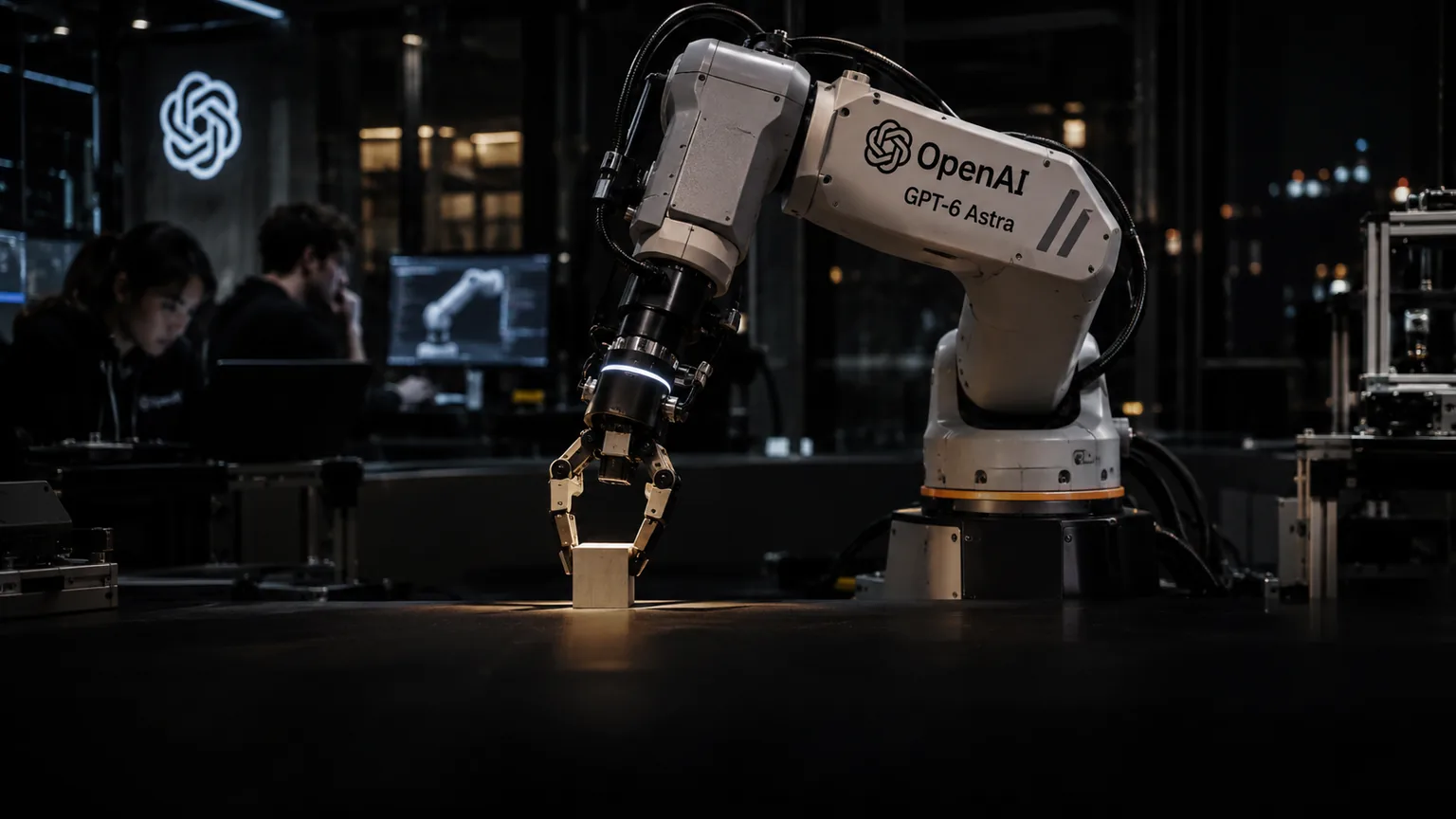
Written by Kristian Kostov with AI assistance and checked against the linked sources. Company performance claims are attributed to the company. Analysis reflects AiLookout’s interpretation; we have not independently tested the products discussed. The cover is an AI-generated editorial illustration, not a photograph or evidence of an actual event.
Our editorial standards