Announced 21 Oct 2026 · Sources checked
What NVIDIA announced at GTC Berlin
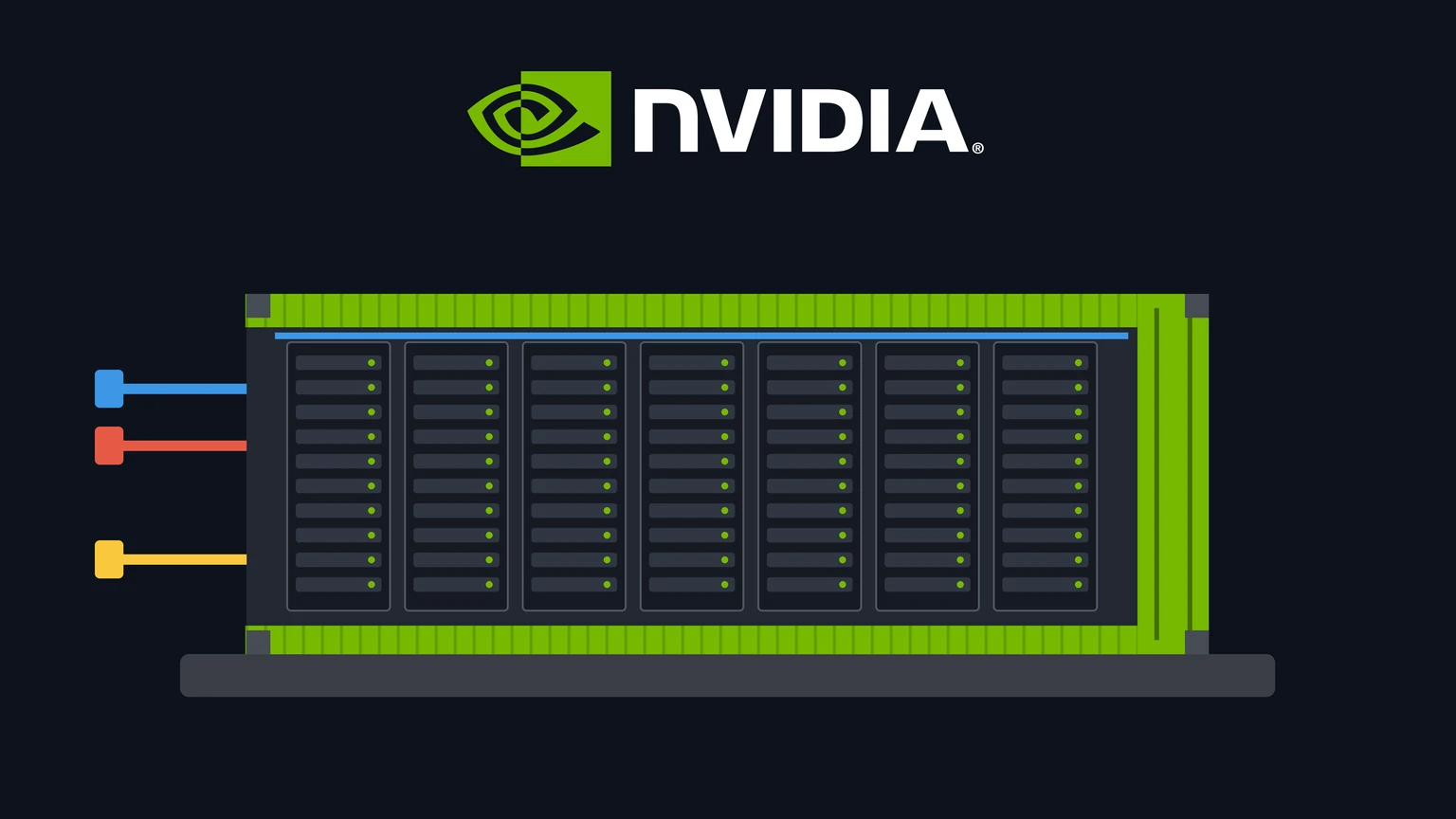
At its GTC Berlin keynote on 21 October 2026, NVIDIA introduced DSX POD, a reference design for complete AI data centres built around its next-generation Vera Rubin systems and delivered inside modular containers. According to NVIDIA's press release, partners will assemble, cable, plumb and test the computing, networking, rack power and liquid cooling in a factory, then ship the containers to a site that already has power, cooling and network connections waiting.
NVIDIA's headline claim is about time. A traditional on-site build of this kind of capacity takes about six months, the company says, while a DSX POD can be running in as little as 14 days once it reaches a prepared site. Seventeen hardware and infrastructure partners will build the units, with deliveries worldwide expected in early 2027. NVIDIA did not give a price, a power rating or a GPU count per container.
The announcement came alongside a second release on NVIDIA's wider DSX AI factory platform, covering water-free cooling, power-management software and new open-source operations tools, and opened a keynote in which, according to NVIDIA's live blog, Jensen Huang said the company has committed nearly $10 billion to Europe's technology ecosystem during a week of events in Paris, London, Stockholm and Dublin. Germany signed its own physical AI pact with NVIDIA ahead of the conference.
How a DSX POD differs from a normal build
Most large AI data centres are still assembled where they stand. Servers, switches, cabling, power distribution and liquid-cooling manifolds arrive separately, and specialist crews put them together and test them on site. That work competes for scarce electricians and pipefitters, and a late component can hold up an entire hall.
DSX POD moves that work into the partner's factory. NVIDIA says partners complete rack-to-rack cabling, wiring, piping and functional validation before shipment, and that this happens in parallel with preparing the site. The containers then connect to the site's power, cooling and networking infrastructure out of the box. NVIDIA describes DSX POD as carrying forward the design approach of its broader DSX platform, but with a distinct architecture built around purpose-made containers.
The Vera Rubin systems inside are NVIDIA's successor to the Blackwell generation; the company had already opened parts of the Vera Rubin rack architecture to the Open Compute Project this month. Containerised data centres are not new, and several partners already sell modular units, but a validated NVIDIA reference design for a complete Vera Rubin installation in that form is.
Who will build DSX PODs and when
NVIDIA lists Anduril, Armada, Bull, Crusoe, DayOne, Dell Technologies, Delta, Eaton, Foxconn (through its Ingrasys unit), GIGABYTE, HPE, Lenovo, Pegatron, Quanta Cloud Technology, Schneider Electric, Vertiv and Wistron as partners working to deliver DSX POD AI factories worldwide in early 2027.
The list mixes the server makers that already build most NVIDIA systems with power and cooling suppliers and cloud builders. It also includes defence contractor Anduril and Armada, which sells modular edge data centres, a hint that containerised AI capacity could end up in places that are not classic data centre campuses. NVIDIA did not say which partners will ship first, or whether any European customer has ordered units, despite the release's title framing DSX POD as a way to speed up Europe's infrastructure build-out.
The rest of the DSX platform: water, power and software
The companion DSX platform release sets out the rest of NVIDIA's pitch. Its reference designs pair Vera Rubin's fully liquid-cooled racks, which accept coolant at up to 45 degrees Celsius, with dry coolers that reject heat to the air without evaporating water. NVIDIA says this can cut facility cooling water use to near zero and save 54 million litres a day at a 2-gigawatt deployment compared with cooling towers, about the daily use of 180,000 households. It adds that hot climates may still need supplementary mechanical cooling.
On power, NVIDIA says its DSX MaxLPS software, which reallocates power within a site's fixed budget, can produce the same number of tokens with up to 30 percent less electricity, or run more GPUs on the same supply. It quotes two customer tests. Lambda reported 24 percent more cluster token throughput and 19 percent more GPU capacity on HGX B200 systems within a fixed power budget. Nscale reported 49 percent higher inference throughput and 37 percent more managed GPU capacity across four GB300 NVL72 racks in Iceland, within the same 264 kilowatts.
DSX Flex lets a site cut or shift its draw when the grid is stressed. In an early trial with Emerald AI, the research institute EPRI, Nebius and the UK's National Grid, NVIDIA says a Blackwell Ultra cluster reduced its power draw by up to 40 percent during simulated grid events while critical jobs kept running. NVIDIA is also launching a SimReady Central library of simulation-ready power and cooling equipment models on Hugging Face, and three open-source DSX OS tools in developer preview for network configuration, rack management and checking that GPU clusters are healthy before production work arrives.
Why deployment speed is the pitch
NVIDIA frames speed as economics. Time to first token, it argues, is when an AI factory starts earning, so weeks saved on installation are weeks of revenue gained. "An AI factory creates value when it starts producing tokens, not when construction is complete," Huang said in the release.
The bottleneck in Europe, though, is often electricity rather than construction. Nscale, one of the companies quoted in NVIDIA's DSX release, saw Microsoft pull out of its planned Essex data centre last week after the grid operator said power would not be available until the 2030s. A container that installs in 14 days does not shorten a grid connection queue, which is why NVIDIA pairs DSX POD with software that promises more output per megawatt and sites that can flex their demand.
For operators who do have power, factory integration could reduce the risk of the kind of hardware faults that large clusters suffer early in life; Meta recently described keeping thousands of spare GPUs idle in its Prometheus cluster just to absorb failures. Pre-tested containers will not remove that problem, but they move some of the debugging off the construction site.
What the claims leave out
The 14-day figure assumes a site that is already prepared with power, cooling and network connections, which is the slow and expensive part of most projects. NVIDIA has not published the capacity of a single DSX POD, its cost compared with a conventional build, or how containers are serviced when parts fail. Deliveries are more than two months away at the earliest.
The efficiency numbers are NVIDIA's or its customers' and have not been independently checked. The MaxLPS results come from proofs of concept on Blackwell systems, not Vera Rubin, and "up to" figures describe best cases. The water savings depend on climate and compare dry coolers with evaporative towers, not with other closed-loop designs already in use. Several partners, including Vertiv and Schneider Electric, already sell their own modular data centre products, so it is not yet clear how much DSX POD changes beyond giving those offerings an NVIDIA-validated blueprint.
Common questions
What is in a DSX POD?
NVIDIA describes a complete Vera Rubin AI factory in modular containers: computing, networking, cabling, rack-level power and liquid cooling, integrated and validated by a partner before delivery. It has not published the number of GPUs or the power rating per unit.
When can companies buy one?
NVIDIA says its partners are working to deliver DSX POD AI factories worldwide in early 2027. Pricing will come from the partners, and none had been announced on 21 October.
Does it solve the power shortage for AI data centres?
No. A DSX POD still needs a site with power, cooling and network connections ready. NVIDIA's separate MaxLPS and Flex software aim to get more output from a fixed power supply and to help sites connect to the grid faster, but those claims are its own.
Sources & further reading
How this story was made
Written by Kristian Kostov with AI assistance and checked against the linked sources. Company performance claims are attributed to the company. Analysis reflects AiLookout’s interpretation; we have not independently tested the products discussed. The cover places the companies’ own logos, taken from public-domain or openly licensed files credited in the caption, on a plain background. It is not a product photograph, a screenshot, or an endorsement.
Our editorial standards