Announced 19 Oct 2026 · Sources checked
What Meta disclosed
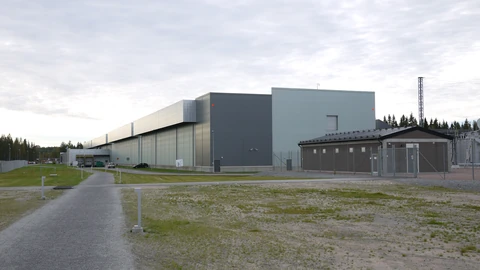
Meta has published the most detailed account yet of Prometheus, the AI supercluster it is building in New Albany, Ohio. In a 19 October 2026 post on its engineering blog, the company says the first phase of the gigawatt-scale cluster is complete and was used to train its Muse foundation models, including Muse Wonder, the frontier models it launched on 12 October.
According to Meta, Prometheus today links hundreds of thousands of GPUs across several interconnected buildings and is meant to grow to roughly one million GPUs working in lockstep. Meta says the cluster is now being scaled with the next frontier models from Meta Superintelligence Labs in mind.
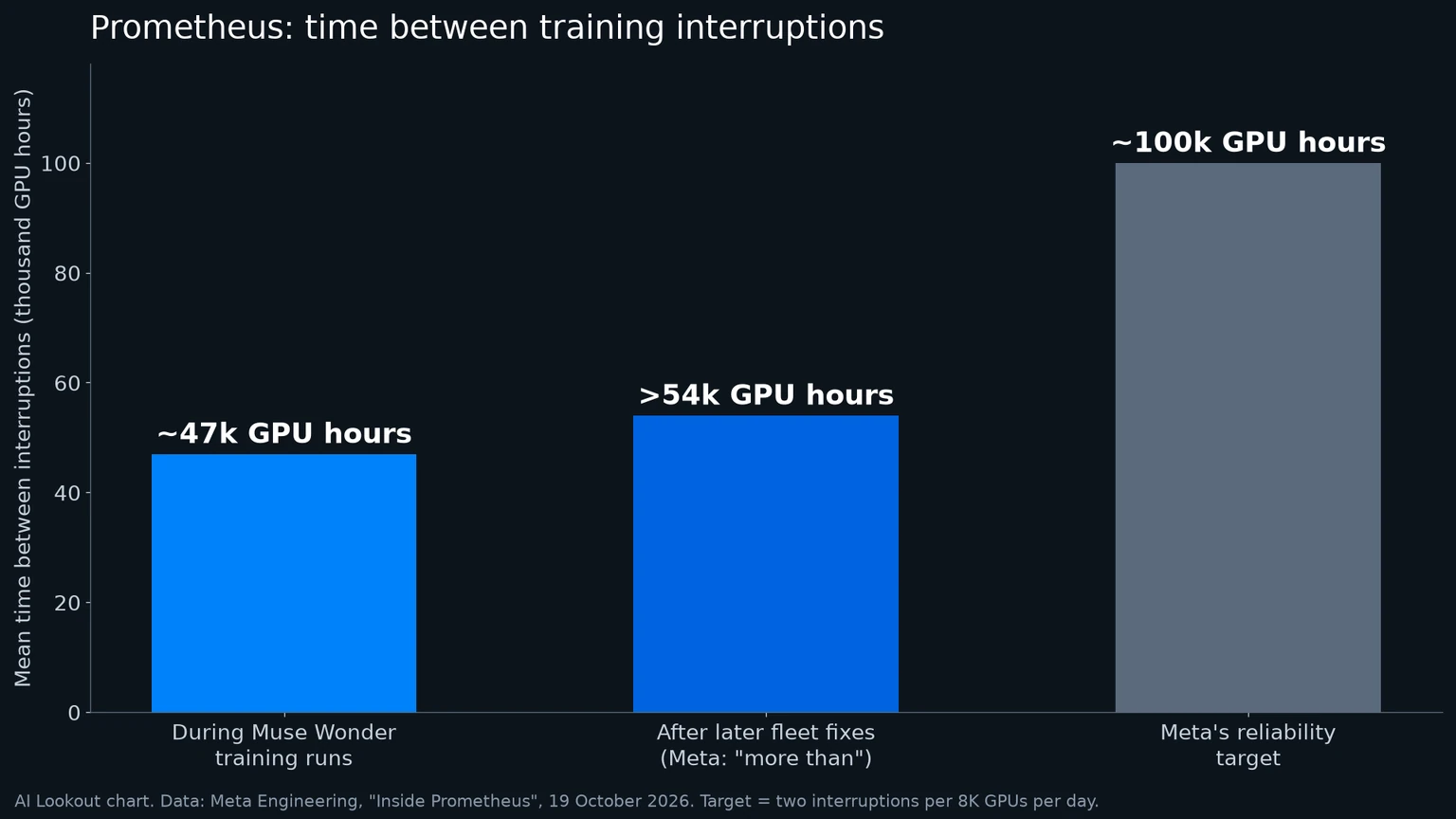
The headline numbers are about keeping the machine running rather than raw size. Meta says it reached more than 85 percent goodput on pre-training runs for Muse Wonder and more than 90 percent on reinforcement learning runs. Goodput is the share of time a training job spends doing useful work rather than recovering from failures. Meta also says the overall mean time between interruptions was about 47,000 GPU hours during those runs, and has since passed 54,000 after further fixes.
The same day, Meta's data-centre site published a community post saying New Albany supports 300 operational jobs, had 1,200 skilled trade workers on site at peak construction and is part of an investment of more than $1.5 billion in Ohio. Meta broke ground there in 2017.
The hardware inside Prometheus
Prometheus runs two NVIDIA rack platforms today, with a third on the way. All use NVL72 racks, in which 72 GPUs are linked by NVLink and act as one large accelerator.
The first, which Meta calls Catalina, is built on the GB200 NVL72. Meta uses a two-rack variant called Ariel with 36 GPUs per rack, pairing each Blackwell GPU with a Grace CPU and two 400-gigabit network cards. That gave each GPU 800 gigabits of outside bandwidth earlier than the standard design, a choice Meta says it made because the GB200 raised almost every other spec over the H100 but would have left scale-out bandwidth flat. Meta lists 192 GB of HBM3e per GPU, 720 petaflops of peak FP8 training compute and about 120 kW of power across the two-rack pair.
The second, Clemente, uses the GB300 NVL72. Memory rises to 288 GB per GPU, newer network cards deliver 800 gigabits per GPU natively, and the whole 72-GPU domain fits in a single rack drawing about 135 kW. Meta lists a 5 to 10 percent performance improvement over the GB200 NVL72.
The third, called San Miguel, will bring NVIDIA's Vera Rubin NVL72, with 288 GB of HBM4 per GPU and more than 170 kW per fully liquid-cooled rack. Meta expects a 10 to 20 percent improvement in performance per watt over GB300. The racks build on the Open Rack designs Meta contributes to the Open Compute Project, which it updated at OCP 2026 with liquid-cooled switches and a new GPU fabric.
A network stretched across 100 kilometres
Large training runs depend as much on the network as on the chips. Meta runs a dedicated back-end Ethernet network for GPU-to-GPU traffic, separate from its normal data-centre network. Inside each building, a fabric connects up to 20,736 GPUs. Meta first used a scheduled fabric to avoid congestion from the few, very large data flows that training produces, then moved to a simpler non-scheduled design with 51.2-terabit switches once network cards could reorder packets themselves.
Buildings are joined by what Meta calls the Backend Aggregation network, which spans from 2 kilometres to more than 100 kilometres between sites and is built on Arista switches with Broadcom Jericho3 chips. Meta says running pre-training across those distances took a dedicated optimisation effort with Meta Superintelligence Labs, because the speed of light starts to matter.
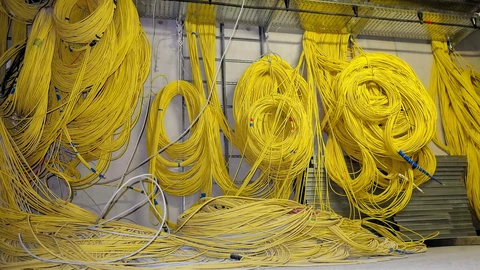
The training jobs are split to match. Traffic that is sensitive to delay stays inside a model replica, close together, while more tolerant traffic travels between replicas. Meta says the whole network uses millions of miles of fibre strand, tens of thousands of switches and millions of optical transceivers.
Why reliability is the real story
The most unusual part of the post is how openly Meta describes failure. In mid-2025, during Prometheus's first phase, interruptions peaked at nearly 1,000 events per 8,000 GPUs per day, according to the company. It says a year of work cut that rate by 99 percent, enough to run several training jobs of tens of thousands of GPUs side by side.
Part of the problem is the rack itself. In the H100 generation, a fault could take out a group of eight tightly linked GPUs. With NVL72 the group is 72, so Meta says the blast radius grew ninefold. Its answer is to run 64 GPUs per rack and keep eight as spares. When one fails, a spare takes over and the job restarts from its last checkpoint. Meta also holds about 2 percent extra racks in reserve. For a run with 32,768 active GPUs, it provisions 523 racks, or 37,656 GPUs, about 13 percent more than the job uses.
Meta lists the biggest sources of trouble. NVLink signal quality was initially the main bottleneck on GB200, across more than 600,000 connections. Memory faults grew as GB300 added capacity. A single NVLink switch fault can take down a whole 72-GPU domain. Fixes ranged from burn-in tests and memory scrubbing to firmware that can now be pushed to more than 100,000 GPUs in a few hours.
When a fault stays inside one model replica, Meta can drop that replica and let the rest keep training. Bigger faults force a restart from a checkpoint, which Meta saves frequently and in the background. Its stated target is two interruptions per 8,000 GPUs per day, which it equates to about 100,000 GPU hours between interruptions, roughly double where it says it is now.
Power swings and cooling
Synchronised training creates a power problem that ordinary data centres rarely see. When tens of thousands of GPUs switch between computing and communicating at the same moment, Meta says load can swing by 30 to 40 percent within the cluster, and starting or pausing a large job can shift more than tens of megawatts in seconds.
Meta's answer is a system it calls Dynamo Dimmer, which gradually lowers GPU power limits as the cluster nears its electrical ceiling instead of stopping work. Batteries in the racks absorb sudden spikes, capacitor trays smooth peaks, and site-level battery storage and coordination with utilities handle the rest. Meta says it pays the full cost of the energy it uses at New Albany.
Cooling is mixed because the cluster grew fast. Prometheus combines air-assisted liquid cooling in older free-air buildings and quick-build structures with facility liquid cooling in a purpose-built AI building. Meta also says it uses leased capacity from partners alongside its own buildings to speed up deployment.
What Meta did not say
The post is a vendor account, and the reliability figures are Meta's own, with no outside audit. Meta gives no exact GPU count beyond “hundreds of thousands,” no current power draw beyond calling the cluster gigawatt-scale, and no cost. It also does not say how many GPUs a Muse Wonder pre-training run used or how long it took.
It is still a useful benchmark for an industry that is racing to build ever larger clusters, from Meta's own Muse Wonder launch to Anthropic's reported $45 billion compute talks with Nscale. The message is that at this scale, keeping training running is as hard as buying the chips.
Meta says the lessons are going into Hyperion, its next supercluster in Richland Parish, Louisiana, which is being designed from the start with closed-loop liquid cooling, a full grid connection through the utility Entergy and newer network designs. The next milestones to watch are the arrival of Vera Rubin racks at Prometheus and whether Meta reaches its 100,000-GPU-hour reliability target.
Common questions
What is Meta Prometheus?
Prometheus is Meta's gigawatt-scale AI training supercluster in New Albany, Ohio. Meta says its first phase is complete and was used to train the Muse Wonder models.
How many GPUs does Prometheus have?
Meta says hundreds of thousands of GPUs today across several buildings, growing to roughly one million. It runs NVIDIA GB200 and GB300 NVL72 racks, with Vera Rubin racks coming.
How reliable is Prometheus?
Meta reports more than 85 percent pre-training goodput and more than 54,000 GPU hours between interruptions, against a target of about 100,000.
Sources & further reading
How this story was made
Written by Kristian Kostov with AI assistance and checked against the linked sources. Company performance claims are attributed to the company. Analysis reflects AiLookout’s interpretation; we have not independently tested the products discussed. The cover places the companies’ own logos, taken from public-domain or openly licensed files credited in the caption, on a plain background. It is not a product photograph, a screenshot, or an endorsement.
Our editorial standards