Announced 12 Oct 2026 · Sources checked
What did Meta announce at OCP 2026?
Meta used the 2026 OCP Global Summit to show the networks it is building for gigawatt-scale AI training. In a post on its engineering blog on 12 October, the company’s network infrastructure team linked the work directly to its latest AI products, the Muse Wonder and Muse Spark models and the Muse personal agent.
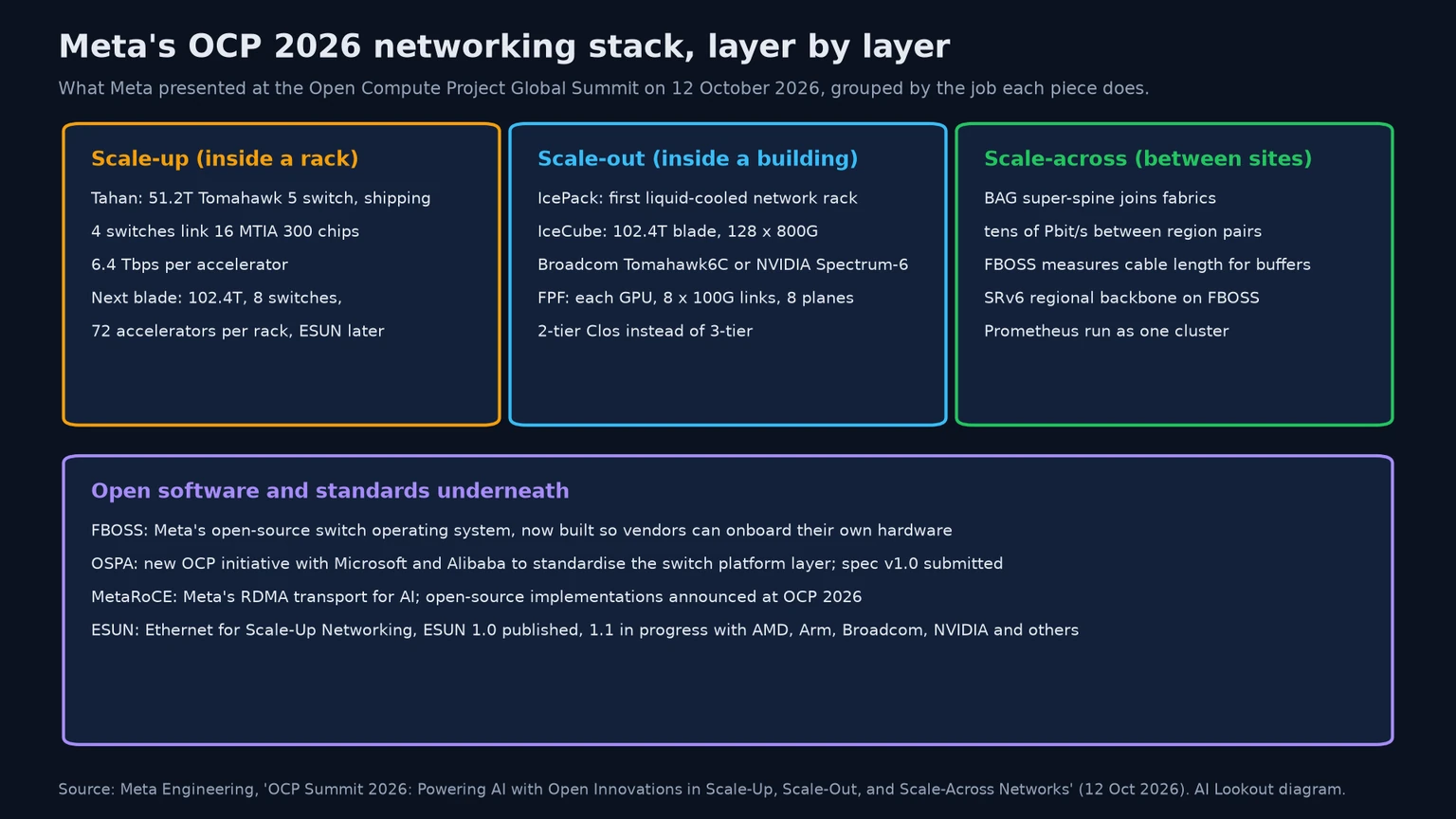
The announcements cover every distance a training job’s traffic has to travel. Inside a rack, Meta introduced Tahan, an Ethernet switch that links its own accelerators. Across a building, it showed new liquid-cooled 102.4-terabit switches and a new network design, Flattened Planar Fabric. Between buildings and regions, it described the super-spine and backbone that let one cluster span several sites. Underneath it all, Meta is pushing open software and standards: its FBOSS switch operating system, a new OCP initiative for switch platforms, and open-source code for MetaRoCE, the data transport it introduced in August.
Meta co-founded OCP in 2011 and has used the summit for years to share data-centre designs. This year’s show also brought NVIDIA’s opening of its Vera Rubin rack architecture and AMD’s Helion rack for agentic AI, so Meta’s contribution is mostly about the network that ties such systems together.
What are IcePack and IceCube?
IcePack is Meta’s first liquid-cooled network rack. It follows OCP’s ORV3-HPRv1 rack standard and holds IceCube switch blades, each a 102.4-terabit-per-second fabric switch with 128 non-blocking ports at 800 gigabits per second. That is twice the bandwidth of Meta’s current 51.2-terabit platforms.
IceCube comes in two versions, one built on Broadcom’s Tomahawk6C switch chip and one on NVIDIA’s Spectrum-6. Both run FBOSS, Meta’s open-source network operating system, which talks to the switch chip through OCP’s Switch Abstraction Interface. Offering two chip suppliers under one software stack is a deliberate hedge: Meta can buy from either vendor without rewriting its network software.
Liquid cooling has become normal for GPU racks, but switches have mostly stayed air-cooled. Meta says the move is needed because switches at this bandwidth consume much more power in the same space, and gigawatt-scale clusters need every rack to run at higher thermal density.
How does Flattened Planar Fabric change GPU networking?
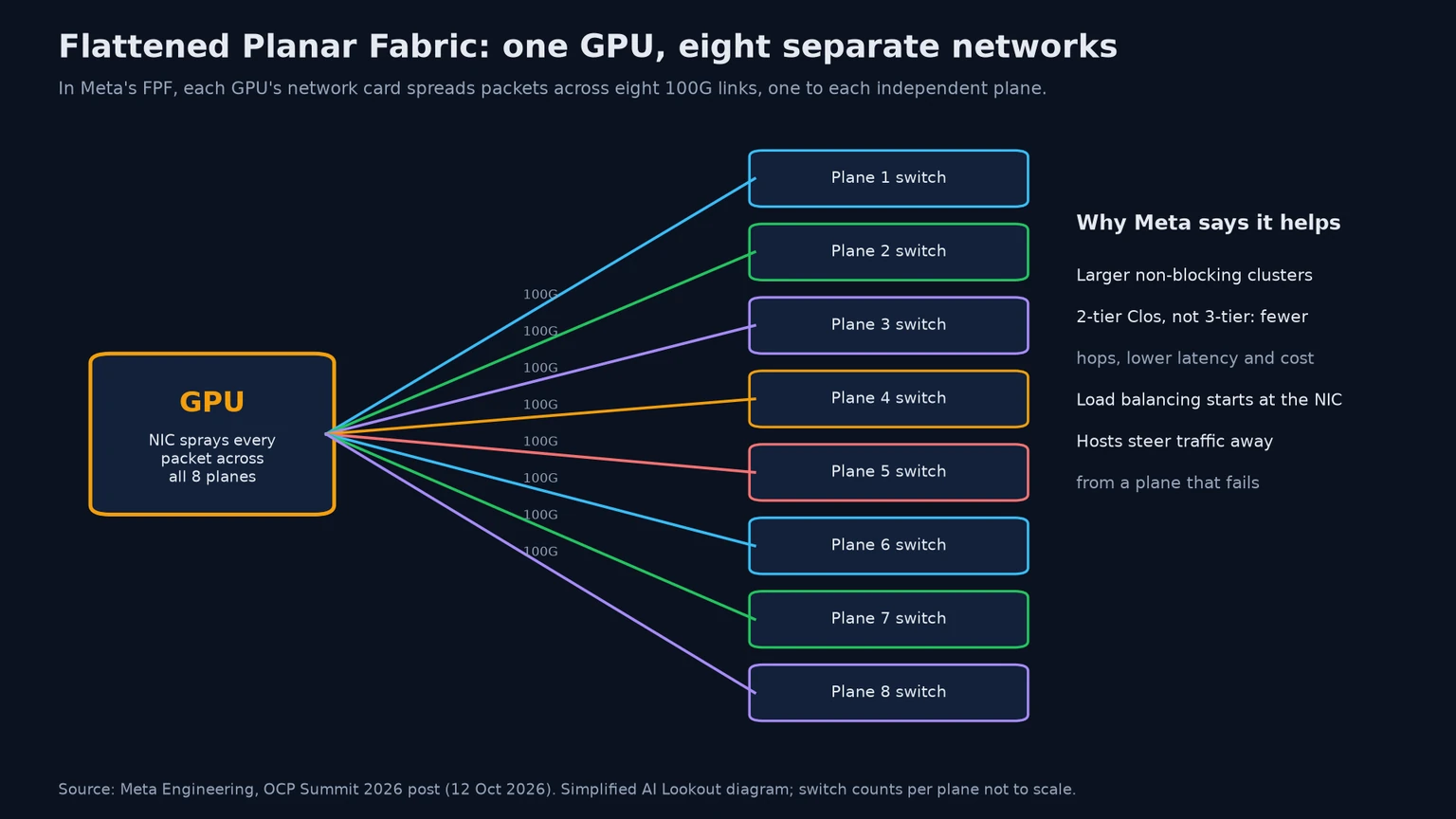
Flattened Planar Fabric, or FPF, is Meta’s new design for the back-end network that GPUs use to exchange data during training. Instead of one fat uplink, each GPU connects through eight independent 100-gigabit links to eight different switches, one in each of eight separate network planes.
Meta lists four benefits. The multiplane design supports larger non-blocking clusters than a single plane. It flattens the network from the three-tier Clos fabric used in Meta’s earlier NSF design to two tiers, removing a layer of switches and cutting hops, latency and cost. Load balancing moves to the network card, which sprays every packet across all eight planes in hardware rather than leaving it to switches. And the control plane spans both switches and hosts, so a server can steer traffic away from a plane that fails.
NVIDIA helped build it. Meta says FPF uses NVIDIA’s Spectrum-X Multiplane technology, and that the two companies are working with shared cloud partners to standardise multiplane fabrics based on what Meta learned. That matters because Meta now rents capacity as well as building it: the post says data centres take years to build while demand moves in months, so Meta uses leased sites and public clouds too. It describes a common benchmark suite that cloud partners run, from tens to more than a thousand GPUs, before handing over a cluster, and it maps each provider’s different traffic classes onto Meta’s own so jobs behave the same everywhere.
How does Meta stretch one AI cluster across buildings and regions?
Meta’s plans have outgrown single sites. The post puts its Prometheus cluster at roughly one gigawatt in 2026 and says Hyperion is scaling toward five gigawatts. To make Prometheus behave as one cluster, even though it is spread across conventional buildings, weatherproof outdoor structures and nearby colocation space, Meta uses a backend aggregation layer, or BAG: an Ethernet super-spine that joins many building-scale fabrics. Capacity between a pair of regions reaches tens of petabits per second.
Distance creates new problems. Lossless Ethernet needs buffer space proportional to cable length, so instead of assuming the worst case, FBOSS now measures each cable’s real length by timing probe packets and allocates buffers to match. Routing shares traffic in proportion to the capacity each path actually has, with damping so one failed link does not set off churn across the network. Meta also schedules jobs to keep collective traffic off the long links where possible, and if one training replica fails, the others drop it and continue.
Between campuses and out to public clouds, Meta runs a regional backbone using Segment Routing over IPv6, managed by FBOSS on Cisco Silicon One switches. Gigawatt clusters are a theme across the industry; Microsoft’s Maia 300 plans also assume multi-gigawatt deployments from 2027.
Why is Meta betting on Ethernet inside the rack?
The scale-up network, which links accelerators inside a rack or pod, has traditionally used proprietary links such as NVIDIA’s NVLink. Meta wants Ethernet there too. Its Tahan switch, built for the MTIA 300 training chips Meta described in August, uses Broadcom’s 51.2-terabit Tomahawk 5 with 64 ports at 800 gigabits, half of them wired to accelerators through the backplane. Four Tahan switches link 16 accelerators without blocking, giving each 6.4 terabits per second, and they use the same lossless RoCE transport as the scale-out network, so FBOSS manages both. Meta says Tahan is shipping.
It also previewed the next scale-up blade: a 216-port, 400-gigabit switch on 102.4-terabit Tomahawk6C silicon, eight of which link 72 accelerators in one rack. A later version is planned to adopt ESUN, the Ethernet for Scale-Up Networking effort Meta started within OCP last year with AMD, Arista, Arm, Broadcom, Cisco, HPE, Marvell, Microsoft and NVIDIA. ESUN 1.0 was published earlier this year, and version 1.1, adding switch profiles and shorter gaps between packets, is close.
What is open, and why does it matter beyond Meta?
Two announcements are about openness. Meta is co-leading the Open Switch Platform Architecture (OSPA) with Microsoft and Alibaba, and version 1.0 of the specification has been submitted to OCP. It targets the layer below the switch chip software: power sequencing, sensors and fans, hardware inventory, management ports, firmware updates and diagnostics. Meta says every new switch now needs months of custom work to bring up, which is hard to afford when AI hardware changes every year. Separately, Meta has extended FBOSS so vendors can bring up their own hardware on it without Meta engineers.
The second is MetaRoCE, the RDMA transport Meta unveiled in August with a specification, a reference implementation and a compliance test suite through OCP. It sprays packets across many paths and accepts that they arrive out of order, writing each one straight to its final memory location. At OCP, Meta announced open-source MetaRoCE implementations so others can adopt what it calls a production-proven stack.
For the industry, the effect is to make Meta-style AI networking a shared design rather than an in-house one. Cloud providers renting GPUs to Meta, switch makers selling to hyperscalers and smaller operators can follow the same specs. The networks are being built to train models like Muse Wonder, which Meta trained at Prometheus.
What are the caveats?
Everything here is Meta’s description of its own systems. The post gives architecture and bandwidth figures but no measured training speed-ups, failure rates or costs for FPF, BAG or Tahan, so the benefits are claims rather than published results. It does not say whether IcePack, IceCube or Tahan designs will be contributed to OCP as open hardware.
We could not find a public link to the new MetaRoCE code when we checked, and the post does not give a licence, so how open the implementations are remains to be seen. OSPA is a submitted specification, not yet an adopted standard. And much of this is useful mainly to companies building clusters at a scale few will reach. We did not attend the summit; this article is based on Meta’s published posts.
Common questions
What is Meta’s IcePack?
IcePack is Meta’s first liquid-cooled network rack, built on OCP’s ORV3-HPRv1 standard and holding IceCube switches that each provide 102.4 Tbps across 128 ports at 800G.
What is Flattened Planar Fabric?
It is Meta’s back-end GPU network in which each GPU connects through eight 100G links to eight separate planes, reducing the network from three switch tiers to two.
Is MetaRoCE open source?
Meta published the MetaRoCE specification, a reference implementation and a test suite through OCP in August and announced open-source implementations at OCP 2026.
What to remember
At OCP 2026, Meta showed liquid-cooled 102.4-terabit switches, an eight-plane GPU fabric, an Ethernet scale-up switch for its MTIA chips and a super-spine that joins sites into one cluster, plus new open standards and MetaRoCE code.
Sources & further reading
How this story was made
Written by Kristian Kostov with AI assistance and checked against the linked sources. Company performance claims are attributed to the company. Analysis reflects AiLookout’s interpretation; we have not independently tested the products discussed. Cover photography is illustrative and does not depict the specific announcement or product.
Our editorial standards