Announced 24 Oct 2026 · Sources checked
What Nanbeige released
Nanbeige, a Chinese AI lab, has published Nanbeige4.3-33B, a 33-billion-parameter open-weight language model built for coding agents and office-style agent work. The model card on Hugging Face was created on 24 October 2026, alongside a separate base model, and both are released under the Apache 2.0 licence, which allows commercial use and modification.
The lab calls it the flagship teacher model of its new Nanbeige4.3 series. The plan, in its own words, is to build a high-capacity agent first and then distil its skills into smaller models, starting with a Nanbeige4.3-3B that has been announced but not released. Its headline claim is that the 33B model leads open models of roughly the same size on most agentic coding and task benchmarks it tested.
Nanbeige is best known for small models. Its Hugging Face organisation lists Nanbeige4-3B from late 2025, Nanbeige4.1-3B in February 2026 and Nanbeige4.2-3B in July. The new release is its first large flagship on the hub. The model card lists a contact address at kanzhun.com, the domain of Kanzhun, the company behind the Boss Zhipin recruitment app, and Startup Fortune describes the team as backed by Boss Zhipin.
What is inside the model
The published configuration file describes a dense transformer in the Llama format rather than a mixture-of-experts design, so every parameter is used for every token. It has 52 layers, a hidden size of 7,168 and 56 attention heads with 8 key-value heads, a common grouped-query setup that keeps memory use down during long conversations. The vocabulary has 166,912 tokens, and the weights ship in bfloat16 across 14 files.
The headline feature is context length. The card says the model handles up to 524,288 tokens, or 512K, and the configuration sets its maximum positions to the same number. That is enough to hold a sizeable codebase or a very long agent session in one prompt, though the card does not publish long-context retrieval tests beyond one long-context reasoning score.
The model can reason before answering. A switch called enable_thinking turns that on or off, and a second one, preserve_thinking, decides whether reasoning from earlier turns stays in the conversation. Nanbeige recommends keeping it for multi-turn tool use and code agents, and dropping it for ordinary chat. Tool calls work in XML or JSON, with XML recommended for the best results.
The benchmark claims
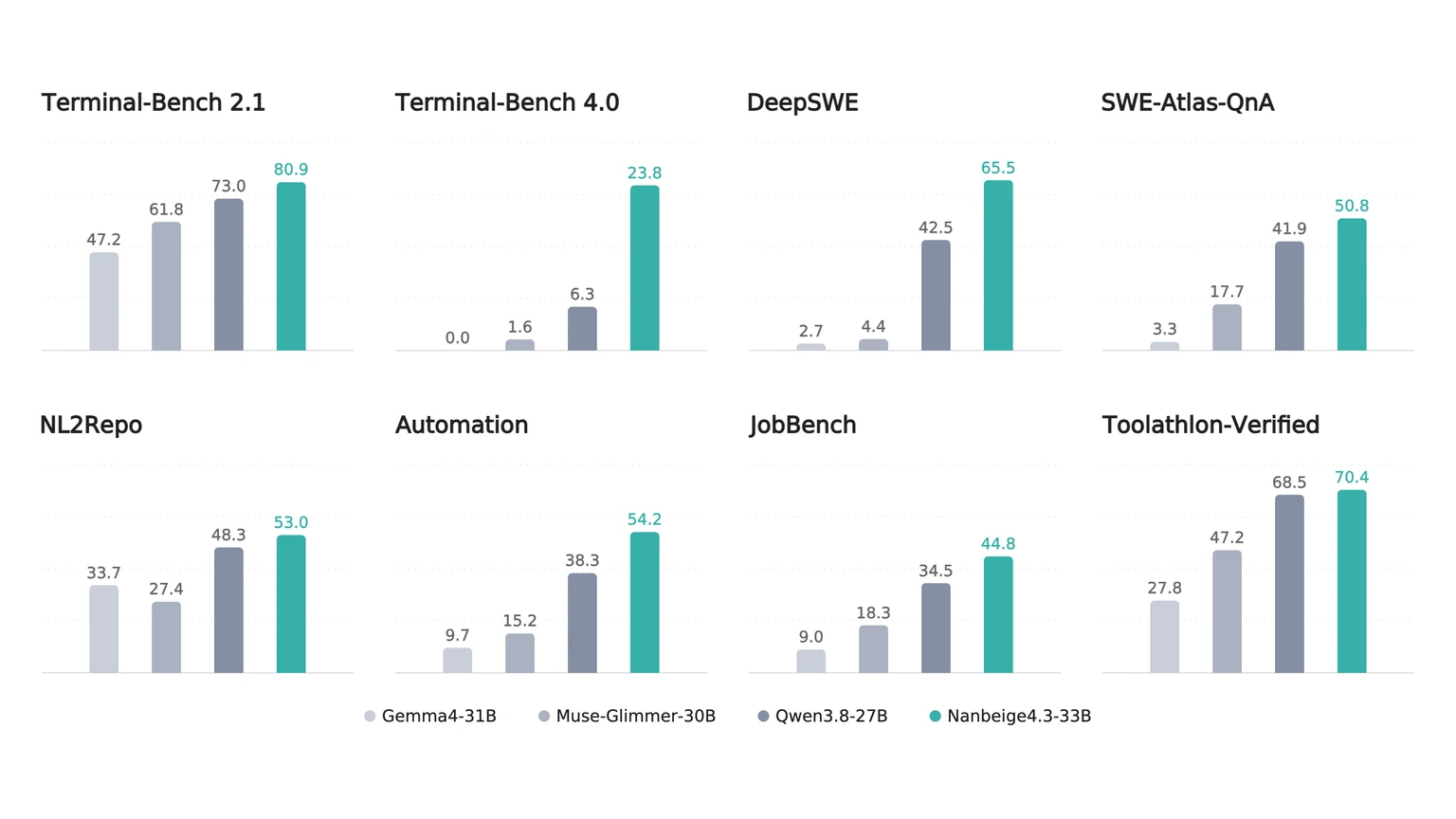
Nanbeige compares its model with three similar-sized rivals: Alibaba's Qwen3.8-27B, Meta's Muse-Glimmer-30B and Google's Gemma4-31B, all run at their highest thinking effort with the same settings and harness. The chart below shows the agentic coding results. On Terminal-Bench 2.1 it scores 80.9 against 73.0 for Qwen3.8-27B. On DeepSWE it scores 65.5 against 42.5, and on the newer Terminal-Bench 4.0 it reaches 23.8 where Qwen scores 6.3. It sits in the same size band as Krafton's Raon-1-mini and below Recursive's 40B Flint coding model, both released this month.
The gaps are widest on agent tasks that look like office work. Nanbeige reports 54.2 on Automation Bench against 38.3 for Qwen, 44.8 on JobBench against 34.5, and 63.3 on DeepPlanning against 49.2. On YC-bench, a simulation where the model runs a company, it lists a final balance of $1,025,437 against $641,290 for Qwen. The card adds that on JobBench the model beats the baseline in most of the 35 occupations tested.
For the base model, Nanbeige compares only against Gemma4-31B-Base, which it calls the only frontier open base model at this size released in the past six months. It reports wins on all eight listed tests, including 66.9 against 59.3 on MMLU-Pro and 62.0 against 41.5 on GPQA. Releasing the base model matters for teams that want to do their own post-training rather than use Nanbeige's tuned version.
Where the numbers need care
Every number above comes from Nanbeige's own runs, published on the same day as the weights, with no technical report yet. The lab's table is also not a clean sweep. Qwen3.8-27B edges it on SWE-Bench Pro, 61.7 to 60.3, and on GDPval, 86.4 to 84.8. Gemma4-31B leads on GPQA Diamond with 91.3 against 89.5. On AIME 2026 and Tau3-Bench the margins are under one point.
The footnotes show how much the setup varies by test. Terminal-Bench 2.1 used the Terminus 2 harness, DeepSWE used mini-swe-agent, NL2Repo and JobBench ran inside Claude Code, and SWE-Atlas-QnA was graded against 1,304 rubrics by GPT-6 Sol acting as a judge. Nanbeige's own model was run with preserve_thinking switched on. Harness choice can move agent scores by many points, so these results show the model is strong under Nanbeige's conditions, not that it will rank the same in every agent framework.
Very large gaps, such as 65.5 against 4.4 for Muse-Glimmer-30B on DeepSWE, may partly reflect how well each rival model fits a given harness rather than raw ability. Independent leaderboards and community tests over the coming weeks will be the real check.
How to run it
The model runs with Hugging Face Transformers, SGLang or vLLM, and the card gives commands for each. Its server examples split the model across four GPUs and reuse the Qwen3 reasoning and tool-call parsers, which suggests the output format follows Qwen conventions. The Transformers example loads the tokenizer and model with trust_remote_code enabled, so teams should review any custom code before running it.
For agent and tool-use work Nanbeige recommends a temperature of 1.0 and up to 65,536 new tokens per turn. For reasoning and chat it suggests 0.6 and up to 262,144 tokens, a sign of how long its thinking traces can get. By AI Lookout's arithmetic, 33 billion parameters in bfloat16 take about 66 GB for the weights alone, before any memory for long contexts. A 4-bit quantised version would need roughly a quarter of that, but Nanbeige has not published official quantised builds.
Why a teacher model
Calling the model a teacher explains Nanbeige's strategy. Its earlier releases were 3B models aimed at phones and cheap servers. Rather than train another small model directly, the lab built a much larger one whose outputs can be used to train the next small model, a process known as distillation. The card names Nanbeige4.3-3B as the first planned student but gives no date.
This mirrors a wider pattern among Chinese labs, which have been releasing capable open models at a fast pace, from DeepSeek's V4.1 Flash to Shanghai AI Lab's Atria Dawn, which also offers a 512K context. A permissive licence on both the base and tuned weights makes Nanbeige4.3-33B usable as a starting point for other companies' fine-tunes as well.
Limits and open questions
Nanbeige has not described its training data, the number of tokens used, its reinforcement learning setup or any safety testing. There is no model card section on misuse, bias or refusals, and no paper. AI Lookout did not run the model for this article; the figures are the lab's.
The 512K context is a configuration limit, and the card does not show how accuracy holds up near that length. Running a dense 33B model at long context also needs far more memory than the weights alone, which may put full-length use out of reach for single-GPU setups.
Why it matters
If its numbers hold up, Nanbeige4.3-33B is one of the strongest open agent models in the 30B class, and it comes with a licence that lets anyone build on it. It also shows a lab known for 3B models moving up a size to compete directly with Qwen and Gemma. What to watch next is independent agent benchmarks, official quantised builds, a technical report and the promised 3B student model.
Common questions
What is Nanbeige4.3-33B?
A 33-billion-parameter open-weight language model from the Chinese lab Nanbeige, tuned for coding agents and multi-step office tasks, released on Hugging Face under Apache 2.0.
Is Nanbeige4.3-33B better than Qwen3.8-27B?
On Nanbeige's own benchmarks it leads on most agentic coding and task tests, but Qwen3.8-27B wins on SWE-Bench Pro and GDPval. No independent tests were available at publication.
How much context does it support?
Up to 524,288 tokens (512K), according to the model card and its configuration file.
Sources & further reading
How this story was made
Written by Kristian Kostov with AI assistance and checked against the linked sources. Company performance claims are attributed to the company. Analysis reflects AiLookout’s interpretation; we have not independently tested the products discussed. The cover places the companies’ own logos, taken from public-domain or openly licensed files credited in the caption, on a plain background. It is not a product photograph, a screenshot, or an endorsement.
Our editorial standards