Announced 21 Oct 2026 · Sources checked
What Recursive released
Recursive Superintelligence has released Flint, an open-weight coding model it says a small team built from scratch in under four months with help from its automated research system. In its 21 October 2026 announcement, the company describes Flint as a mixture-of-experts model with about 40 billion total parameters and 2.5 billion active per token, aimed at agentic coding on local hardware.
The Hugging Face model card for RecursiveSI/flint lists the BF16 checkpoint under the Apache 2.0 licence, with separate int4 and GGUF quantised variants in the same organisation. The card was created on 21 October 2026. Weights, tokenizer, chat template and an SGLang serving kit ship in the main repository.
NVIDIA also flagged the release the same day. In a GTC Berlin local-AI blog post, NVIDIA said Flint is available for RTX Spark, DGX Spark, GeForce RTX and RTX PRO GPUs, and that specialised kernels from Recursive's research system boosted generation speed on RTX Spark by 55 percent without changing the model's weights.
Size, architecture and claimed scores
The model card gives a precise size: 39.8 billion total parameters, about 2.5 billion active per token including the output head (about 2.2 billion for the active body alone). The architecture is a decoder-only MoE Transformer with 49 layers (2 dense, then 47 MoE), 256 routed experts with 6 selected per token plus a shared expert, 32 query heads and 4 key/value heads, and a documented context of 262,144 tokens. The vocabulary is 150,144 tokens. The stated knowledge cutoff is June 2026.
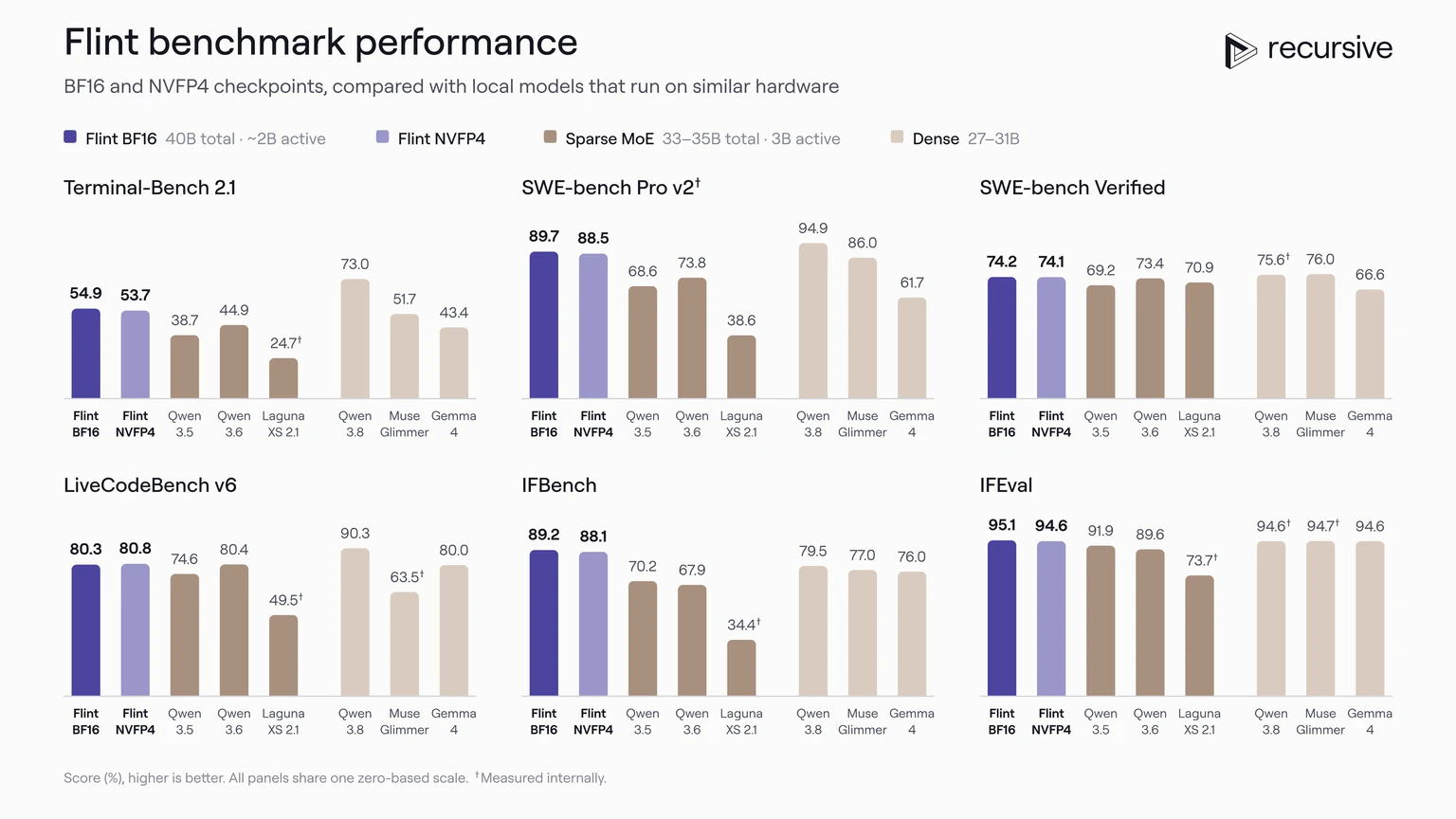
Recursive's release evaluations, reported on the model card, put Flint at 54.9 percent on Terminal-Bench 2.1, 89.7 percent on SWE-bench Pro v2 and 74.2 percent on SWE-bench Verified. Sampling used temperature 1.0, top-p 0.95 and top-k 20. Terminal-Bench used Terminus 2; SWE-bench used mini-swe-agent. Agentic scores are average pass@1 over at least five attempts. The card notes that Flint's Terminal-Bench score counts solutions obtained through web retrieval as unsuccessful, and that other vendors' reported scores may not apply the same rule.
The company blog adds local speed claims: more than 125 tokens per second on an M4 Pro MacBook Pro and more than 150 tokens per second on a 64 GB NVIDIA RTX Spark at short contexts, with its own inference engine. NVIDIA's post quotes a higher figure of over 220 tokens per second on a 64 GB RTX Spark. Those are vendor measurements under different setups; AI Lookout has not timed the model.
WIRED's Will Knight, writing the same day after testing Flint for several days on a Mac with 48 GB of RAM, called the 40-billion-parameter model "impressive" for coding tasks such as a command-line to-do list, a research scraper and a small explanatory website. That is one journalist's hands-on impression, not a controlled benchmark.
How the Eureka Machine shaped the model
Recursive frames Flint as a practical test of its Eureka Machine, a system that automates proposing ideas, implementing them, testing them and deciding what to try next. An earlier June 2026 post described early results on fixed-budget language-model training, small-model training speed and GPU kernel optimisation. The Flint post says the same loop contributed throughout development, from data and training recipes to infrastructure and inference.
On architecture, Recursive says it started from a baseline with 35 billion total and 3 billion active parameters, then let the Eureka Machine explore expert configurations and widths until it landed on the 40B / 2.5B design as the best speed-and-coding trade-off among the options tested. After training, the system searched for quantisation recipes and, against common practice, quantised the output layer (lm_head) to 4 bits, then added offline distillation on a self-discovered coreset. Recursive says the final NVFP4 model scores within 0.7 points of the 16-bit model across its benchmarks.
On kernels, the Eureka Machine produced specialised code for low-bit projections, MoE operations, attention and prompt processing on Apple Silicon and NVIDIA RTX Spark. On M4 and M5 chips it produced a Metal megakernel that fuses the entire decode forward pass. NVIDIA separately credits those specialised kernels with the 55 percent generation-speed gain on RTX Spark.
CEO Richard Socher told WIRED that "nearly every aspect of the entire model pipeline was actually done and improved upon by AI", and that the goal is for the Eureka Machine itself to reach full recursive self-improvement under human oversight. WIRED reports that Recursive has raised $650 million at a $4.65 billion valuation from investors including Google Ventures, Greycroft, Nvidia and AMD Ventures. Socher was previously chief scientist at Salesforce; cofounders include Jeff Clune of the University of British Columbia.
Running Flint locally
Weights are on Hugging Face under Apache 2.0. The model card's getting-started path downloads the BF16 checkpoint (about 80 GB), builds a Docker image from the bundled SGLang kit, and serves on one B300 or H200 GPU per replica. Transformers modeling code is "not included yet". Recommended generation settings are temperature 1.0, top-p 0.95, top-k 20, and at least 32,768 output tokens for hard problems. Flint supports OpenAI-compatible tool calls; callers should preserve returned reasoning_content in history.
For laptops, Recursive ships rec, a Go inference engine under Apache 2.0 aimed at M4 Pro, M5 Pro and M5 Max Macs with at least 48 GB unified memory. The README says a curl-based install puts the binary in ~/.local/bin, and `rec launch pi` (preferred) or `rec launch opencode` starts the server and connects a harness. It also exposes an OpenAI-compatible API on localhost:11500. Recursive claims 1.4–2.6× the token throughput of llama.cpp across the context lengths it shows on M4 Pro.
Documentation at docs.recursive.com also lists Ollama, Unsloth, LM Studio, llama.cpp, vLLM and SGLang as supported routes, and notes that hosted Flint-40B appears on OpenCode's free tier subject to capacity. The company blog says Flint supports context windows of up to 512k tokens but recommends staying within 256k for best results; the model card documents a 262,144-token configuration. Those two figures should be treated as related but not identical claims.
Flint joins a crowded local-coding field that already includes Meta's Muse Spark Open and hardware such as NVIDIA's RTX Spark. Recursive's pitch is not raw parameter count but a small active-parameter MoE plus a tuned local stack so coding agents stay on the user's machine.
Why a self-improving research loop matters
Recursive's larger bet is that automating the research loop itself will compound. Flint is presented as evidence that a handful of people, plus agents that propose and test ideas, can ship a competitive local coding model in months rather than years. The company says the same approach should make the next generation cheaper and faster to build.
That framing sits next to a broader research thread. Google Research's Harness², released earlier this month under Apache 2.0, also studies recursive improvement of agent harnesses. Recursive is more explicit that the long-term target is recursively self-improving systems for scientific discovery, not only coding agents.
WIRED notes that recursive self-improvement has become politically contested in the United States, with some proposed bills seeking to restrict it and some safety researchers warning of runaway risk. Recursive's public line is that Flint was built with a system that cannot escape human control, and that banning the approach would be an unnecessary brake. Those are competing claims about risk, not facts about the weights.
Limitations and open questions
Several caveats matter for anyone planning to rely on Flint. The headline agentic scores and the competitor bars on the model-card chart are Recursive's own measurements or mixtures of internal and developer-reported numbers; evaluation harnesses, internet access and pass@1 attempt counts differ across sources. AI Lookout has not reproduced Terminal-Bench or SWE-bench runs.
The Apache 2.0 weight licence does not grant trademark rights, and hosted API terms are separate from the weight licence. Transformers modeling code is still missing from the main card, so day-one serving paths are SGLang, rec and third-party engines that already support the checkpoint. Long reasoning can exhaust the output budget before an answer finishes, and the card warns that structured tool-call grammar does not stop the model from choosing an unsafe or incorrect action.
Local privacy is a real advantage only if the harness and tools stay local too. Systems such as Perplexity Computer's fully local Mac mode make the same point from another product angle. Flint still needs careful permission boundaries around shell, browser and file tools.
Availability of the weights and the rec engine is confirmed as of 21 October 2026. Independent third-party leaderboard placements, long-context quality across the full 256k window, and how well the NVFP4 and Apple int4 variants hold up outside Recursive's harness remain open questions.
Common questions
Is Flint free to download and use commercially?
The weights on Hugging Face are released under Apache 2.0, which allows commercial use. The licence does not grant trademark rights, and any hosted API has separate terms.
Can Flint run on a laptop?
Recursive ships a Mac-focused engine called rec for M4 Pro / M5 Pro / M5 Max machines with at least 48 GB of unified memory, and lists Ollama, LM Studio, llama.cpp and others. The full BF16 checkpoint is about 80 GB; quantised builds are smaller.
What is the Eureka Machine?
Recursive's name for its automated AI research loop that proposes ideas, implements them, runs experiments and decides what to try next. The company says it contributed across Flint's data, training, quantisation and kernel work.
Sources & further reading
How this story was made
Written by Kristian Kostov with AI assistance and checked against the linked sources. Company performance claims are attributed to the company. Analysis reflects AiLookout’s interpretation; we have not independently tested the products discussed. The cover places the companies’ own logos, taken from public-domain or openly licensed files credited in the caption, on a plain background. It is not a product photograph, a screenshot, or an endorsement.
Our editorial standards