Announced 16 Oct 2026 · Sources checked
What NVIDIA put on sale
NVIDIA's first Windows laptop chip is now in shops. In a press release dated 16 October 2026, NVIDIA said RTX Spark laptops are "available globally today" from ASUS, Dell, HP, Lenovo, Microsoft and MSI, through the makers' websites and major retailers, with more systems to follow. Preorders had opened nine days earlier, when Microsoft and NVIDIA launched the platform and Windows' hybrid intelligence plan.
The launch lineup is the ASUS ProArt P14 and P16, Dell XPS 16, HP OmniBook Ultra and OmniBook X 14, Lenovo Yoga Pro 9n, Microsoft Surface Laptop Ultra, and MSI Prestige N16 Flip AI+ and Prestige N16. NVIDIA's release gives a starting price of $2,599 and says pricing and configurations vary by region. A follow-up NVIDIA blog post on 17 October says "starting at $2,399"; we could not match that figure to a listed configuration, and the reviews below put the cheapest models at $2,599.99.
NVIDIA marked the launch with six retail events in Berlin, Beijing, Istanbul, Seoul, San Francisco and Taipei. Its event recap says Jensen Huang made a surprise appearance at the Berlin event, handed out popcorn and gave away five signed laptops. The company also has a GTC keynote in Berlin on Wednesday, 21 October.
What is inside the RTX Spark chip
Every RTX Spark laptop uses one system-on-chip that NVIDIA calls a superchip. It combines a Blackwell RTX GPU with a Grace CPU that MediaTek helped design, sharing up to 128GB of unified memory. NVIDIA rates it at up to 1 petaflop of FP4 AI compute, a low-precision number that suits AI inference rather than general graphics work.
Reviewers call the chip N1X. The Register's benchmark review of HP's OmniBook Ultra 16 says it comes in two versions: 18 CPU cores with 5,120 CUDA GPU cores, or 20 CPU cores with 6,144 CUDA cores, the same CUDA count as a desktop RTX 5070. The CPU mixes equal numbers of Arm X925 performance cores and Cortex-A725 efficiency cores.
The Register also points out that the N1X is not entirely new. It is closely based on the GB10 chip in NVIDIA's Linux mini PC, the DGX Spark, which shipped more than a year ago and gained a 64GB model this month. The main change is memory speed: about 300 GB/s of bandwidth on the N1X against 273 GB/s on the DGX Spark. Bandwidth matters because it limits how quickly a local language model can produce tokens.
The local AI software at launch
NVIDIA is selling RTX Spark less as a gaming laptop and more as a machine for running AI agents locally. The release says guided installers set up GitHub Copilot, Hermes, OpenClaw, Perplexity, Pi and WorkBuddy without the command line. Hermes is Nous Research's agent; its CEO, Dillon Rolnick, said in the release that the goal was to let people run open models and agents "locally on a Windows laptop, with greater control over their data."
The model NVIDIA highlights is Nemotron 3.5 Bolt 74B-A9B in a 24GB build, a mixture-of-experts model tuned for tool calling that it released for DGX Spark earlier this week. Permissions are handled by NVIDIA's OpenShell runtime and Microsoft Execution Containers, and NVIDIA agent skills let compatible agents operate Broadcast, RTX Remix and Omniverse tools. That builds on the local MCP server in the NVIDIA App, which lets agents change GPU settings.
Two items are aimed at developers. NVIDIA PAIR lets an RTX Spark laptop serve AI inference to other Windows, Linux and macOS computers on a home network. And NVIDIA and Microsoft list several firsts for Windows on Arm: a PyTorch-CUDA build, a Python build that is native by default, a native Conda installer, and support for 97% of the top 15,000 Python packages.
For creators, Photoshop and Premiere ship native RTX Spark support as beta releases, with Substance 3D "coming soon", following the Adobe and NVIDIA work announced on 15 October. NVIDIA also claims the laptops can edit 8K 4:2:2 video and render 3D scenes up to 90GB, which no reviewer has yet checked.
What the first reviews found running local AI
The first reviews landed around launch day, and they are more cautious than the launch copy. The Register tested the OmniBook Ultra 16 with the 20-core chip and 128GB of memory using llama.cpp version 0.6.0 and five open models from Meta, Google and Alibaba, ranging from about 26 billion to 122 billion parameters. Its verdict was that "you'll be hard pressed to find a faster Windows notebook for local AI."
There are catches. Windows does not share memory dynamically between CPU and GPU the way Linux does on the DGX Spark: the review unit arrived with a fixed split of 64GB each, which can be changed but is "not exactly ideal." Software such as llama.cpp can spill a model into CPU memory, and because the memory is shared the penalty is smaller than on a discrete GPU. In an agentic coding test with Alibaba's Qwen Code, the larger Qwen3.5-122B-A10B produced tokens at roughly half the rate of a 35B model but finished a bin-packing task about 40 seconds faster, because it needed far fewer tokens.
Heat was the bigger problem. Under a constant inference load the GPU passed 90°C, and The Register saw occasional lock-ups and, once, graphical artefacts. It does not expect this in normal use, since a few seconds between prompts kept the laptop stable, but it suggests anyone planning to fine-tune models look at the DGX Spark or another GB10 workstation instead.
The Verge's three reviewers spent a week with five RTX Spark laptops. Tom Warren's answer to whether local AI is useful was "Not yet. It all feels like a beta aimed at developers right now." Sean Hollister asked Hermes, running Qwen3.8-27B, for a daily news briefing; it took 10 minutes and 10% of a 99.9 watt-hour battery, while Claude Opus 5.5 in the cloud took half as long and gave better-sourced results. After a clean reinstall the same prompt took longer and used 60% of the battery. Antonio Di Benedetto used 30% of a Lenovo Yoga's battery in 36 minutes getting a local model to edit five product photos, and it cropped them wrong on the first try.
CPU speed, games and battery life
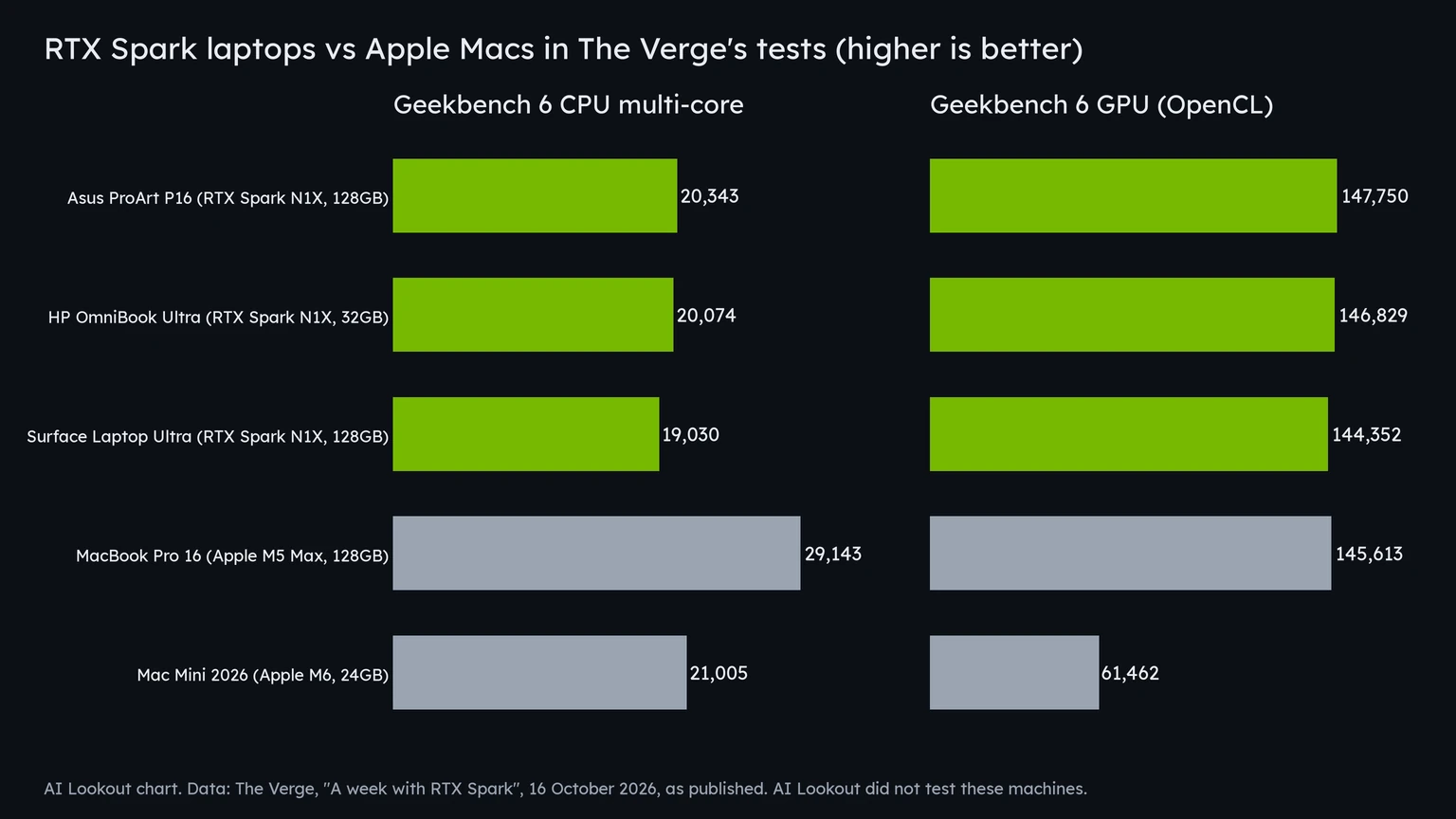
On graphics the chip holds up. In The Verge's Geekbench 6 GPU test, the three RTX Spark laptops scored between 144,352 and 147,750, level with a MacBook Pro 16 with Apple's M5 Max at 145,613. On the CPU it trails: the RTX Spark machines scored 19,030 to 20,343 in multi-core, against 29,143 for the M5 Max and 21,005 for a Mac Mini with the base M6 chip. Di Benedetto noted that a Mac Mini starts at $900.
Gaming works on an Arm Windows laptop for once. Warren found that medium settings at 1440p with DLSS performance mode held about 60 frames per second in most games, including 66 fps in Cyberpunk 2077. Hollister hit CPU limits: Helldivers 2 could not hold 60 fps in busy missions, and Star Wars Zero Company stayed between 37 and 39 fps whatever the settings. Di Benedetto placed the GPU between an RTX 5070 Laptop and an RTX 5060 Laptop, below NVIDIA's own comparison.
Battery life is ordinary. Hollister's best day on the ASUS ProArt P16, which has a 99.9 watt-hour battery, was 5 hours 40 minutes of browser work at half brightness, and the reviewers agreed that heavy local AI drains the battery well before lunch.
Who RTX Spark is for right now
Both reviews land in the same place: the hardware is well made and fast for local AI, but it is expensive. The Verge's test units ran from $3,199.99 for an HP OmniBook Ultra with 32GB to $6,999.99 for an ASUS ProArt P16 with 128GB. The Register's OmniBook cost $6,229 as tested, and the review blames the prices partly on record memory costs, adding that memory makers expect DRAM supplies to stay tight through at least 2028.
The Register's buyer is an AI developer, researcher or creative professional who needs a lot of GPU memory and prefers NVIDIA's CUDA over Apple's platform or AMD's ROCm. It suggests that models of about 20 to 60 billion parameters are the sweet spot for local coding assistants, small enough for the cheaper 64GB configurations, and recommends cross-shopping AMD's Strix Halo and Gorgon Halo systems. For people who just want to try local models on a PC they already own, tools such as Hugging Face's Llama Windows tray app run on ordinary RTX GPUs.
For Windows itself, the launch matters even if few people buy a $6,000 laptop. Microsoft and NVIDIA now have shipping hardware for their pitch that a PC should run some AI locally and send the rest to the cloud, and developers have a native CUDA and PyTorch stack on Windows on Arm for the first time.
What is still unclear
These are first impressions after about a week. The Register says CPU, gaming and longer agent tests are still to come, and The Verge has not yet published full battery rundown tests or reviewed the cheaper 24GB models. Performance claims such as 1 petaflop of FP4 compute, 1440p gaming above 100 fps and 90GB scene rendering are NVIDIA's, and AI Lookout has not tested an RTX Spark laptop.
The entry price is also muddled: NVIDIA's release says $2,599, its later blog post says $2,399, and regional pricing differs. The Adobe apps are still betas, Substance 3D has no date, and the thermal issue The Register hit may or may not be fixed by firmware. We will update this article if NVIDIA or the laptop makers change prices, ship fixes, or announce cheaper RTX Spark models.
Common questions
Which laptops use NVIDIA RTX Spark?
At launch: ASUS ProArt P14 and P16, Dell XPS 16, HP OmniBook Ultra and OmniBook X 14, Lenovo Yoga Pro 9n, Microsoft Surface Laptop Ultra, and MSI Prestige N16 Flip AI+ and Prestige N16.
How much does an RTX Spark laptop cost?
NVIDIA's release says from $2,599, varying by region. The Verge lists $2,599.99 for a base Surface Laptop Ultra or ASUS ProArt P14 with 24GB; 128GB models it tested cost $5,899.99 to $6,999.99.
Can an RTX Spark laptop replace a cloud AI model?
Not yet for most people, based on early reviews. Large open models run, but in The Verge's tests a local agent was slower than cloud Claude and drained the battery quickly; it suits developers who want private, local inference.
Sources & further reading
- NVIDIA RTX Spark PCs Available Today — A New Beginning for Windows PCs ↗
- RTX Spark Ignites Global Celebration as New Windows PCs Arrive ↗
- Benchmarked: Nvidia's RTX Spark notebook delivers serious local AI compute, at a price ↗
- A week with RTX Spark: everything we've learned using Nvidia's new laptops ↗
How this story was made
Written by Kristian Kostov with AI assistance and checked against the linked sources. Company performance claims are attributed to the company. Analysis reflects AiLookout’s interpretation; we have not independently tested the products discussed. The cover places the companies’ own logos, taken from public-domain or openly licensed files credited in the caption, on a plain background. It is not a product photograph, a screenshot, or an endorsement.
Our editorial standards