Announced 23 Oct 2026 · Sources checked
What Shanghai AI Lab released
Shanghai Artificial Intelligence Laboratory has published the full weights of Atria Dawn, the agentic model it first previewed in September. The internlm/Atria-Dawn repository on Hugging Face was created on 23 October 2026, alongside an FP8 version, and the lab says both the code and the weights are released under the MIT License. Copies are also listed on ModelScope.
The release is a step up from the Atria Dawn Preview, whose weights went up on 11 September with a 256,000-token context window. The full release doubles that to 512,000 tokens. TSN reported that when the lab first announced the full model in mid-October it was available only through an API, and that the GitHub README still listed the full weights as coming soon on 19 October. That makes the download, rather than the model itself, the new part of this week's news.
Atria Dawn comes from the same institute behind the Intern model family. Earlier this month a preprint credited its Intern-S2 science model with helping prove a maths conjecture. Atria Dawn is aimed at a different job: long, multi-step work in research and engineering, where an agent has to read, plan, call tools, run code and recover from its own mistakes.
What is under the hood
According to the Atria Dawn README on GitHub, the model is built on GLM-5.2, a 744-billion-parameter mixture-of-experts foundation model. A mixture-of-experts model switches on only part of its network for each token. The published configuration uses eight experts per token, and TSN counted 256 routed experts in the file. The lab has not stated how many parameters are active at once.
The model is text only. The README says the hosted endpoint rejects images with an error stating that Atria Dawn is not a multimodal model, and its setup guides for coding tools are partly about stopping those tools from sending screenshots or PDFs. Teams whose agents depend on reading images will need to convert them to text first.
The files are big. Hugging Face lists about 1.5 terabytes for the main release, and TSN put the FP8 version at about 0.76 terabytes. The lab has not published a recommended hardware configuration, so running the full model locally is realistically a job for a multi-GPU server rather than a workstation.
The lab describes four focus areas. Discovery means turning research questions into experiment plans and running them. Creation covers building software and tools. Delivery means producing reports, documents and presentations from source material. The fourth, cybersecurity, is described as analysing security issues, validating vulnerabilities, applying fixes and re-validating them in authorised environments.
Where the lab says it leads
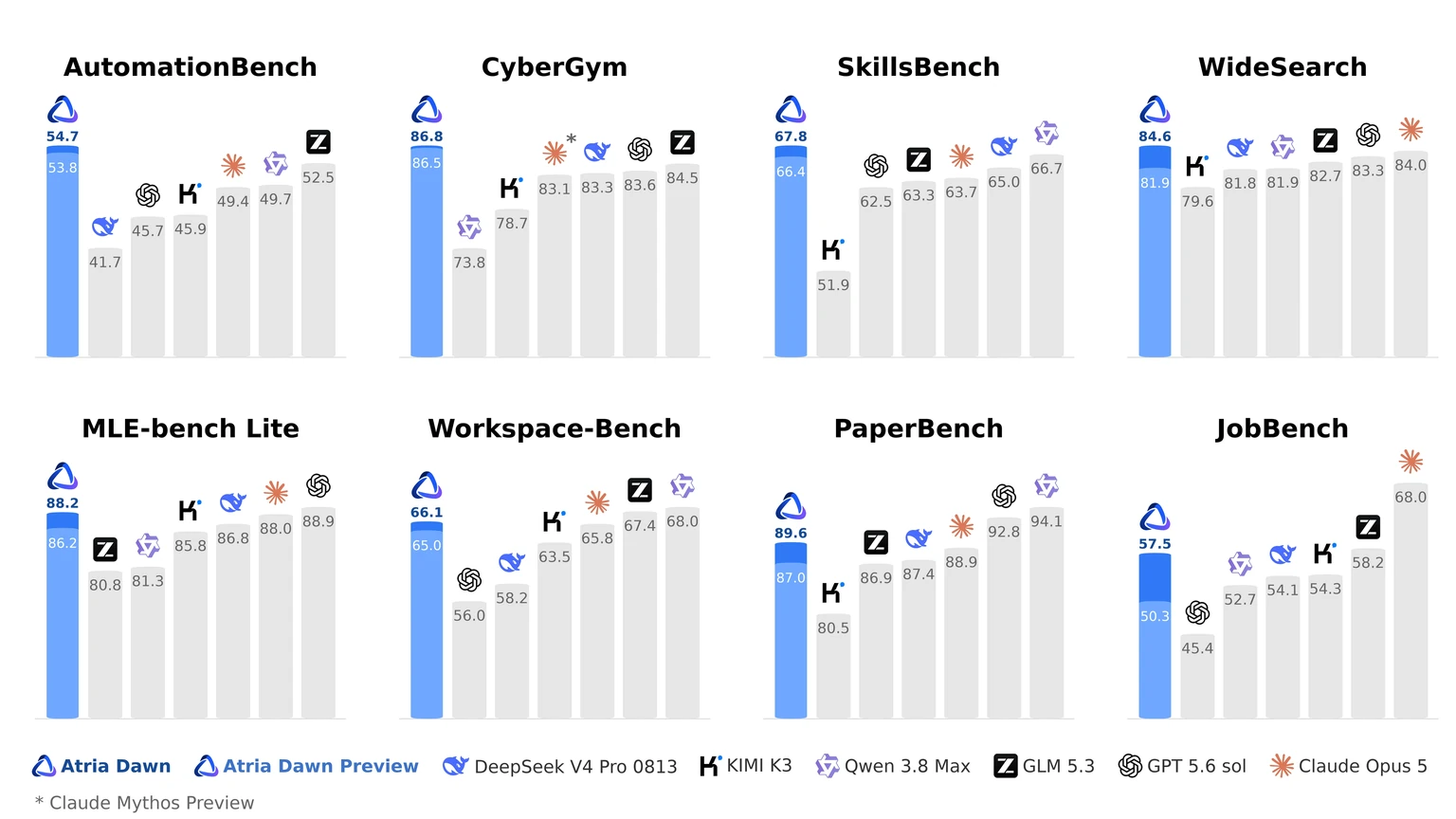
The README compares Atria Dawn and its Preview with six other models: DeepSeek V4 Pro 0813, Kimi K3, Qwen 3.8 Max, GLM 5.3, GPT 5.6 sol and Claude Opus 5. Every score comes from the lab's own testing, which it says matches the table on its website. No independent evaluation of the full release has been published yet.
On those numbers, Atria Dawn has the best score of the eight on AutomationBench at 54.7, CyberGym at 86.8, SkillsBench at 67.8, WideSearch at 84.6, BFCL V4 at 78.4, DeepSearchQA at 96.5 and the legal benchmark Harvey LAB at 27.5. Several of those margins are thin. On WideSearch, Claude Opus 5 is at 84.0, and on AutomationBench GLM 5.3 is at 52.5.
The gains over the Preview are small in the lab's own testing. CyberGym moves from 86.5 to 86.8 and SWE-bench Pro from 59.6 to 61.7. On BrowseComp the Preview actually scores higher, 92.5 against 91.3. Neural Daily's summary also stresses that these are the developer's results only.
Where it trails
The same table shows clear gaps on software engineering. Claude Opus 5 scores 90.2 on Terminal-Bench 2.1 against Atria Dawn's 81.0, 76.5 on SWE-bench Pro against 61.7, and 79.9 on NL2Repo against 50.0. On Harbor-Index the gap is 41.0 to 17.3, and on DeepSWE 72.6 to 49.3. Qwen 3.8 Max and Kimi K3 also edge it on SWE-bench Pro, at 65.3 and 62.0.
It is not the leader on office-style or research reproduction tests either. GPT 5.6 sol has 88.9 on MLE-bench Lite to Atria Dawn's 88.2, Qwen 3.8 Max scores 94.1 on PaperBench to its 89.6, and on the GDPval work benchmark Claude Opus 5 is listed at 1714.0 against 1594.2. On JobBench, the chart shows Claude Opus 5 at 68.0 and Atria Dawn at 57.5.
That pattern matters for buyers. Atria Dawn looks strongest at search, tool use and security tasks, and weaker as a coding agent. Teams that mainly want an open model for code may find Moonshot's Kimi K3.1 Pro, which Moonshot says nears Claude Opus 5.5 on coding, a closer fit.
How to run it
For local serving, the README asks for SGLang v0.5.13.post1 or later, or vLLM v0.23.0 or later, and points to the GLM-5.2 recipes for both. The hosted option is an API that accepts both OpenAI-style and Anthropic-style requests, with separate international and China consoles. Requests use Atria-Dawn as the model name, and output can run up to 65,536 tokens. The lab has not published prices.
The README includes setup guides for three coding tools: Codex CLI, Claude Code and Kimi Code. For Claude Code it suggests a hook that blocks the tool from reading PDF and image files, and for Codex it declares the model as text-only so the tool stops attaching images. TPS noted that this means existing agent tooling can be pointed at the model with configuration changes rather than new code.
Why the MIT licence matters
The licence may be the most important line in the release. MIT lets anyone use, modify and redistribute the weights, including commercially, with little more than an attribution notice. That is unusual for a model of this size. Other recent Chinese releases have come with tighter terms, such as MiniMax's M3.1 Flash, which TSN noted ships under a non-commercial community licence.
It also puts a frontier-scale model in the same permissive bracket as much smaller releases like Recursive's Apache-licensed Flint coding model. One housekeeping detail: the MIT text sits in the GitHub repository, while the Hugging Face listing relies on the README statement and, according to TSN, carries no licence tag. Companies with strict legal review may want to check both.
The cyber question
CyberGym, a benchmark of vulnerability reproduction tasks, is where Atria Dawn makes its boldest claim. The table gives it 86.8, against 84.5 for GLM 5.3 and 83.6 for GPT 5.6 sol. The written table has no Claude Opus 5 score for CyberGym. The lab's chart fills that slot with 83.1, footnoted as a Claude Mythos Preview result.
If the result holds up, security teams gain a capable vulnerability analysis model they can run inside their own networks, without sending sensitive code to an outside API. The lab frames the work as defensive and limited to authorised environments. But open weights cannot be withdrawn or patched once downloaded, so the same capability is available to anyone. That is why outside testing of open releases with strong cyber scores matters more than usual.
What to watch
The first useful checks will be independent runs of SWE-bench Pro and CyberGym on the full release, and a clear statement of the hardware needed to serve it at 512,000 tokens. Download numbers are still small: Hugging Face showed 41 downloads and six likes for the main repository when AI Lookout checked, while the GitHub repository had 622 stars.
Pricing for the hosted API is the other open question. Until the lab publishes it, the practical case for Atria Dawn rests on the licence and the self-hosting option. For organisations that want a large, agent-tuned model they can legally modify and run themselves, that alone makes it worth testing, especially for search, automation and security work rather than coding.
Common questions
What is Atria Dawn?
An open-weights agentic language model from Shanghai Artificial Intelligence Laboratory, built on the 744-billion-parameter GLM-5.2 and tuned for multi-step research, engineering and security work.
Can Atria Dawn be used commercially?
Yes. The lab says the code and weights are under the MIT License, which allows commercial use, modification and redistribution with an attribution notice.
Does Atria Dawn accept images or PDFs?
No. It is text only, and the hosted API rejects image input. The lab's guides configure coding tools to avoid sending images and PDFs.
Sources & further reading
How this story was made
Written by Kristian Kostov with AI assistance and checked against the linked sources. Company performance claims are attributed to the company. Analysis reflects AiLookout’s interpretation; we have not independently tested the products discussed. The cover places the companies’ own logos, taken from public-domain or openly licensed files credited in the caption, on a plain background. It is not a product photograph, a screenshot, or an endorsement.
Our editorial standards