Announced 21 Oct 2026 · Sources checked
A game company ships its own model
KRAFTON, the South Korean company behind the battle royale game PUBG, has released its own large language model. Raon-1 mini preview is a 30-billion-parameter mixture-of-experts model that KRAFTON AI says it designed and trained from scratch, rather than fine-tuning someone else's open model. The weights went up on Hugging Face on 21 October under the Apache 2.0 licence, which allows commercial use.
The pitch is efficiency and Korean. Only about 4.3 billion of its 28.8 billion parameters are active for each token, so it runs much more cheaply than a dense model of the same size. KRAFTON says it is strongest at natural Korean conversation, instruction following and agent tasks, and that it also speaks English, Japanese, Chinese, Spanish, French and Thai.
It is labelled a preview. The model card warns that specifications and results may change before the final version, and KRAFTON has not said when that will be.
What is inside Raon-1 mini
The architecture borrows from the newest Chinese open models and changes them. According to the model card, Raon-1 mini has 25 layers. Eighteen use what KRAFTON calls Raon Delta Attention, a linear attention design based on Moonshot's Kimi Delta Attention, with the erase and write gates separated; KRAFTON says that improves long-context performance. Those layers keep a fixed-size state instead of a growing memory of every past token.
The other seven layers use gated multi-head latent attention, the compressed attention scheme popularized by DeepSeek. Only those seven keep a key-value cache, about 8 KiB per token in BF16, which is what makes the native 262,144-token context window affordable. The model uses no positional encoding at all.
Each token is routed to 6 of 128 experts plus one shared expert. KRAFTON also built Raon-mHC, a cheaper version of DeepSeek's manifold-constrained hyper-connections, which it says speeds up training. Thinking mode is on by default, and the card advises against turning it off.
How it scores against Qwen, Gemma and Muse
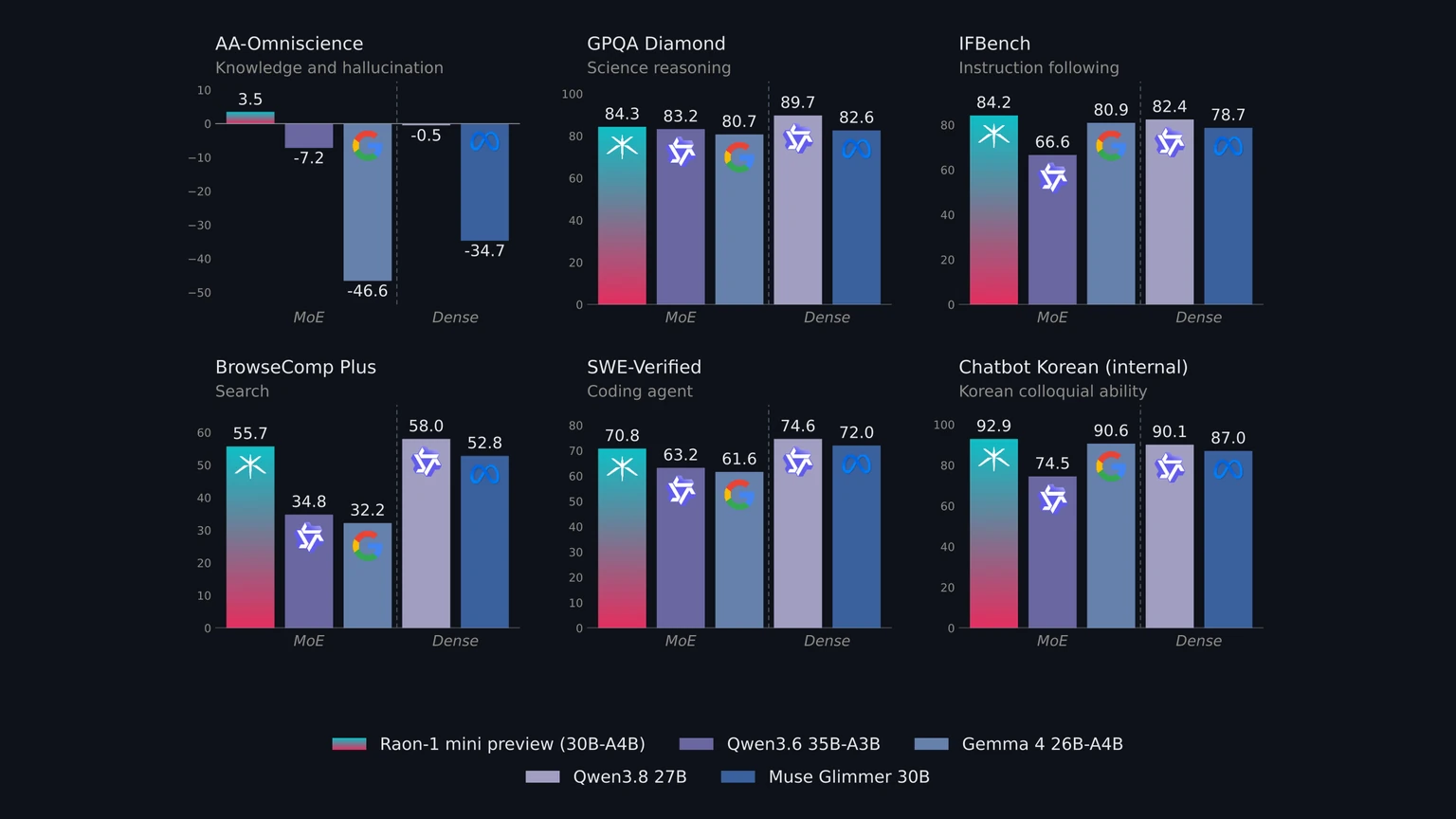
KRAFTON compares Raon-1 mini with two similar-size mixture-of-experts models, Qwen3.6-35B-A3B and Gemma 4 26B-A4B, and shows two dense models, Qwen3.8-27B and Muse Glimmer 30B, for reference. All of the numbers are KRAFTON's own, and it used gpt-5.6-luna as the judge and user simulator for every evaluation.
Against the MoE peers the results are mixed but often good. Raon-1 mini scores 84.3 on GPQA Diamond against 83.2 for Qwen3.6 and 80.7 for Gemma 4, 84.2 on the IFBench instruction-following test against 66.6 and 80.9, and 70.8 on SWE-Verified against 63.2 and 61.6. On BrowseComp Plus, a search and research test, it reaches 55.7, well ahead of both. On an internal Korean chatbot benchmark it scores 92.9.
It loses elsewhere. Its MMLU Pro score of 76.5 trails Qwen3.6 at 85.9 and Gemma 4 at 82.9 by a wide margin, and it is behind on Terminal-Bench Lite (47.0 against 63.3 for Qwen3.6) and the BFCL tool-calling test. The dense Qwen3.8-27B beats it on most rows, including GPQA, AIME 2026 and SWE-Verified.
One result stands out. On Artificial Analysis's AA-Omniscience test, which rewards correct answers and penalizes confident wrong ones, Raon-1 mini scores 3.5 while every comparison model is negative, down to minus 46.6 for Gemma 4. That suggests the model is more willing to say it does not know, though the internal Korean benchmark has not been published and some tests used non-standard splits.
| Benchmark | Raon-1 mini | Qwen3.6-35B-A3B | Gemma 4 26B-A4B | Qwen3.8-27B (dense) |
|---|---|---|---|---|
| GPQA Diamond | 84.3 | 83.2 | 80.7 | 89.7 |
| IFBench | 84.2 | 66.6 | 80.9 | 82.4 |
| SWE-Verified | 70.8 | 63.2 | 61.6 | 74.6 |
| BrowseComp Plus | 55.7 | 34.8 | 32.2 | 58.0 |
| MMLU Pro | 76.5 | 85.9 | 82.9 | 85.7 |
| AA-Omniscience | 3.5 | -7.2 | -46.6 | -0.5 |
Running it on one GPU
KRAFTON has put real effort into making the model easy to run. It ships MXFP8 and NVFP4 versions, and says the NVFP4 checkpoint runs on a single Nvidia RTX 5090 with 32 GB of memory. There are also GGUF files for llama.cpp and an MLX build for Apple silicon, though the vLLM and llama.cpp support currently comes from KRAFTON's own forks.
It also released a draft model for DFlash2 speculative decoding. On a single Nvidia B300, KRAFTON reports up to 2.18 times the output throughput of normal decoding on the GSM8K maths set at one request at a time, and says speedups vary by hardware and workload.
The card includes setup instructions for three open agent harnesses: Hermes Agent, Pi and OpenCode, all through an OpenAI-compatible endpoint. That is a sign of who KRAFTON expects to try the model first: developers who want a cheap local model for coding and tool use.
Licence, gating and the playground
The weights are under Apache 2.0, and the card says anyone may download, modify and redistribute them, including for commercial purposes. KRAFTON keeps ownership of its training data and methods, which are not released.
Access is gated, however. Users must request it on Hugging Face with their name, affiliation, job title, country and intended use.
KRAFTON also runs a hosted API and a playground through its Raon website, free for a limited time. Those services are not covered by Apache 2.0. They come with separate hosted access terms that cover suspension and termination and keep KRAFTON's right to charge fees in the future.
Why KRAFTON is building models
KRAFTON is better known for games than models, but KRAFTON AI has been publishing research for several years, and the company has shown AI-driven companion characters for its games. A home-grown model that runs cheaply and speaks natural Korean fits that plan, and gives it something it controls rather than renting from a US or Chinese lab.
It also places KRAFTON in South Korea's push for its own foundation models, where groups such as LG, SK Telecom and Naver lead. Korean media covered the launch widely on 21 October. Most of the open models it is measured against come from China, such as Alibaba's Qwen and DeepSeek's V4.1 Flash, and a 30B model will not challenge giants like Moonshot's Kimi K3.1 Pro. Its aim is the smaller, cheaper tier.
What to watch
The most important missing piece is independent testing. KRAFTON's benchmark table uses a single judge model, an unpublished Korean test and some public subsets in place of official evaluation sets. Outside results on leaderboards such as Artificial Analysis would show whether the low hallucination score holds.
The second is the final release. The preview tag means the weights, specs and scores may change, and KRAFTON has called Raon-1 mini part of a wider Raon family, which implies larger models to come. For now, it is one of the few open models of this size trained from scratch outside the US and China, with a licence that lets developers build on it.
Common questions
Is Raon-1 mini open source?
The weights and code in the repository are under Apache 2.0, allowing commercial use. Access requires filling in a short request form on Hugging Face.
Can Raon-1 mini run on a gaming PC?
KRAFTON says the NVFP4 version runs on a single Nvidia RTX 5090 with 32 GB of memory. GGUF and MLX builds are also available for llama.cpp and Apple silicon.
Is Raon-1 mini based on Qwen or DeepSeek?
KRAFTON says it was trained from scratch. Its design adapts ideas from Kimi Delta Attention and DeepSeek's latent attention and hyper-connections, but it is not a fine-tune.
Sources & further reading
How this story was made
Written by Kristian Kostov with AI assistance and checked against the linked sources. Company performance claims are attributed to the company. Analysis reflects AiLookout’s interpretation; we have not independently tested the products discussed. The cover places the companies’ own logos, taken from public-domain or openly licensed files credited in the caption, on a plain background. It is not a product photograph, a screenshot, or an endorsement.
Our editorial standards