Announced 23 Oct 2026 · Sources checked
A robot duck stole the end of the keynote
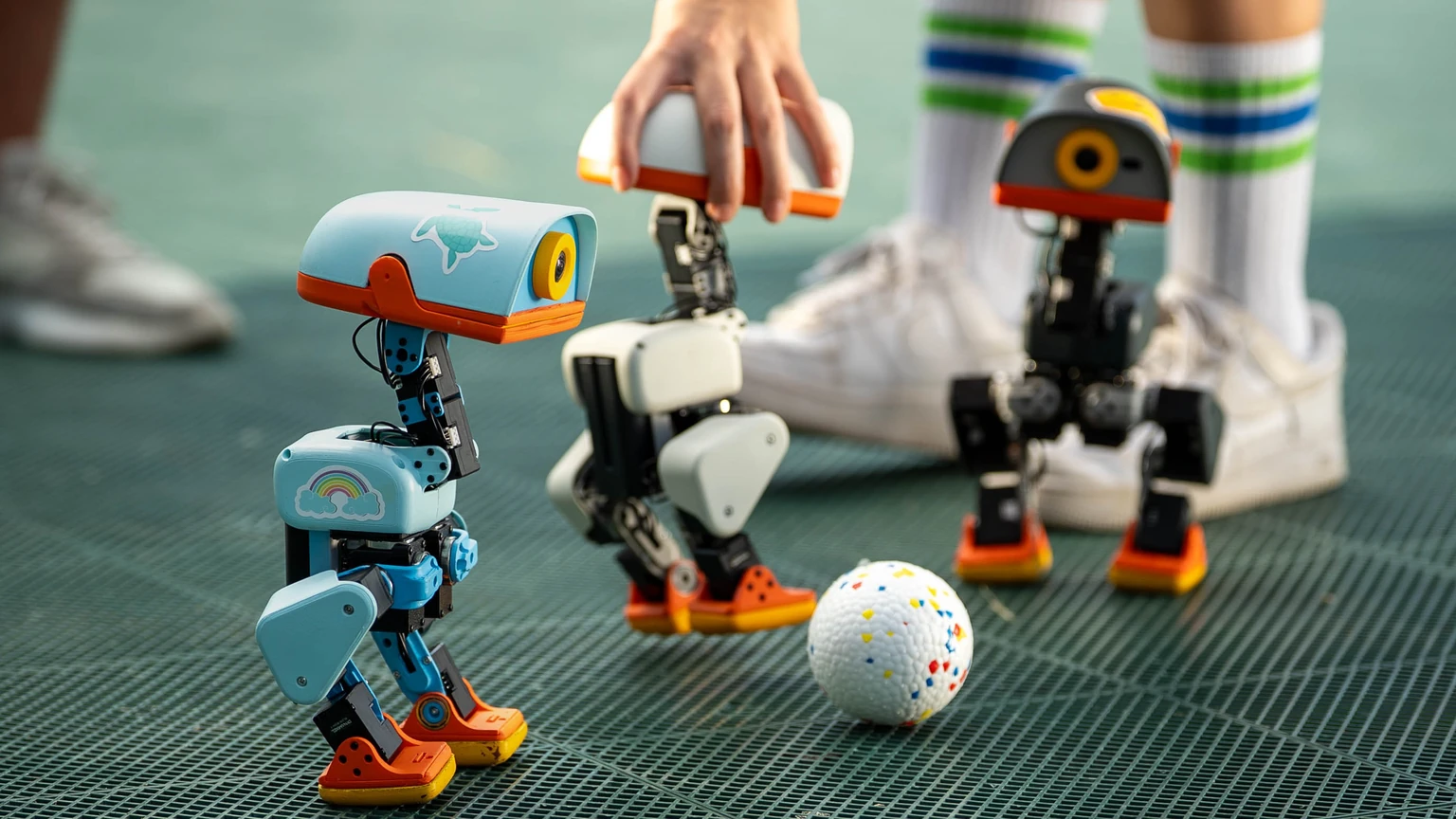
Jensen Huang closed NVIDIA's GTC Berlin keynote this week with four small robots at his feet. They were Microducks, 25 centimetre two-legged robots made by Pollen Robotics, the Bordeaux team that has been part of Hugging Face since April 2025. On cue they sat down, stood up and lay flat for a nap, and Huang told them they had been created on RTX Spark, trained in the cloud on NVIDIA supercomputers and taught their skills in simulation.
Clips of the moment spread quickly, and Hugging Face chief executive Clement Delangue says orders surged after the keynote. The robot costs $399, which puts it closer to a premium toy or a game console accessory than to the research robots that usually appear on an NVIDIA stage, and that price gap is a big part of why the clip landed with people who do not normally follow robotics.
The demo also mattered for a less cute reason. NVIDIA used Microduck to show the whole loop it wants developers to run on its hardware: an AI agent sets up a training course, a simulated robot learns in the cloud, the policy comes back to a laptop for testing, and then it runs on the real machine. The same keynote also launched the Agile ONE SN reference humanoid, but the duck is the robot ordinary buyers can actually put on a desk this year.
How close to 20,000 preorders
The exact number is worth handling carefully, because it comes from the company. On 22 October Delangue wrote on X that Microduck was going to cross 20,000 total preorders, probably the next day. On 23 October TechCrunch reported that preorders had passed 20,000 units by the day after the keynote, citing Delangue. Neither Pollen nor Hugging Face has published an audited order count, and preorders are reservations rather than delivered units, so the figure is best read as a strong signal of interest rather than a sales total.
Even so, the scale is unusual. Pollen opened preorders on 27 August 2026, so the robot has been on sale for less than two months. At the $399 base price, 20,000 orders would represent roughly $8 million in robot sales before taxes, shipping and add-on packs, which is real money for a small consumer robot from a team of researchers. Delangue has also said Hugging Face is hiring to keep up with what he called an explosion of interest in Microduck and Reachy Mini, the desktop robot Pollen launched before it.
The timing makes the next step the hard part. Pollen's own fact sheet targets first deliveries before Christmas 2026. Making tens of thousands of legged robots with 15 motors each, and shipping them across North America and Europe in about two months, is a very different job from taking reservations. Buyers who saw the keynote clip and ordered for the holidays should treat that date as a target, not a promise.
What you actually get for $399
Pollen's press kit fact sheet is unusually specific. Microduck stands 25 centimetres tall and 14 centimetres wide and weighs under 800 grams. It has 15 motors across its legs, neck and head, a Rockchip RK3566 processor with an AI accelerator, 1 GB of RAM and 32 GB of storage. For sensing it has a front camera with a recording light, an 8 by 8 time-of-flight depth sensor that Pollen calls a compact LiDAR, and two motion sensors, one in the body and one in the head.
The beak is the most charming part of the design and also the most useful. It opens and closes, so the robot can pick up socks, markers and small toys, and it holds one of two NFC antennas, so the duck can react to tagged objects. It talks in chirps and squeaks rather than words, and each robot generates its own voice the first time it wakes up and keeps it for life. Power comes from a removable NP-F550 camera battery rated at 2,600 mAh, which Pollen says gives about an hour of use.
The base box includes the robot, one battery, a USB-C cable and a game controller, so it can be driven before anyone writes code. Pollen sells a $39 charger pack with a dual charger and two more batteries, a $39 accessory pack with a laser pointer, roller skates, a ball and NFC tags, and a $119 developer pack with spare motors, cables, batteries and Hugging Face credit. It comes in four colours, Cream, Graphite, Lavender and Sky, which Pollen says are the same robot underneath.
| Item | Detail |
|---|---|
| Size and weight | 25 cm tall, 14 cm wide, under 800 g |
| Motors | 15, across legs, neck and head |
| Compute | Rockchip RK3566 with AI accelerator, 1 GB RAM, 32 GB storage |
| Sensors | Camera, 8x8 time-of-flight depth sensor, two IMUs, microphones |
| Battery | Removable NP-F550, 2,600 mAh, about one hour |
| Price | $399 robot; $39 charger pack; $39 accessory pack; $119 dev pack |
| Delivery target | Before Christmas 2026, North America and Europe |
The training story is the real product
Out of the box Microduck ships with seven trained moves, including walking, sitting, standing up after a fall and roller skating. Its control policies run on the robot 50 times a second. The more interesting part is where those moves come from. Pollen's microduck_rl repository trains them with reinforcement learning in mjlab, a robot learning framework built on MuJoCo Warp, the GPU version of the MuJoCo physics simulator, using the PPO algorithm. Finished policies are exported in the ONNX format and loaded onto the robot.
The repository lists task environments for walking, fall recovery, standing up from the floor, sitting, touching the ground with the beak, kicking a small ball, doing a forward roll and several roller skating tricks. Its readme says a usable walking gait takes about one to two hours on a single CUDA GPU running 4,096 simulated robots in parallel, and that people without a GPU can send the same job to Hugging Face Jobs instead. Owners can then publish a trained policy to the Hugging Face Hub for others to download.
That is the same simulation-first approach that research labs use for much larger machines, such as the humanoid work in UC Berkeley's SuperMimic. Microduck's bet is that it can make that workflow approachable for hobbyists and students, because a 800 gram duck that falls over does not break anything expensive. NVIDIA's keynote version of the story used Isaac Sim for the course and an RTX Spark laptop for evaluation, and the first RTX Spark machines went on sale only last week.
One detail from Pollen is worth repeating exactly. The Microduck software is open source under the Apache 2.0 licence, and the main robot repository, written in Rust, had about 10,500 stars on GitHub when we checked. But Pollen's fact sheet asks press not to call Microduck open-source hardware, because the mechanical and electronic design files are not covered by that statement. It is an open software platform on a closed body.
Why NVIDIA wants this duck on stage
The duck now sits inside a much bigger deal. NVIDIA agreed in September to buy Hugging Face for $12.93 billion, and its filing with the SEC says the deal is expected to close in the first half of 2027, subject to regulatory approval. Some coverage describes Pollen as already part of NVIDIA, but until the deal closes Hugging Face remains an independent company. NVIDIA has also committed to keep the Hugging Face platform open to other chip makers.
For NVIDIA, a cheap robot with a large hobbyist community is a way to put its simulation tools and its new consumer laptops in front of people who will never buy a humanoid. Hugging Face has used the same playbook in software, for example with tools like its llama.cpp tray app for RTX Spark. Every owner who retrains a Microduck learns the same pipeline that NVIDIA sells to robot companies.
Reviews will decide whether that strategy works. So far Microduck has been shown in polished launch videos and a staged keynote, and nobody outside Pollen has tested how long the battery lasts with heavy use, how well it walks on carpet, or how hard the retraining workflow is for a beginner. Some specifications are still marked as not final in the press kit, including camera resolution, depth sensor range and the SDK programming languages.
What to watch before Christmas
The first thing to watch is shipping. If Pollen hits its before-Christmas window at this volume, Microduck will be one of the fastest-selling consumer robots of the year. If dates slip, a lot of holiday buyers will be waiting into 2027, and early reviews will arrive at the same time as the frustration.
The second is the policy library. The open training stack only becomes a real advantage if owners share useful new moves and the good ones are easy to find and install. Hugging Face already runs the largest public library of AI models, so it is in a strong position to make that work, but robot policies that behave safely on thousands of slightly different physical units are harder to share than text models.
For now the takeaway is simple. A $399 robot built by a small French team has become the most visible consumer face of physical AI, and it got there because one keynote showed both a cute toy and a complete training loop in the same minute.
Common questions
How much does Microduck cost and when does it ship?
The robot costs $399 before taxes and shipping, with optional $39 charger and accessory packs and a $119 developer pack. Pollen targets first deliveries before Christmas 2026.
Is Microduck open source?
Its software stack, including the robot runtime and the reinforcement learning training environments, is open source under Apache 2.0. Pollen says the mechanical and electronic design files are not covered, so it is not open-source hardware.
Is Hugging Face part of NVIDIA now?
Not yet. NVIDIA agreed in September 2026 to acquire Hugging Face for $12.93 billion, and its SEC filing says the deal is expected to close in the first half of 2027.
Sources & further reading
- Hottest toy for Christmas? Nvidia CEO plays with adorable Microduck robots ↗
- GTC Berlin 2026 keynote live blog ↗
- Microduck press kit and fact sheet ↗
- pollen-robotics/microduck and microduck_rl repositories ↗
- NVIDIA to acquire Hugging Face ↗
- NVIDIA Form 8-K, 2 September 2026 ↗
- Hugging Face's new robot is an adorable rollerskating duck ↗
How this story was made
Written by Kristian Kostov with AI assistance and checked against the linked sources. Company performance claims are attributed to the company. Analysis reflects AiLookout’s interpretation; we have not independently tested the products discussed. Cover photography is illustrative and does not depict the specific announcement or product.
Our editorial standards