Announced 20 Oct 2026 · Sources checked
What the Berkeley team reported
A team at UC Berkeley says it has trained a general humanoid motion tracker on one GPU in three hours, a job that a leading earlier system needed a 128-GPU cluster and a week to do. The method is called SuperMimic, and the paper, posted to arXiv on 20 October 2026, has been accepted as an oral presentation at the Conference on Robot Learning (CoRL) 2026.
The authors are Qiayuan Liao, Yiyang Shao, Junfeng Long, Kevin Zakka, Roberto Horowitz, Pieter Abbeel and Koushil Sreenath. Their headline claim is that within three hours on a single NVIDIA H100, SuperMimic surpasses the score of SONIC, a state-of-the-art tracker trained for seven days on 128 GPUs, cutting GPU-hours by more than 1,000 times. After 9.8 hours on two GPUs, they report, it fails on none of the 129,514 motions in their benchmark.
Motion tracking is the skill of making a humanoid copy a recorded human movement, from walking to cartwheels, and it has become a popular route to general whole-body control. A tracker trained on a large motion library can then serve as a base for other tasks. The policy in this paper runs on a physical Unitree G1, the same small humanoid used in work such as UW's Reflex box-catching demo.
How SuperMimic learns
Most current trackers are trained with model-free reinforcement learning, usually PPO, which learns by trial and error from huge numbers of simulated rollouts. Teams either train many per-motion specialists and merge them through distillation, which the authors call lossy, or brute-force one policy with cluster-scale compute.
SuperMimic instead learns one world model, a neural network that predicts how the robot's body will move next, shared across every motion in the dataset. The world model is fitted to logged transitions from a standard rigid-body simulator, MuJoCo Warp. Because the learned model is differentiable, the policy can be improved by backpropagating its imagined return through 32 predicted steps, which gives analytic gradients instead of noisy trial-and-error estimates. A critic estimates the return beyond those 32 steps.
Both learners train together in one loop. The current policy collects transitions in the simulator, the world model is updated on short eight-step windows from a replay buffer, and the policy is then updated inside the world model, which is held fixed only during that update. The project page stresses that SuperMimic never differentiates the simulator itself, so ordinary simulators with non-smooth contacts work as they are.
The authors give two reasons the approach is fast. Imagined rollouts run more than ten times faster than MuJoCo Warp at the batch sizes they use, and first-order gradients need about 64 times fewer imagined steps to reach the best training return of PPO run on the same world model. It is a different bet from latent world models such as Meta FAIR's RoboJEPA: here the model predicts the robot's own physical state for control, not a scene.
The comparison with SONIC
SONIC, published in Science Robotics in 2026 by Zhengyi Luo and colleagues, was trained with PPO on 128 NVIDIA L40 GPUs for 168 hours, about 21,000 GPU-hours by its reported figures. Its released checkpoint scores a normalized return of 0.90 on the Berkeley benchmark. SuperMimic passes that within three hours on one H100, which the authors put at about 7,200 times fewer GPU-hours and about 56 times less wall-clock time. They round those down to more than 1,000 times and more than 50 times.
The three hours cover the full training loop, including collecting simulator data and fitting the world model; checkpoint evaluations are not counted. The authors say they state it conservatively, since every later checkpoint stays ahead of SONIC by at least half the gap to SuperMimic's best result.
They also flag that the comparison is not like for like. SuperMimic trained on 264.56 hours of BONES-SEED, the public subset of SONIC's 611-hour dataset, so it saw 2.3 times less data. An H100 has 0.74 times the fp32 and 5.5 times the tensor-core peak throughput of an L40, and how much of that peak either run used is unknown. Their argument is that those factors cannot account for a gap of three orders of magnitude.
A controlled test backs the trend. On LAFAN1, a 40-clip dataset, the team trained a PPO baseline in the simulator with the same motions, rewards and network sizes. SuperMimic reached a return of 0.82 within 1.2 hours on one GPU. The PPO baseline did not reach it within 18 hours, ending at 0.60 on one GPU, 0.70 on four and 0.72 on eight.
Flips, side rolls and failed motions
The benchmark plays each of the 129,514 motions once from its first frame with the same physics for every policy, and counts a failure when the rollout trips SuperMimic's training termination. SONIC's released checkpoint fails 179 of them, including all 44 flips, all 22 side rolls and all eight dance routines. SuperMimic fails 25 after three hours on one GPU, among them two side rolls and one flip, and none after 9.8 hours on two GPUs.
The project page is careful about what that means. The benchmark motions are training motions for both methods, so the counts measure how much of the library each policy covers, not how well it generalizes to movements it has never seen.
The paper also reports that the world model's prediction error stayed between 0.007 and 0.011 as the training data grew from one hour to 264 hours of motion, while the GPU-hours needed to reach a target return grew slowly. The authors present this as the reason one model can absorb a whole motion library, and say it makes measuring scaling laws for motion tracking practical.
What ran on the real robot
A single tracking policy, trained entirely through the world model, ran on a real Unitree G1 with no per-motion tuning. The paper shows four motions: a skipping jump, a side roll with the torso and limbs on the floor, a 90-degree flip and an in-place 360-degree flip.
The team also ran a preliminary test of downstream control. It trained a velocity encoder, which turns speed and direction commands into inputs for the shared controller, using a velocity-tracking reward through the world model, and compared it with a distillation-style baseline. Across 672 step responses the reinforcement-learning encoder had the lower steady-state error on 650 and the baseline on 15. Only the baseline fell, on seven fast turns that had almost no matching motion data.
The project page includes a browser demo that runs the policy, and side-by-side clips in which the world model correctly predicts a fall when the policy is switched off and a slide when the floor turns slippery. It is a contrast with demos built around language-model planners, such as Gemini 4 Argon's MuJoCo robotics examples, where the hard part is deciding what to do rather than staying upright while doing it.
Why the compute claim matters
If the result holds up, the cost of training a general humanoid controller drops from a cluster budget to a single rented GPU for an afternoon. That matters for university labs and small robot makers, which rarely have 128 GPUs for a week, and it lets researchers run many more experiments on data mixes and model sizes.
Humanoid companies are moving fast. Firms such as Agile Robots are building on vendor stacks, and governments are starting pilots such as South Korea's 20-humanoid sandbox. A cheaper way to learn full-body skills could shorten the path from motion-capture data to a robot that moves well, though deployment depends on far more than motion tracking.
The work was supported in part by Komatsu, the BAIR Center for Humanoid Intelligence, Apple and the RAI Institute, with compute sponsored by Lambda and motion data from Bones Studio. Abbeel and Sreenath also hold Amazon Scholar appointments; the paper says the work was done at UC Berkeley and is not associated with Amazon.
Caveats and open questions
The authors list three limitations. The world model learns only from simulator data, not real-robot data. Training covers flat ground only, with no terrain or object interaction, which they describe as ongoing work. And training several control interfaces at once is understudied, since the velocity reward currently updates only the encoder, not the shared controller.
The real-robot evidence is four demonstrated motions, not a measured success rate on hardware. The SONIC comparison crosses GPU types and dataset sizes, and it compares against a released checkpoint rather than a rerun. The project page did not link a code repository when AI Lookout checked, so outside groups cannot yet reproduce the training numbers.
AI Lookout has not run SuperMimic. All results here are the authors' own, from a preprint that has been accepted at CoRL but whose figures have not been independently checked.
Common questions
What is SuperMimic?
A training method from UC Berkeley that teaches one humanoid policy to track a large library of human motions by learning through a differentiable world model instead of pure trial and error.
Does SuperMimic run on a real robot?
Yes. One policy ran a skipping jump, a side roll and two flips on a physical Unitree G1 without per-motion tuning, according to the paper.
Is SuperMimic open source?
The paper and a browser demo are public. The project page did not link training code when AI Lookout checked on 22 October 2026.
Sources & further reading
How this story was made
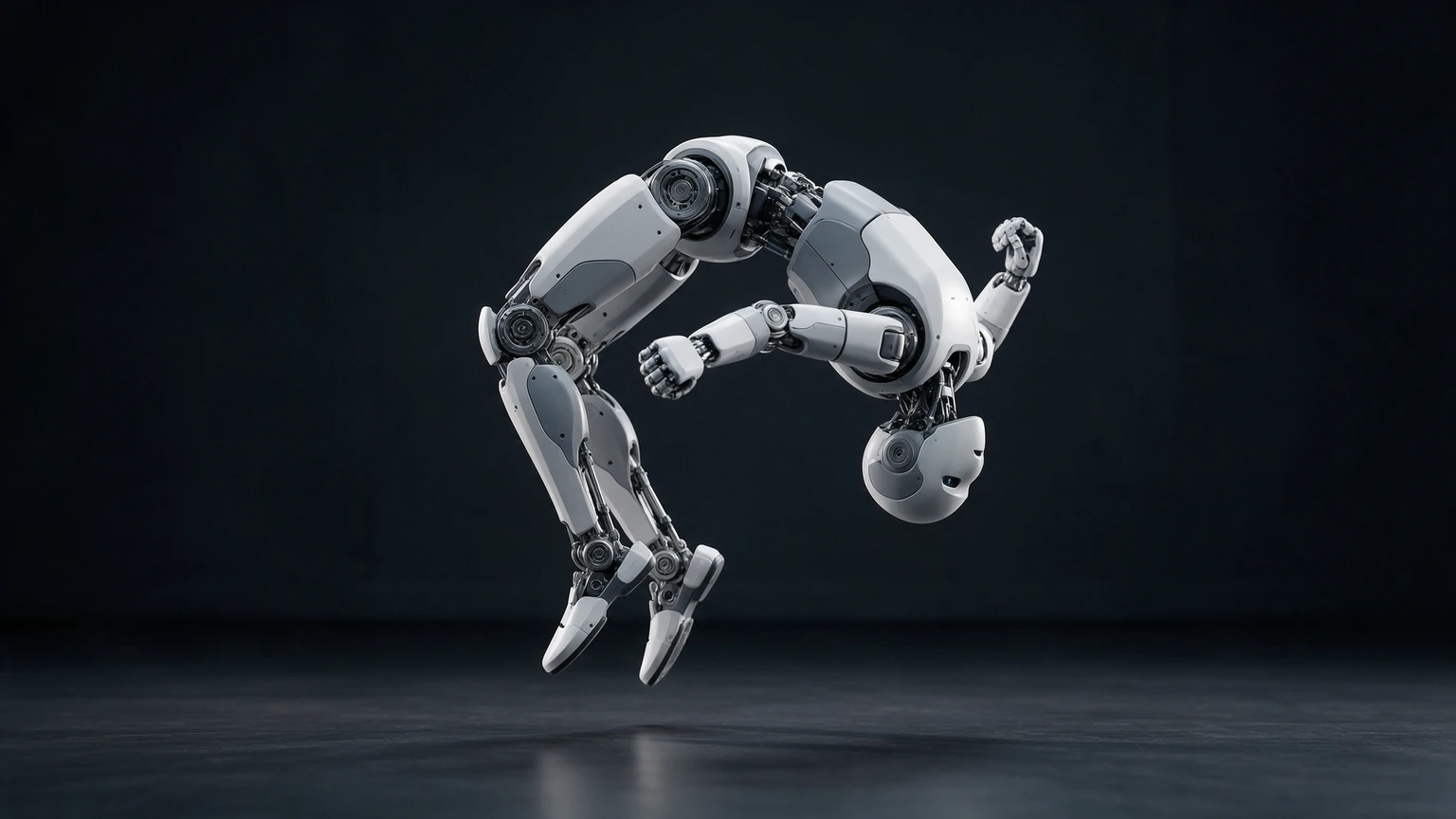
Written by Kristian Kostov with AI assistance and checked against the linked sources. Company performance claims are attributed to the company. Analysis reflects AiLookout’s interpretation; we have not independently tested the products discussed. The cover is an AI-generated editorial illustration, not a photograph or evidence of an actual event.
Our editorial standards