Announced 21 Oct 2026 · Sources checked
What was announced at GTC Berlin
NVIDIA used its GTC Berlin keynote on Wednesday to put a humanoid robot at the centre of its robotics pitch. In a press release dated 21 October 2026, NVIDIA said Agile Robots has built Agile ONE SN, "a full-stack reference humanoid preconfigured with NVIDIA Isaac GR00T and powered by the NVIDIA Jetson Thor edge AI platform". X
In NVIDIA's live blog of the keynote, Jensen Huang is described announcing the robot as a 31-degree-of-freedom body "designed to cut researcher setup time from weeks to days". The platform is modular, the blog says, so researchers can use the full workflow or pull in selected parts. "This is a great starting point," Huang said.
The humanoid came with a wider update to NVIDIA Isaac, the company's open robotics development platform: a new runtime called Isaac OS, the general release of Isaac Lab 3.0 for robot learning, open reference workflows for its DGX Station desktop computer, and new datasets on Hugging Face. "General-purpose robotics is advancing at extraordinary speed — the ChatGPT moment for robotics is fast approaching," Huang said in the release.
What is inside Agile ONE SN
NVIDIA lists the robot's main parts. The body is Agile Robots' Agile ONE S humanoid, which stands 1.40 metres (4.59 feet) tall, weighs 40 kilograms (88 pounds), has 31 degrees of freedom and can carry a 3-kilogram payload in each arm. It has two WUJI Hand 2 five-fingered hands, each with 20 degrees of freedom, force control at 1 kHz and tactile sensing for fine manipulation.
Onboard computing comes from NVIDIA Jetson Thor, which NVIDIA says delivers 2,070 FP4 teraflops and 128 GB of unified memory for reasoning and real-time control on the robot itself. Sensors include head and wrist cameras, lidar and inertial measurement units. The software side is NVIDIA's Isaac GR00T platform, which includes the GR00T foundation model for robots, a workflow from data capture to deployment, and whole-body control for coordinated movement.
Safety is described as a plan rather than a finished feature. NVIDIA says the robot will have "planned integration" of its on-robot safety protocols with NVIDIA Halos, the company's safety system for autonomous vehicles and robots, built on its IGX Thor hardware.
"The breakthrough for humanoids is usefulness at scale: one adaptable machine that learns many skills and works across environments built for people," said Zhaopeng Chen, founder and chief executive of Agile Robots, in the release. NVIDIA says leading institutions such as Stanford University and ETH Zurich have shown interest in the platform.
The software NVIDIA is shipping around it
The reference humanoid is designed to sit on top of a set of NVIDIA tools, most of them released or updated the same day. Isaac Lab 3.0 is now generally available. NVIDIA describes it as an open source, agent-ready framework for training and refining robot policies, scaling from a desktop to a data centre across multiple GPUs, with physics engines including Newton and PhysX.
Isaac OS is a new open source runtime built on NVIDIA Holoscan. Its job is to connect AI models, sensors, controls and robot hardware with deterministic, real-time performance, so the same software can move from simulation to a physical robot. NVIDIA is also releasing three open source reference workflows for DGX Station: one for refining GR00T 1.7 models with reinforcement learning, one for training dexterous manipulation skills in Isaac Lab, and one for post-training NVIDIA Cosmos world models to generate synthetic training data using ChatGPT Astra.
Two data releases round it out. The SimReady Central Library offers more than 2,000 simulation-ready robot and factory assets from companies including Comau, FANUC, Franka Robotics, LG Electronics, Universal Robots and Vertiv. The Human 1M Dataset contains varied human activities with synchronised three-view video and 3D hand tracking. Both are on Hugging Face, although NVIDIA says the full Human 1M Dataset is only open to Cosmos Coalition partners.
Who else is building on the stack
NVIDIA's release names a long list of European robotics companies using parts of the stack. ABB Robotics is adding NVIDIA Omniverse libraries to its RobotStudio HyperReality software to simulate robot cells before installation, and KUKA is using Omniverse in its Visual Components FactoryLens. NEURA Robotics is using Isaac Sim and Isaac Lab to generate synthetic data and train skills for its Neuron AI model. Sereact is training its Cortex goods-handling platform with Isaac GR00T and Cosmos Transfer on Universal Robots arms.
Others are working with the hardware and runtime. NVIDIA says Humanoid is validating robot behaviours before industrial pilots using Jetson Thor, Halos and Isaac OS, and Hexagon Robotics is building perception for its AEON robot. Agile Robots, Agility, Dexory, FORT Robotics and KION are integrating Halos into their safety designs, and SICK is evaluating it. Toyota Material Handling Europe and SoftServe say Omniverse and Isaac Sim cut deployment time for autonomous material handling by up to 50 percent.
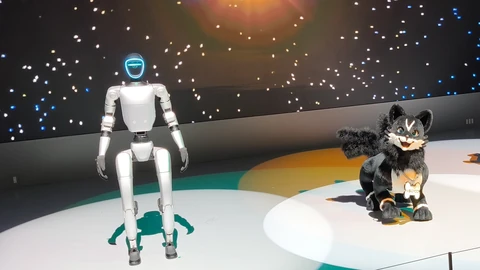
The keynote also featured a small open source robot. Hugging Face and Pollen Robotics are using Isaac Lab, Isaac Sim and Newton to build Microduck, and NVIDIA's live blog says four Microducks joined Huang on stage, sitting, standing and taking a nap on cue. Huang showed an AI agent setting up a course for the robot in simulation, sending training jobs to the cloud and testing the learned policy on an RTX Spark laptop before deploying it to the real robot.
Why a reference humanoid matters
Humanoid research is slowed by integration work. A lab that buys a humanoid body still has to connect hands, sensors, onboard computers, simulation software and training pipelines before it can test an idea, and each lab tends to build its own version. A reference platform promises a common starting point, in the way reference designs helped standardise PCs and phones. NVIDIA's claim is that Agile ONE SN cuts that setup from weeks to days; that is a vendor estimate until researchers use it.
It also fits NVIDIA's broader strategy at GTC Berlin, where it sold everything from containerised AI factories to robot software. A reference humanoid built around Jetson Thor and GR00T gives researchers a reason to standardise on NVIDIA's chips and models. Open hardware projects take a different route: the RoboParty RP1 is an open source humanoid, and independent demos such as Reflex's box-catching Unitree G1 show labs building their own stacks on off-the-shelf bodies.
What is still unclear
Several basics are missing. NVIDIA's release gives no price for Agile ONE SN and no firm date beyond early 2027, and Agile Robots' own announcement page did not load as readable text when AI Lookout checked it, so the details here come from NVIDIA. NVIDIA also notes that many of the products it describes "remain in various stages" and will be offered on a when-and-if-available basis.
Halos integration is planned, not shipped, which matters for a robot meant to work near people. And NVIDIA's comparison of robotics to a coming "ChatGPT moment" is a forecast. The partner list shows broad interest in its tools, but it does not show how many humanoids are doing useful work today.
AI Lookout has not seen or tested the robot. The specifications above are those published by NVIDIA for Agile Robots, and should be checked against Agile Robots' own documentation once the platform ships.
Common questions
What is Agile ONE SN?
A reference humanoid robot from Agile Robots for researchers and developers. It comes preconfigured with NVIDIA Isaac GR00T software and a Jetson Thor computer, so labs can start training skills without building their own stack.
When will Agile ONE SN be available, and how much will it cost?
NVIDIA says it is scheduled for early 2027. Neither NVIDIA nor Agile Robots has announced a price in the material AI Lookout reviewed.
What is NVIDIA Isaac Lab 3.0?
An open source framework for training robot policies in simulation, from a desktop to a data centre. NVIDIA made it generally available at GTC Berlin alongside a new Isaac OS runtime.
Sources & further reading
How this story was made
Written by Kristian Kostov with AI assistance and checked against the linked sources. Company performance claims are attributed to the company. Analysis reflects AiLookout’s interpretation; we have not independently tested the products discussed. The cover places the companies’ own logos, taken from public-domain or openly licensed files credited in the caption, on a plain background. It is not a product photograph, a screenshot, or an endorsement.
Our editorial standards