Announced 13 Nov 2026 · Sources checked
What happened
Agent management startup LangChain has raised a $300 million Series C at a $3 billion valuation, the company announced on Friday.
Alphabet's independent growth fund CapitalG led the round, with participation from Singapore sovereign wealth fund GIC, DFJ Growth, IVP, and Sapphire Ventures.
The funding more than doubles LangChain's valuation from its $1.25 billion mark in 2025, when it raised a $125 million Series B. The company has now raised $460 million in total funding.
The round ranks among the larger AI infrastructure deals this year, though it is still far behind the mega-rounds raised by foundation model companies.
Fractile raised $720 million for AI inference chips in October, and SoftBank has committed $40 billion to AI cloud infrastructure for 2027.
LangChain's raise stands out because it targets the software layer above the hardware stack, where margins are higher and switching costs are stickier once enterprise teams build on a platform.
The company does not disclose revenue, but the 2.4x valuation increase over 13 months implies strong subscription growth for LangSmith.
The platform charges per-seat fees for enterprise tiers and usage-based pricing for its cloud offering, with self-hosted options available for regulated industries that cannot route data through external APIs.
Why it matters
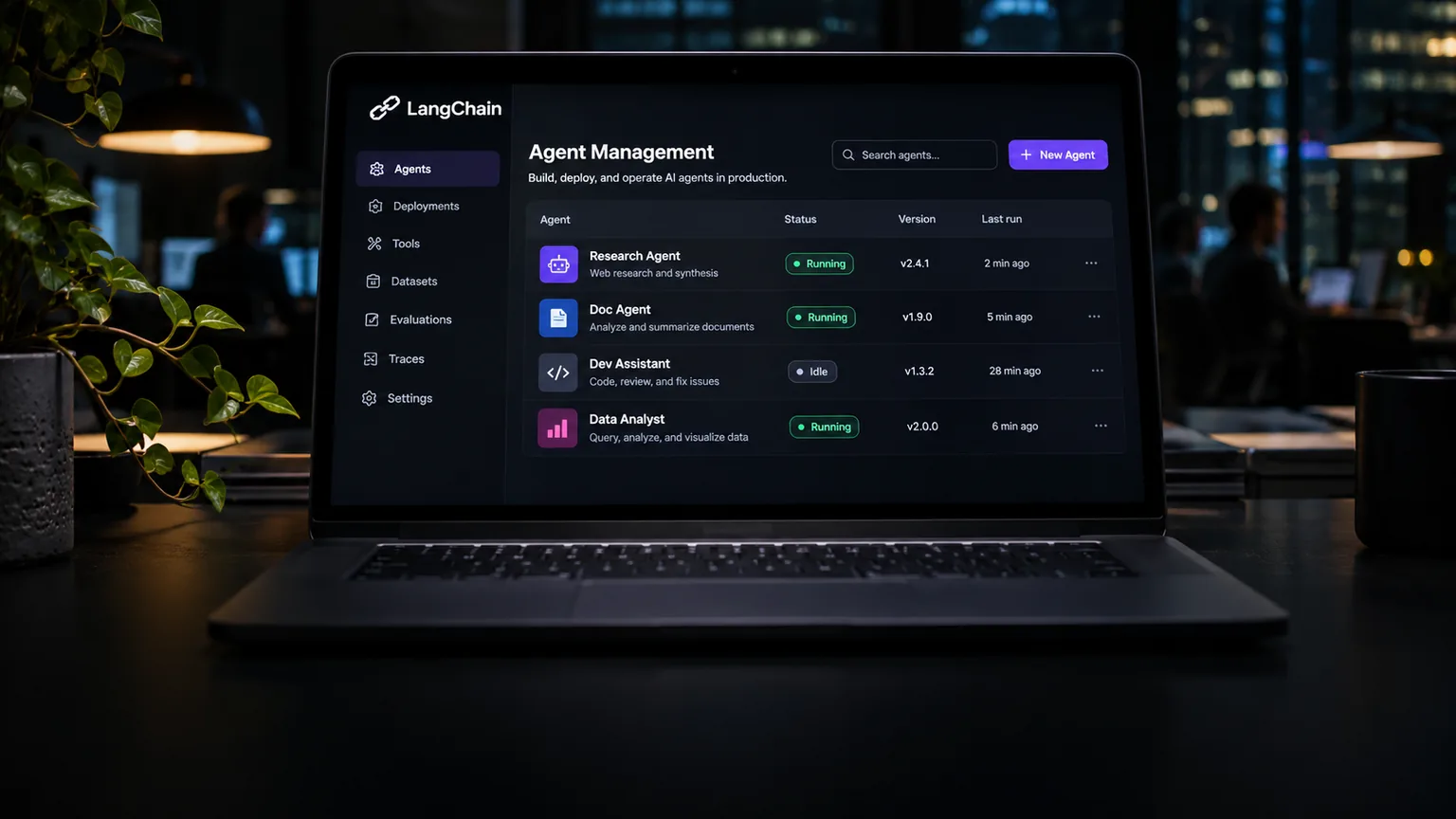
LangChain has become the central infrastructure layer for companies building AI agents. Its LangSmith platform handles agent development, testing, deployment, and monitoring across any large language model provider.
The company claims 7,000 customers use the platform, a sign that enterprise demand for agent-building tools is accelerating even as overall AI venture funding has cooled in the second half of 2026.
The raise signals that investors still see massive opportunity in the agent infrastructure layer, even as the broader AI funding market has slowed.
Global AI venture capital surpassed $500 billion in the first nine months of 2026, but the third quarter brought a sharp deceleration, the WSJ reported.
Enterprise adoption of AI agents has been one of the few bright spots in an otherwise cautious second half of 2026.
Companies in financial services, healthcare, and logistics have started deploying agent systems for tasks like document processing, customer triage, and supply chain coordination.
LangSmith's observability and evaluation tooling addresses the key concern holding many enterprises back: the inability to test whether an agent system will behave correctly in production before deploying it.
The details
LangChain started as an open-source framework for chaining large language model calls together, but has since evolved into a full platform.
LangSmith provides observability, evaluation, and prompt management tools that let enterprise teams build production-grade agent systems without switching between model providers.
The company said the new funding will go toward expanding LangSmith's enterprise features, growing its go-to-market team, and investing in research around multi-agent systems and agent reliability.
Harrison Chase, LangChain's founder and CEO, said in the announcement that the goal is to let every company own its intelligence rather than lock into a single model provider.
Singapore's GIC joining the round alongside CapitalG, DFJ Growth, IVP, and Sapphire Ventures gives LangChain a geographically diverse investor base with deep enterprise and cloud connections. LangChain's open-source heritage gives it a distribution advantage that proprietary-only competitors lack.
The LangChain and LangGraph repositories have accumulated tens of thousands of GitHub stars, creating a pipeline of developers who experiment with the open-source tools and later advocate for the paid LangSmith platform inside their organizations.
CapitalG, the Alphabet growth fund that led the round, has been one of the more active corporate venture investors in the AI infrastructure space. The fund previously backed companies including Stripe, UiPath, and CrowdStrike.
Its involvement signals that Alphabet sees agent management tooling as a strategic layer complementary to Google Cloud's Vertex AI platform, which also offers agent-building capabilities.
What is next
LangChain faces growing competition in the agent development space. Rivals include OpenAI's Agents SDK, Anthropic's Claude Code and Claude Duet, and Google's Agent Development Kit.
But the company's model-agnostic approach and open-source roots give it an advantage with enterprises that want to avoid vendor lock-in, the company argues.
The fresh capital positions LangChain to double down on enterprise sales and multi-agent orchestration, one of the hardest unsolved problems in production AI today.
The company's valuation jump from $1.25 billion to $3 billion in just over a year reflects how quickly the agent tooling market has become a priority for enterprise technology buyers.
LangChain has also been investing in open-source community development alongside its commercial product. The company maintains several widely-used open-source libraries including LangChain Core and LangGraph, which have accumulated tens of thousands of GitHub stars.
This dual open-source-plus-commercial strategy mirrors the playbook that companies like MongoDB and Elastic used to build enterprise businesses on open-source foundations.
The bigger picture
LangChain's rapid ascent mirrors the broader shift from chatbots to autonomous agents in enterprise AI. Companies are moving beyond simple Q&A use cases toward agent systems that can execute multi-step workflows, interact with APIs, and make decisions within guardrails.
LangSmith sits at the center of that transition, providing the testing and monitoring infrastructure that enterprise teams need before putting agents into production.
The $3 billion valuation also signals that investors see agent management as a category with its own winner, separate from the foundation model layer where OpenAI, Anthropic, and Google dominate.
If LangChain can hold its position as the model-agnostic platform of choice, the new valuation may look conservative in another year.
The agent management market is still in its early stages. Most enterprises have fewer than five agent systems in production today, according to industry surveys, but adoption is expected to accelerate as reliability improves and best practices mature.
LangChain's bet is that model-agnostic tooling becomes the default choice as companies diversify across multiple LLM providers rather than standardizing on one.
The funding also comes at a time when the broader AI industry is grappling with the fallout from Jensen Huang's resignation at Nvidia.
The uncertainty at the chip level has made some enterprise buyers more cautious about committing to hardware-specific AI stacks.
LangChain's model-agnostic positioning becomes more valuable in that environment, since it lets companies switch underlying models and hardware without rebuilding their agent infrastructure.
Common questions
What is LangChain?
LangChain is an AI agent development platform that helps companies build, test, deploy, and monitor agent systems across any large language model provider. Its LangSmith product is used by 7,000 enterprise customers.
Who invested in LangChain's Series C?
CapitalG, Alphabet's independent growth fund, led the $300 million round. Participants include Singapore's GIC, DFJ Growth, IVP, and Sapphire Ventures.
How much has LangChain raised in total?
The company has raised $460 million across all funding rounds, including today's Series C and a $125 million Series B in 2025.
Sources & further reading
How this story was made
Written by Kristian Kostov with AI assistance and checked against the linked sources. Company performance claims are attributed to the company. Analysis reflects AiLookout’s interpretation; we have not independently tested the products discussed. The cover is an AI-generated editorial illustration, not a photograph or evidence of an actual event.
Our editorial standards