Announced 29 Oct 2026 · Sources checked
The numbers that spooked investors
Alphabet's Q3 2026 earnings report, published on October 29, contained a paradox. Search queries are growing at their fastest rate in five years. Yet Google's Search revenue growth slowed to 12 percent year over year, down from roughly 17 percent in Q2. Paid clicks — the ads that generate revenue — slowed from 13 percent growth to 8 percent.
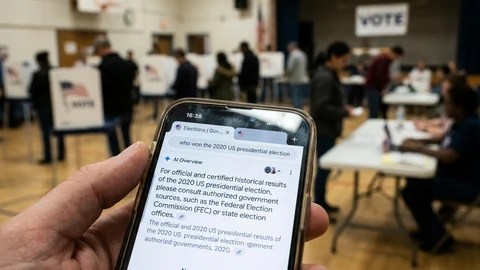
The divergence has a name: AI Mode. Google's conversational search interface, which generates direct answers instead of a list of blue links, now handles a meaningful share of daily queries. And those queries earn less money per search than traditional results.
Chief Business Officer Philipp Schindler confirmed as much on the earnings call. AI Mode queries "monetize at a lower rate" than traditional Google Search queries, he said, attributing part of the revenue-growth slowdown to the shift. Currency effects and changes in advertiser spending in specific industries were also factors, he noted.
Alphabet plans to spend roughly $200 billion on infrastructure this year, largely to support AI. The market's response was swift: Alphabet shares fell about 14 percent since the report.
Why AI Mode earns less than traditional search
Traditional Google Search presents ads alongside organic results. A user searching for "Nike running shoes" sees shopping listings and text ads alongside the organic results. The model is proven: advertisers pay for placement next to high-intent queries, and users click because they are ready to buy.
AI Mode changes the equation. Instead of a list of links, users get a synthesized answer. There are fewer opportunities to insert ads, and when ads do appear, they compete with the AI's direct response. As Nate Elliott, an eMarketer principal analyst covering AI and advertising, told The Verge: "This is the first major disruption that Google is facing to its core business in decades."
Google is experimenting with ad placements inside AI Mode — sponsored answers, inline product suggestions, and multi-turn conversational ads. Schindler said the company's "ad experiments have shown promising results" and that Google is expanding ads in AI Overviews and AI Mode internationally. But the company has not disclosed whether those experiments are closing the monetization gap.
An early study of ChatGPT ads suggests the challenge is real. An October working paper found that US visits from ChatGPT ads generated 64 percent less revenue for retailers per session than visits from Google Search ads: $0.89 versus $2.45. While that study measures retailer sales rather than Google's own platform revenue, it underscores the structural challenge of advertising inside a conversational interface.
What Google says about the trajectory
Google's argument is that AI is expanding the total search pie. Schindler said most AI Mode queries are "incremental" — new questions users would not have asked in a traditional search box, rather than replacements for existing queries. Many are also "upper-funnel," meaning users are researching before they know what they want to buy. The company sees those as future ad opportunities.
"We feel good about our trajectory," Schindler said on the call. Google is currently expanding ads in AI Overviews and AI Mode, including internationally and across multiple turns of US AI Mode conversations. It has also floated bringing ads to the standalone Gemini app, saying formats developed for AI Mode could carry over, but has not announced a timeline.
Andy Taylor, vice president of research at digital advertising agency Tinuiti, notes that advertisers are still getting results. Tinuiti's same-store advertisers increased their Google paid search spending 14 percent year over year in Q3 while maintaining their return-on-ad-spend targets. But Taylor cautions that advertisers cannot isolate how AI ads are performing — Google does not let them separately target that inventory or break out its performance. Steady overall returns could mean AI ad traffic is still too small to matter, or that it performs similarly to existing inventory.
The risk nobody can quantify
The unanswered question is whether AI Mode cannibalizes high-value search queries. Google claims most AI Mode queries are incremental, but the company has not disclosed how many traditional searches AI Mode replaces. If AI Mode draws users away from searches that Google monetizes effectively — local business queries, product comparisons, high-intent shopping — the revenue impact could be significant even as query volumes grow.
"If people are clicking through less often," Elliott said, "that is a challenge that they need to figure out."
The comparison to ChatGPT ads is instructive. An October working paper from researchers at the University of Chicago and the University of Pennsylvania found that US visits from ChatGPT ads generated 64 percent less revenue for retailers per session than visits from Google Search ads: $0.89 versus $2.45. That study measures retailer sales rather than Google's platform revenue, but it illustrates the structural challenge: conversational interfaces produce lower purchase intent than traditional search results.
Elliott cautions that finding effective ad formats can take years. Search engines started with banner ads before adopting paid listings; social media went through its own long experimentation phase. "They absolutely do not have it all figured out," he said. "No one has it all figured out."
The difference is the clock. Google is spending billions on AI infrastructure while its core business model faces structural pressure. The 14 percent stock drop suggests investors are not willing to wait forever for an answer.
What comes next
Google has time. Its search business still generates tens of billions in quarterly revenue, and the company's cash position gives it room to experiment. Taylor points to Google's successful shift to mobile: early phone traffic was less valuable to advertisers, but the company eventually found its footing.
The question is whether AI represents a similar transition or something more fundamental. Unlike mobile, which changed the device but not the search-ad model, AI Mode changes the product itself. Users no longer need to click through to a website to get an answer. If that becomes the norm, the entire web advertising economy — not just Google — will need to adapt.
For now, Google is buying time with experiments, international expansion, and the claim that AI will ultimately grow the pie. The Q3 numbers suggest the pie is growing, but each slice is worth less. That is a problem Google has not solved yet.
Common questions
Is Google's AI Mode actually losing money?
No — AI Mode still generates revenue, just at a lower rate per query than traditional search. Google's overall Search business remains highly profitable. The concern is that as AI Mode grows as a share of total queries, the average revenue per search declines, pressuring the growth rate of the company's most important business.
Will ads in AI Mode improve over time?
Google is actively testing new ad formats for AI Mode, including sponsored answers and multi-turn conversational ads. The company has a strong incentive to make them work: AI Mode is the future of its product, and a durable monetization model is essential. But early data from ChatGPT suggests conversational ads generate significantly lower retailer revenue per session than traditional search ads.
Should advertisers change their Google strategy because of AI Mode?
Not yet. Google does not allow advertisers to separately target or measure AI Mode inventory, so there is no actionable difference for campaign management. Advertisers should monitor Google's disclosures on AI ad performance and prepare for a future where conversational search changes how users discover products.
Sources & further reading
- Google hasn't figured out how to make AI pay like its search engine - The Verge ↗
- Google admits AI search makes less money, but it's fixing that with more ads - Ars Technica ↗
- Google: AI Mode's lower monetization slowed Search ad growth - Search Engine Land ↗
- Alphabet Q3 2026: Search +12%, AI Mode monetization lower - Relevant Audience ↗
How this story was made
Written by Kristian Kostov with AI assistance and checked against the linked sources. Company performance claims are attributed to the company. Analysis reflects AiLookout’s interpretation; we have not independently tested the products discussed. The cover is an AI-generated editorial illustration, not a photograph or evidence of an actual event.
Our editorial standards