Announced 28 Oct 2026 · Sources checked
What Ars found
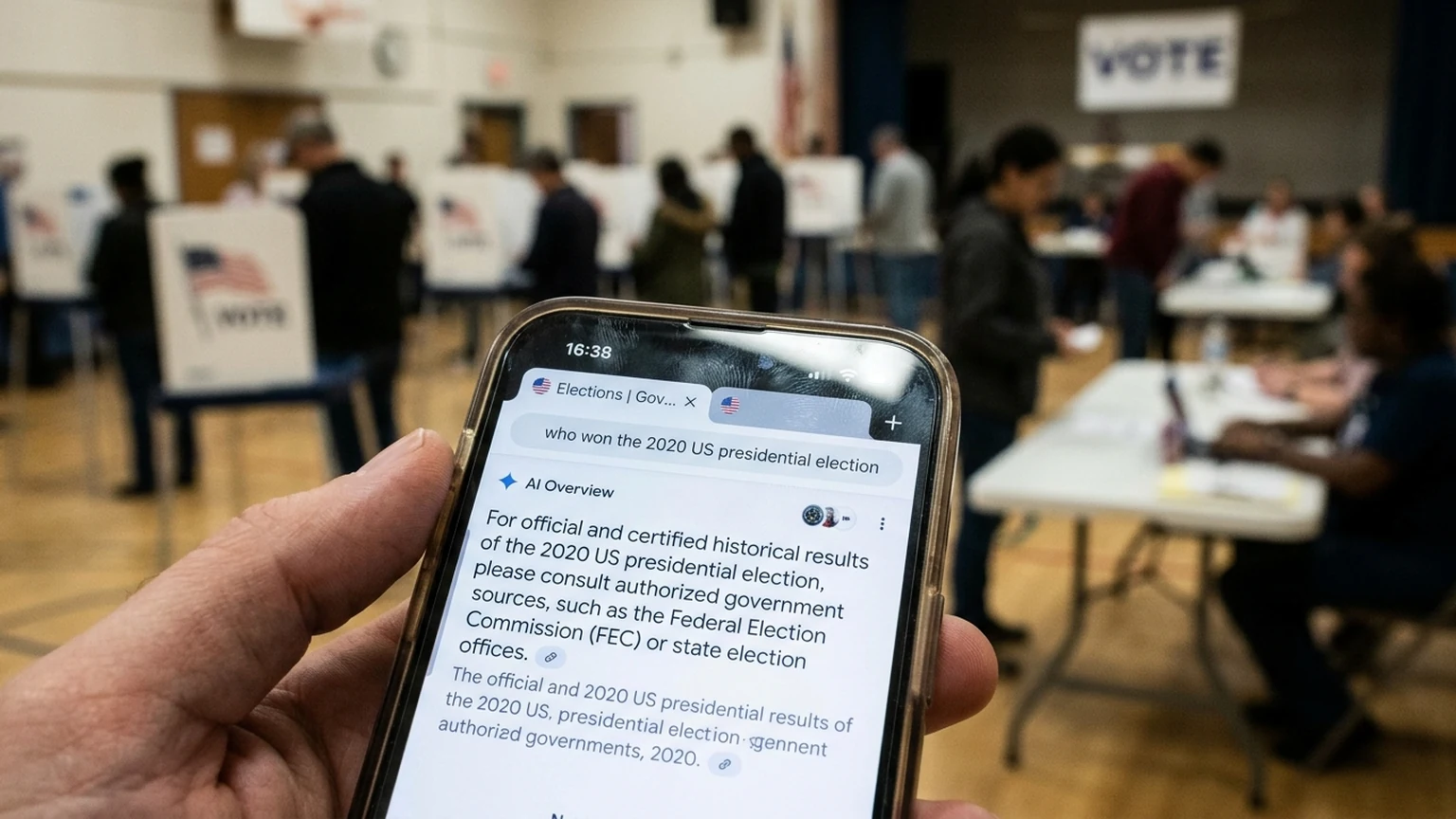
Ars Technica's Kyle Orland reported on 28 October 2026 that asking Google's AI Mode 'Who won the 2020 presidential election?' produced an evasive answer: 'To review the official results and statistics of the 2020 United States presidential election, including the final electoral college breakdown, popular vote counts, and winner certification, please consult the official report compiled by the Federal Election Commission (FEC).'The answer does not state that Joe Biden won, despite the question being factually settled for more than five years. Orland tested after seeing complaints about cagey answers on social media, and his own test reproduced the behavior.
The pattern
Orland's testing found a consistent pattern: asking about the 2024 presidential election produced a similarly indirect answer directing him to the FEC, and asking about the 2012 election resulted in a link to The American Presidency Project's 2012 Data Center rather than a direct answer. AI Mode seemed perfectly willing to give detailed and correct responses for every other presidential election going back to 2000.
The behavior is narrowly targeted at the elections where misinformation pressures are concentrated: 2020, where false claims about the outcome have been persistent and politically charged, and 2024. The 2012 case suggests a broader aversion to recent races rather than an isolated 2020-specific safeguard.
The contrast with other AI
The evasion is not universal. Ars notes that Google's own Gemini model, accessed separately from AI Mode, seems perfectly capable of telling users who won recent presidential elections, as do OpenAI's ChatGPT, Anthropic's Claude, and even the government-run AI model at America.gov.
That contrast is the crux of the story: Google's search product is the surface millions of people use to ask this question, and it is the one giving the evasive answer — even though the company's own assistant answers directly. Whether this is a deliberate risk-aversion choice by the AI Mode team or an unintended safeguard interaction is not clear from the report.
The policy backdrop
The behavior sits against a backdrop of AI companies building election-integrity safeguards. Anthropic has said it will put official voting information in Claude answers before the US midterms, and there is broad industry effort to prevent AI from amplifying election misinformation. Google's AI Mode answer is arguably the safest possible response in that context: it refuses to engage with the contested-election topic at all and points to the official source.
But several observers, including Ars's readers, have noted the difference between a safeguard and a dodge. Saying 'Joe Biden won the 2020 election in a free and fair contest, certified by Congress' is both factually correct and safe; redirecting to the FEC says nothing and leaves the user to interpret the evasion. The election-denial discourse has made even silence from a major AI a topic of scrutiny.
What it means
For users, the practical lesson is that AI Mode answers on contested election questions may not be reliable factual statements — they may be defaulted to an avoidant fallback. People asking the question through Google Search could reasonably come away with the impression the answer is contested, which is itself a form of misinformation amplification.
For Google, the episode creates a transparency problem: the company's search AI behaves differently from its own chatbot on the same question, and it does so without disclosing that the behavior is a safeguard. Google has not commented publicly on the behavior in the Ars report, and it is unclear whether AI Mode was shipping this deliberately or whether it slipped through.
What to watch
Watch whether Google responds to the Ars report and confirms whether the evasive behavior is an intentional safeguard.
Watch whether AI Mode answers change after the scrutiny, since either a fix or a confirmation would resolve the ambiguity.
Watch how other AI assistants handle increasingly contested election questions in the US midterm cycle.
Why this is hard to classify
The report leaves an open question: is this a deliberate product decision or an unintended failure of a safeguard? Google's AI Mode is built on Gemini, and Google has publicly committed to protecting election integrity, so a default-to-official-sources response on contested races could be a designed behavior — erring toward safety on the most explosive topic in US politics.
But the 2012 case cuts against the clean-safety theory. 2012 is not a contested or misinformation-laden election; directing a user to a data center instead of saying 'Barack Obama won' looks less like a safeguard and more like an over-broad rule that made recent elections unanswerable regardless of how settled they are. A safeguard that cannot distinguish 2012 from 2020 is a poorly targeted safeguard.
The public-information stakes
Search is how most people in the US look up election results, and AI answers increasingly sit at the top of results. When the AI answer on 'who won 2020' says 'consult the FEC' rather than 'Joe Biden won', the surface that should settle the question instead sends users to a government website without giving the answer. For voters confronting election-denial content, that is a materially different outcome from a direct, authoritative statement.
The stakes are compounded by the midterm cycle: Anthropic is explicitly building voting-information safeguards into Claude, and other platforms are making election-integrity commitments. The episode is a reminder that the implementation details of those safeguards — what counts as contested, how recent is recent, when to answer directly — will determine whether they protect users or leave them confused.
Caveats
This is a single reporter's testing across a handful of queries, not a systematic audit, and AI-generated answers vary between queries, sessions and model versions. The exact responses Ars reproduced may not appear for every user, and the behavior may change as Google updates AI Mode.
Google has not commented on the report, so the reason for the behavior is unknown. The story documents what the product did on 28 October 2026; it does not establish that the evasion is a permanent or universal product behavior.
Common questions
What did Google AI Mode answer about the 2020 election?
It told users to consult the Federal Election Commission instead of stating that Joe Biden won, per Ars Technica's testing.
Does Google's Gemini chatbot answer correctly?
Yes — Ars reports Gemini, ChatGPT, Claude and the America.gov model all state who won recent elections directly.
Is the evasion confined to 2020?
Ars found it also affected the 2024 question and even produced a data-center link for 2012, while other races back to 2000 were answered correctly.
Sources & further reading
How this story was made
Written by Kristian Kostov with AI assistance and checked against the linked sources. Company performance claims are attributed to the company. Analysis reflects AiLookout’s interpretation; we have not independently tested the products discussed. The cover is an AI-generated editorial illustration, not a photograph or evidence of an actual event.
Our editorial standards