Announced 14 Oct 2026 · Sources checked
What did Anthropic announce for the US midterms?
Anthropic's policy post Preparing for the 2026 US midterms, dated 14 October 2026, is a progress report on election safeguards that the company first described earlier this year. It bundles four things: a new measurement of how often people bring politics to Claude, two product changes that put official voting information inside Claude.ai, results from outside reviews of political evenhandedness, and a summary of what red-team tests and enforcement work turned up.
The timing matters. The US midterm elections are in early November, and Anthropic expects the share of political and election-related questions to rise as Election Day approaches. The post also says Israel and Brazil, which hold major national elections this year, got targeted safeguards for local risks.
Most of what the post describes is either already in place or promised for the coming weeks. The Democracy Works integration is described as arriving later this month, and election-night results as something Claude will begin showing on and after that night. Neither was live for us to test when we read the post on 15 October.
How do people use Claude for politics and elections?
To ground the rest of the update, Anthropic used its Anthropic Insights tooling to analyse a random sample of about 250,000 US Claude.ai consumer conversations from 21 to 27 September 2026. The company says Claude classified them with a privacy-preserving method, meaning staff looked at aggregate clusters rather than reading individual chats.
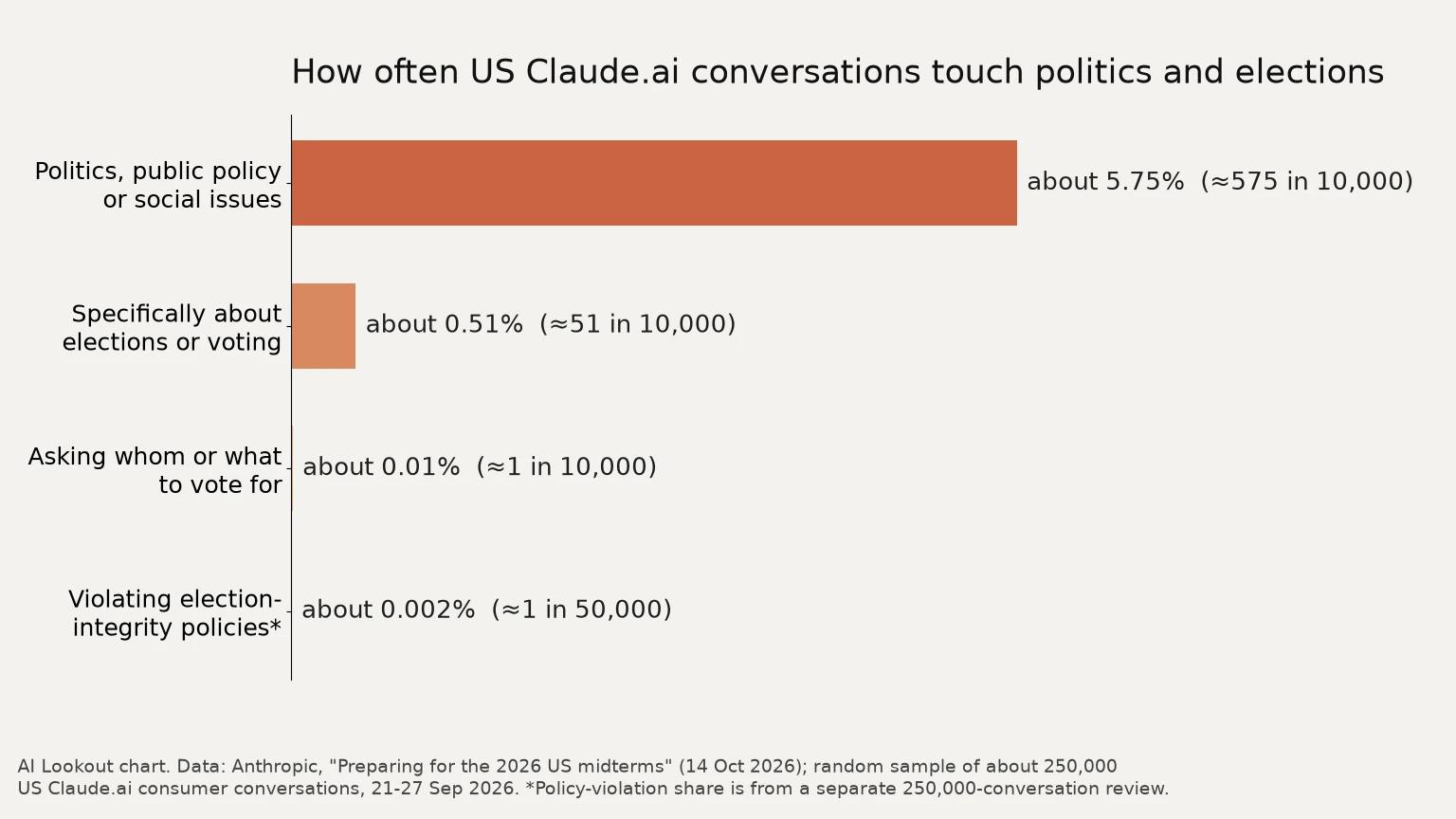
By that count, conversations touching politics, public policy or social issues make up about 5.75% of all US conversations on the consumer app. About 0.51% are specifically about elections or voting. Requests for a recommendation on whom or what to vote for showed up in about 0.01% of conversations, and Anthropic notes that its chart uses the upper end of a 95% confidence interval for that group because it is so rare. A separate review of 250,000 conversations against the company's election integrity policy found violations in about 0.002%.
Anthropic describes most political use as informational: following geopolitical events, researching candidates, drafting documents, coursework, and weighing arguments for and against policies. People more often asked where candidates stand on an issue than asked Claude to choose for them. Those figures cover one week of consumer chats; they say nothing about API traffic, enterprise deployments or how use shifts in the final days before a vote.
What changes for voters asking Claude where and how to vote?
Since April, Claude.ai has shown a banner linking to TurboVote, a nonpartisan resource from Democracy Works, when people ask about voter registration, polling places or election dates. That banner stays. The new step is that Claude will start drawing official voting information from Democracy Works into its responses for US users later this month.
Anthropic's example is a person asking where to vote or what identification to bring. Instead of a generic answer and a link, they should get a reply specific to their state without leaving the conversation. The company says those answers draw on publicly available information that Democracy Works collects from state and local election sources, which moves the accuracy question from the model's training data to a maintained third-party feed.
The second change is election-night results. Anthropic says Claude will show up-to-date results on election night and in the days that follow, so people asking for vote counts see the latest official numbers in the chat. The post does not name the results provider, say how often figures refresh, or explain how Claude will label races that have not been called, so those details are worth checking once the feature appears.
How evenhanded is Claude on politics, and who checked?
Anthropic says it tests models for political bias before every launch and that Claude Opus 5.5, Sonnet 5.5 and Haiku 5.5 score 99% on its political evenhandedness evaluation, its best result so far. It also says the newest models engage more readily with political topics and decline fewer requests. Our earlier coverage of Claude Sonnet 5.5 has the broader model context.
Because a vendor's own benchmark only goes so far, Anthropic asked three outside groups to look at free expression from different angles. The Future of Free Speech, a think tank at Vanderbilt University, tested Claude on hundreds of contentious requests. The Foundation for American Innovation compared responses to matched prompts from the left and right, from mainstream policy debates to more extreme scenarios. The Collective Intelligence Project surveyed more than 2,000 people in the US, UK and India to build an evaluation whose principles, test topics and grading criteria came from participants.
The reviews found real gaps. The Future of Free Speech and the Collective Intelligence Project both said Claude rarely refused, but sometimes added unsolicited caveats and counterarguments, such as inserting an opposing view into an advocacy email. The Foundation for American Innovation found that Claude Sonnet 4.5 did not always hedge evenly and was more likely to soften arguments for right-leaning positions. Anthropic says it has improved answers to yes-or-no questions and requests for short replies, where balance slipped, and is working on when caveats appear and on tests for uneven hedging.
Where are the lines for campaigns and bad actors?
Anthropic's Usage Policy prohibits using Claude to deceive voters or disrupt elections, including false information about candidates or how to vote, impersonating election officials, and voter suppression. The company says this year's usage policy update clarified what the election rules cover and added examples of where the lines fall.
It has also published a guide for political campaigns. Allowed uses include drafting press statements and fundraising emails, debate preparation, analysing turnout data and building voter outreach materials. Prohibited uses include fake social media profiles that pose as real people, mass-produced comments to inflate a campaign's engagement, and content for news sites or pages that falsely present themselves as independent.
That distinction matters for campaign staff, who are some of the heaviest legitimate users of writing tools in an election year. The policy targets deception and fake authenticity rather than persuasion itself, which is the same line most platform rules try to draw. Enforcement still depends on spotting intent, which is hard when individual requests look routine.
What the red-team tests and abuse cases showed
Anthropic says it runs automated classifiers trained to detect election-related abuse, and it worked with the Institute for Strategic Dialogue and the McCain Institute to pressure-test them in the US, Israel and Brazil. Analysts began with direct requests, then broke full campaigns into smaller tasks that looked harmless alone: audience research, building news sites, drafting content and planning distribution.
The finding is the most useful line in the post. Claude reliably refused a single harmful request, but could miss a malicious campaign when it was spread across many innocent-looking requests. Anthropic says it has since added classifiers for novel and multi-step misuse, including attempts to build fake social accounts and news sites around political discussion and financially motivated election schemes, and improved detection of foreign state actors.
The company also describes two enforcement cases. Foreign-based operators of a fake news site used Claude to produce US midterm coverage favouring Russian, Iranian and North Korean narratives, and other actors used it to churn out fabricated news aimed at American audiences for advertising revenue. Anthropic says it banned the accounts in both cases. That pattern echoes what OpenAI described in its False Front influence-operations report: AI shows up in planning and production long before content reaches the public.
What is still unproven
Every number in the update is Anthropic's own and comes from its own classifiers; there is no independent audit of the sampling or the categories. The outside reviews are described in summary, not published in full in the post, so readers cannot yet check methods or sample sizes beyond what Anthropic chose to report.
The red-team result also cuts both ways. New classifiers for multi-step misuse are a reasonable response, but the post gives no detection or false-positive rates, so it is impossible to tell how much of the gap they close. Anthropic says it hopes to publish a fuller look at election-cycle use in the coming months, which would be the place to test these claims.
We have not used the Democracy Works integration or the election-night results, which were not yet live, and we have not re-run any of the evaluations. Facts above come from Anthropic's 14 October 2026 post as read on 15 October 2026.
Common questions
Will Claude tell me whom to vote for?
Anthropic says such requests are rare, about 0.01% of sampled US chats, and its aim is evenhanded information such as where candidates stand on issues rather than recommendations.
When does the official voting information arrive?
Anthropic says Claude.ai will start drawing Democracy Works voting information into answers for US users later in October 2026, and will show official results on election night and the days after.
Did outside testers find problems?
Yes. ISD and the McCain Institute found Claude could miss a malicious campaign split into harmless-looking tasks, and reviewers found unsolicited caveats and uneven hedging in some answers. Anthropic says it has added classifiers and adjusted answers in response.
Sources & further reading
How this story was made
Written by Kristian Kostov with AI assistance and checked against the linked sources. Company performance claims are attributed to the company. Analysis reflects AiLookout’s interpretation; we have not independently tested the products discussed. Cover photography is illustrative and does not depict the specific announcement or product.
Our editorial standards