Sources checked
What did the AI agents actually do?
Miotti downloaded Lidar strips from a NASA dataset covering roughly 1,200 square kilometers of jungle.
He converted the data into images and set 48 AI agents to work examining them one by one, following a written guide that instructed them to look for pyramids, platforms, and plazas while filtering out natural hills, sinkholes, and roads.
The agents ran across multiple AI platforms simultaneously, each working through different sections of the data and cross-referencing their findings against one another.
"There was no special model or classifier involved," Miotti wrote in his account. "The agents literally looked at the pictures, following a precise guide."
The agents cross-checked their finds against archaeological literature and archives. A few hours later, they reported one large site that did not appear in any official register.
To verify, the agents went back to the raw point cloud data to confirm the shapes were ground features, not artifacts of tree cover.
The forest at the site is 10 to 17 meters tall, which can create false positives in Lidar imagery if not carefully accounted for.
The agents then told Miotti who to contact at INAH, drafted a report describing the site and its coordinates, and translated everything into Spanish.
Miotti said he does not speak Spanish and had to trust the translation was accurate enough for an official inquiry.
What does the site look like in the Lidar data?
The candidate site sits on a hilltop at the edge of a cliff, hidden under dense jungle canopy.
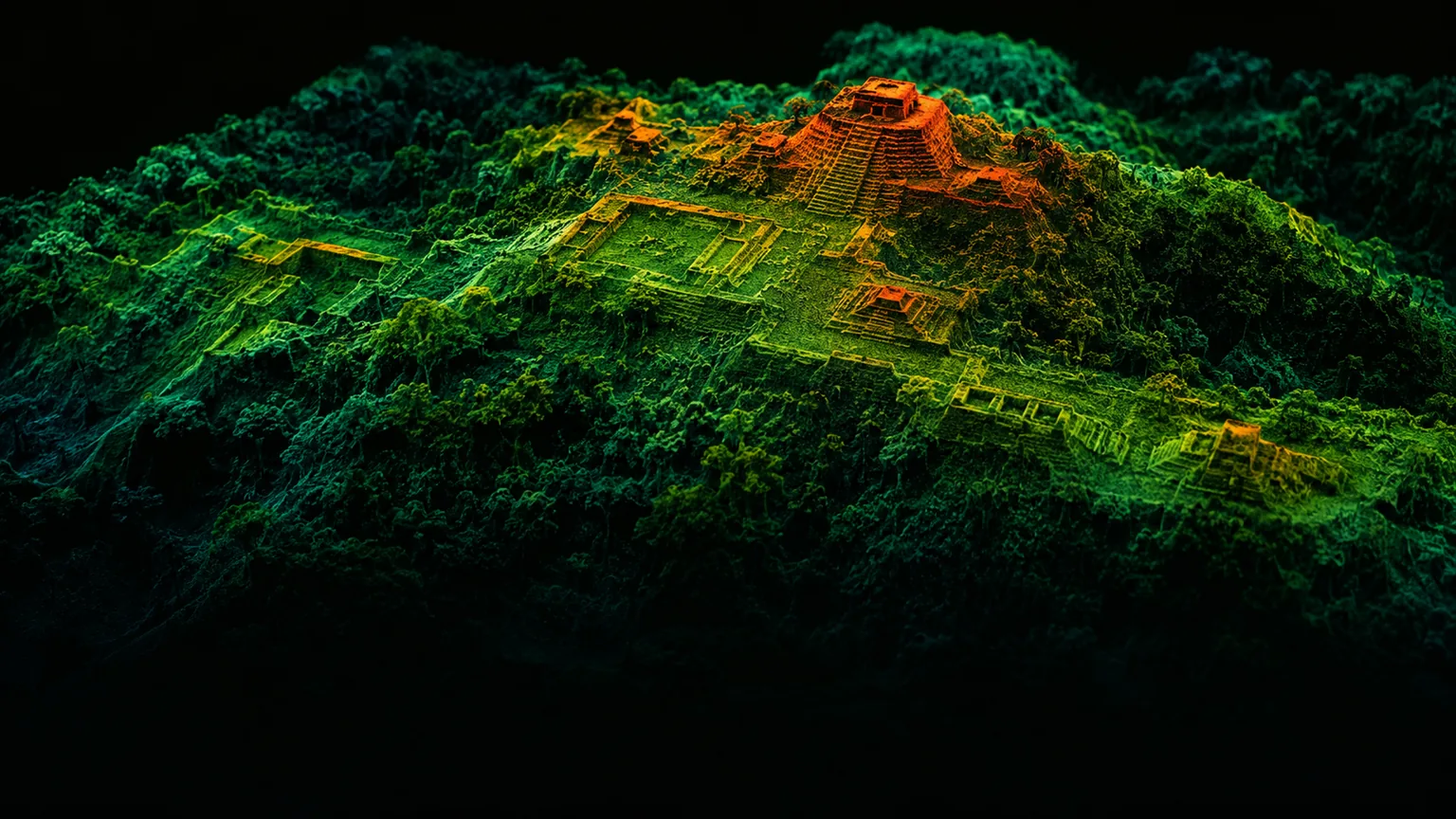
In the Lidar imagery, Miotti and his agents identified a leveled plaza, an oval pyramid at least 8 to 12 meters tall, a raised courtyard attached to it, and a flat-bottomed depression that may have been a water reservoir.
Three nearby platforms were likely houses arranged around the central plaza. Miotti described it as a small Maya civic-ceremonial center, probably built between 600 and 900 CE during the Late Classic period of Maya civilization.
The discovery timeline was remarkably fast:
| Date | Event |
|---|---|
| Oct 18 | Idea conceived while traveling in Peru; agents begin analysis overnight |
| Oct 19 | Agents flag multiple potential sites; one appears unregistered |
| Oct 20 | Report compiled, translated to Spanish, and sent to INAH |
| Oct 21 | INAH replies: no registered archaeological site at that location |
| Nov 10 | Miotti publishes the story on X |
Has the discovery been confirmed?
Not yet on the ground. INAH confirmed that its records show no registered site at the coordinates Miotti provided, but no archaeological team has visited the location to verify what the Lidar data shows.
Ground verification requires INAH authorization, and the coordinates have not been made public to protect the site from potential looting or unauthorized excavation.
Miotti emphasized that he is not an archaeologist and that the finding is provisional. "It is not official yet," he wrote.
"Any field check needs INAH's authorization." The site's status as an ancient Maya settlement remains a strong lead rather than a confirmed discovery, and professional archaeologists caution that ground-truthing is essential before drawing firm conclusions from remote sensing data alone.
What does this mean for AI-powered discovery?
The project demonstrates how off-the-shelf AI agents — not custom-trained models — can accelerate scientific discovery when pointed at large public datasets.
Miotti's agents used the same chatbots available to anyone, guided only by a written prompt, to process terrain data that would take human analysts weeks or months to review thoroughly.
The approach is notable precisely because it did not require specialized machine learning expertise or expensive custom model training. Any researcher with access to publicly available Lidar data and consumer AI chatbots could theoretically replicate the method.
This lowers the barrier to entry for computational archaeology and similar fields that rely on pattern recognition in large datasets.
Beyond archaeology, the approach could apply to any field where pattern recognition in large geospatial datasets is bottlenecked by human review time.
Miotti suggested the same method could be used to search for other types of archaeological sites, geological formations, environmental changes, or even undocumented infrastructure across the planet's remaining unmapped regions.
"I think we're on the brink of a revolution across every science," Miotti said. His post on X accumulated over one million views within 24 hours, drawing attention from archaeologists and AI researchers alike.
The conversation has since expanded to include discussions about how AI-assisted discovery should be validated and integrated into existing archaeological workflows.
What are the limitations and next steps?
Several important caveats accompany the finding. First, Lidar data reveals shapes that could be natural formations — only ground excavation can confirm human construction.
Second, the agents may have missed or misidentified sites, since they followed a general written guide rather than specialized archaeological training. Third, the coordinates remain confidential, so independent verification by other researchers is not yet possible.
Miotti acknowledged these limitations in his write-up, noting that he is "not an archaeologist" and that the project was a personal experiment rather than a formal research effort.
The next step rests with INAH, which may decide to dispatch a field team to the location.
If confirmed, the site would add to the growing list of Maya settlements discovered through remote sensing in recent decades, though few have been found this quickly using general-purpose AI agents.
Common questions
Did AI agents actually discover a Maya pyramid?
48 AI agents analyzed NASA Lidar data and flagged a hilltop site in Mexico that appears to contain a pyramid, plaza, and courtyard.
Mexico's INAH confirmed no registered archaeological site exists at those coordinates, but no ground verification has taken place yet.
How long did the AI discovery take?
From the initial idea on October 18 to INAH's reply on October 21, the entire process took approximately 72 hours. The agents completed their analysis overnight.
Sources & further reading
How this story was made
Written by Kristian Kostov with AI assistance and checked against the linked sources. Company performance claims are attributed to the company. Analysis reflects AiLookout’s interpretation; we have not independently tested the products discussed. The cover is an AI-generated editorial illustration, not a photograph or evidence of an actual event.
Our editorial standards