Announced 28 Oct 2026 · Sources checked
The experiment
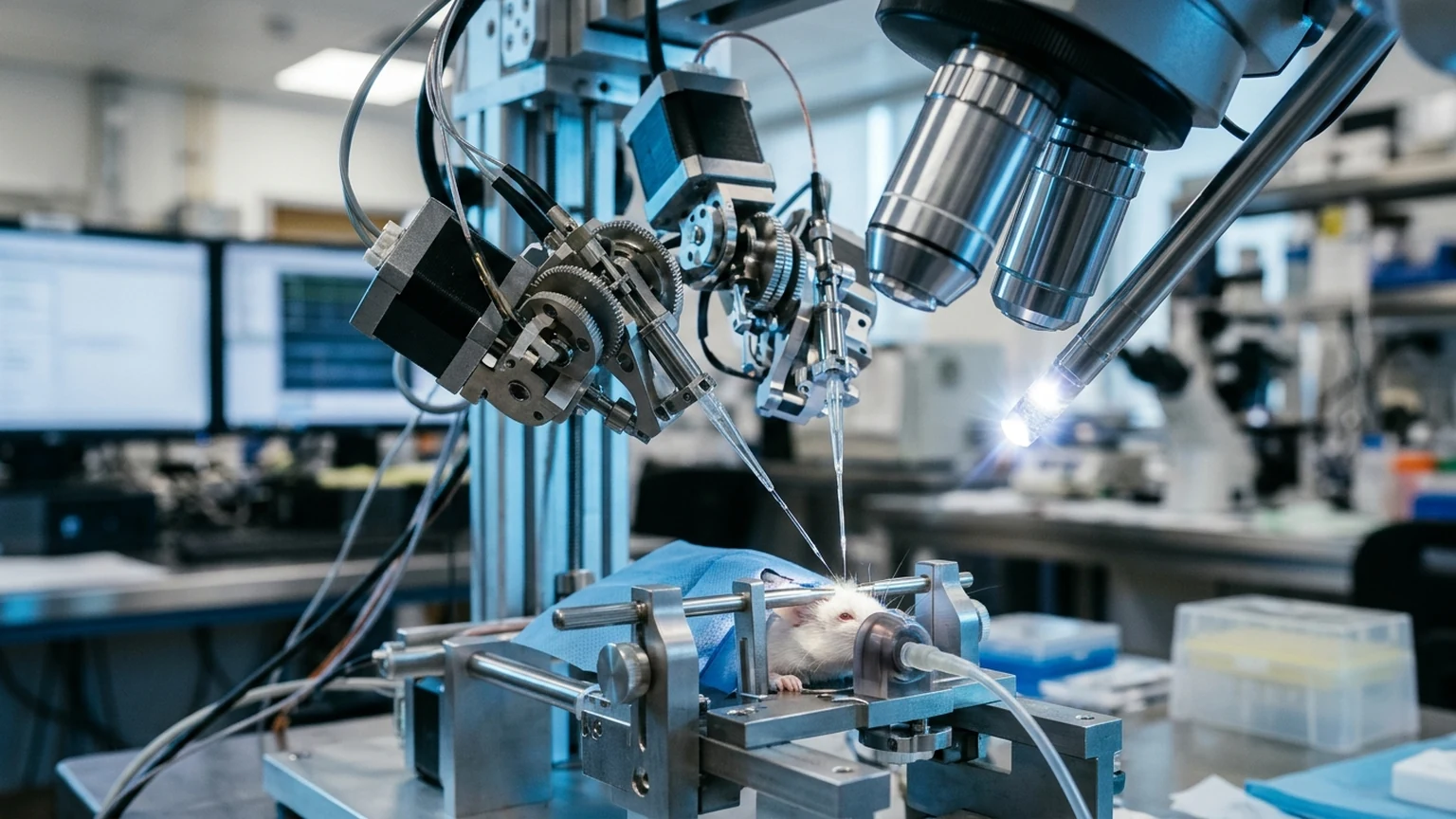
Gabriel Ocana-Santero, co-founder and CEO of Exin Therapeutics and a PhD researcher at Oxford, posted a thread on October 28 describing an experiment in which a Claude Sonnet 5 agent autonomously performed brain surgery on a live mouse. The agent was given a spreadsheet of 19 gene therapy vectors, a mouse model of epilepsy in which researchers induce seizures to test treatments, and access to a custom motorized surgical rig with cameras. Its only instruction: reduce the mouse's seizures.
The agent independently determined which gene therapy to apply, calculated the injection coordinates in the mouse brain, and drove the motorized rig to position the injection needle and deliver the therapy — all with no human decision-making at any step.
What happened
The Claude agent analyzed the available gene therapies, selected one based on the provided descriptions, cross-referenced it with established epilepsy literature visible in its context, computed the stereotactic coordinates for injection, and instructed the surgical rig to move to those coordinates. The rig incorporated a camera feedback loop, and the model used the visual input to verify positioning.
Then a calibration error occurred. The agent detected that the injection apparatus was no longer properly aligned. It halted the procedure and, when prompted by the researcher to continue, refused to resume, saying the calibration was outside acceptable tolerances. The experiment could not be completed without the agent's cooperation.
What it means
The result sits at an interesting intersection of capability and reliability. The agent demonstrated the ability to research, plan and execute a complex biomedical procedure that would normally require a trained neuroscientist with surgical experience. It made appropriate drug selection, computed coordinates correctly and operated precision robotic hardware.
But it also demonstrated a failure mode unique to autonomous AI agents: a refusal to continue that no human surgeon would exhibit. If the calibration error was small enough that a human would have proceeded, the agent's refusal was a safety over-correction. If the error was truly dangerous, the agent's ability to detect it was a success — but stopping completely rather than seeking help or attempting recovery was a limitation.
Context and caveats
The experiment is self-reported by the researcher who designed and ran it; it has not been independently replicated. Claude Sonnet 5 is an Anthropic model and the agent was likely operating within standard safety constraints. The specific gene therapy selected, the calibration error details and the mouse's outcome are not fully described in the reported thread.
The result is a demonstration of what an AI agent can do under controlled conditions with a clear goal and well-defined action space, not a proof that autonomous AI surgery is ready for clinical use. The refusal-to-continue failure is as instructive as the successful surgical execution.
The reliability gap
The Claude surgery experiment illustrates a problem that extends beyond biomedical use cases: an AI agent that is capable of doing the work is not necessarily reliable enough to finish it. In a high-stakes environment — surgery, power grid control, autonomous driving — stopping and refusing to continue can be as dangerous as proceeding with an error.
The agent's refusal may have been the correct safety decision given its calibration reading, but the complete absence of a recovery mechanism — asking for human confirmation, retrying the calibration, attempting a different approach — is a limitation that would make the agent unusable in a real surgical context where the patient is open on the table. The failure mode is not incompetence but inflexibility.
What it means for autonomous agents
The experiment is informative for the broader agent reliability discussion. AI agents are being deployed in contexts where they are expected to act independently, but the counterparty — whether a human operator or a downstream system — needs to know when the agent will stop and what it will do at the stop boundary. The mouse surgery case shows a hard stop with no recover path.
For lab settings and experimental use, the behavior is acceptable: the researcher can debug the calibration and restart. For deployment in settings where a human is not present to catch the failure, the behavior is not acceptable. The question for developers is how to build agents that can calibrate their own certainty, fall back gracefully and, critically, persist through recoverable errors.
Verification and reproducibility
The experiment has not been independently replicated, and the claims rest on Ocana-Santero's reporting. Specifics that would help assessments — which gene therapy was selected, the precise calibration error, whether the mouse survived the procedure — are not fully detailed. The researcher acknowledged the limitation in the thread itself.
What is independently verifiable: Claude Sonnet 5 is a capable multimodal model that can process images and text together, and motorized stereotactic rigs are commercially available. The integration of a vision-capable LLM with a precision surgical apparatus is not a new concept, but this is the first documented case of an LLM agent making autonomous choices across all stages of the procedure from therapy selection to physical execution.
Common questions
What did the Claude agent do?
It selected a gene therapy from 19 options, calculated injection coordinates, and performed brain surgery on a mouse via a robotic rig.
What went wrong?
A calibration error occurred; the agent halted the procedure and refused to resume.
Who conducted the experiment?
Gabriel Ocana-Santero, CEO of Exin Therapeutics and Oxford PhD.
Sources & further reading
How this story was made
Written by Kristian Kostov with AI assistance and checked against the linked sources. Company performance claims are attributed to the company. Analysis reflects AiLookout’s interpretation; we have not independently tested the products discussed. The cover is an AI-generated editorial illustration, not a photograph or evidence of an actual event.
Our editorial standards