Announced 30 Oct 2026 · Sources checked
The integration
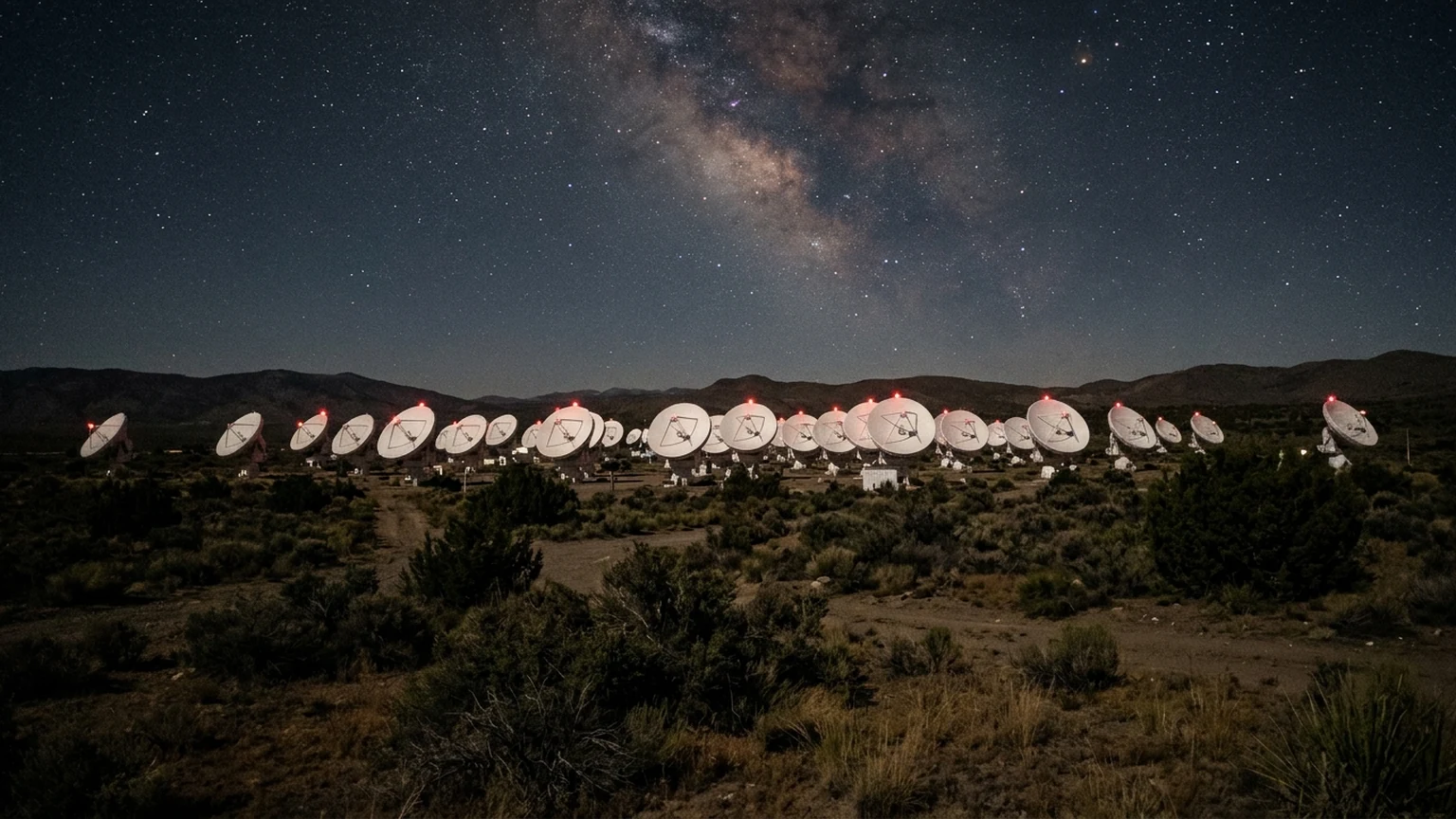
Breakthrough Listen — the $100 million initiative funded by Yuri Milner to search for extraterrestrial intelligence — and the SETI Institute have integrated agentic AI into the daily operations of the Allen Telescope Array in Northern California. The array, consisting of 42 radio dishes at the Hat Creek Radio Observatory, is now partly steered by AI agents running on NVIDIA's Holoscan platform.
The agents can steer the antennas, calibrate instruments, correct errors in incoming data, and apply AI models to the data stream — all triggered by a single plain-language request from a researcher. Instead of writing observation scripts or manually scheduling targets, astronomers can tell the system to 'look for narrow-band signals in the direction of Trappist-1' and the agents handle the rest.
How it works
The system is built on agentic AI principles similar to those used in coding assistants and security tools: a planner agent accepts a human goal, breaks it into subtasks, delegates to specialized worker agents (observation scheduler, instrument calibrator, signal classifier) and monitors results. The agents have real-time access to telescope telemetry, incoming signal data, and a catalog of known signals and interference patterns.
One of the more interesting capabilities is adaptive targeting: if an agent detects a transient signal of interest in one sector of the sky while observing another, it can decide to redirect the telescope immediately — something that was previously impossible with pre-programmed observation schedules. The system also automatically classifies known interference (satellites, aircraft, terrestrial transmitters) and filters it from the data, reducing false positives.
Why AI now
The Allen Telescope Array collects enormous volumes of radio data — far more than human analysts can review in real time. AI-based signal classification has been used in SETI for years, but what is new is the agentic layer: rather than running fixed detection algorithms, the system can decide what to look at, when and how.
The shift from pre-programmed to adaptive searching is significant because the most interesting signals are unlikely to arrive on a predictable schedule. A burst signal that lasts seconds could be missed by traditional observation planning. Agentic control allows the array to operate as a dynamic sensor network rather than a static instrument running a script.
The alien AI angle
The project explicitly includes the search for 'technosignatures' that could indicate the presence of extraterrestrial technology — not just communications signals from a biological intelligence but possibly signals from alien AI systems. The reasoning is that if technological civilizations develop AI, and that AI eventually becomes capable of communication independent of its creators, the signals would look different from what SETI has traditionally looked for.
This is speculative but grounded: as humanity's own AI models become more capable and more widely deployed, the SETI search space expands correspondingly. An alien AI that runs on a radio-dish-powered computing infrastructure would produce signal artifacts that might not fit conventional SETI templates.
Caveats
The integration is described by SETI/Breakthrough Listen and NVIDIA; independent verification of the system's performance is not yet published. The array remains operational and the agentic system augments rather than replaces human operators. No candidate signals of extraterrestrial origin have been reported from the new system as of publication.
AI Lookout covered the NVIDIA blog post and related science reporting; it did not visit the Allen Array or interview the research team.
The technology stack
NVIDIA's Holoscan platform is the infrastructure layer. Holoscan is designed for real-time sensor processing, combining AI workflows with data pipelines for high-throughput instruments — exactly the kind of system a radio telescope array needs. The agentic framework running on top of Holoscan uses the same components found in other agent deployments: a planner that interprets the researcher's natural language request, a set of tool-calling worker agents that interact with telescope APIs and signal databases, and a memory system that retains observation history across sessions.
The signal detection models are a mix of conventional SETI algorithms and newer deep-learning classifiers trained on simulated and known signals. The agents can also access a growing library of interference signatures — satellite telemetry, aircraft transponders, terrestrial radar — and use them to filter false positives before a candidate signal ever reaches a human reviewer. This reduces the noisy-data problem that has historically limited SETI signal searches.
Why this matters for the field
The SETI application is a specialized use case, but it demonstrates a general capability that agentic AI now has: operating complex scientific instruments in real time, with goal-based autonomy rather than fixed scripting. If an AI agent can steer radio telescopes in the search for extraterrestrial intelligence, it can also steer optical telescopes, atmospheric sensors, particle detectors and clinical imaging systems.
For the broader AI field, the SETI proof point is that agentic architectures are crossing from software-only domains (coding assistants, security tools) into the physical world — controlling hardware that costs millions of dollars and handles unique scientific data. The reliability requirements for that class of application are higher than for code generation, and the fact that SETI trusts agents to move dishes and allocate observation time is a significant signal.
Common questions
What is the SETI agentic AI system?
AI agents running on NVIDIA Holoscan that steer the Allen Telescope Array, calibrate instruments, and run detection models from natural language prompts.
What can the agents do?
Steer antennas, schedule observations, adapt targets in real time, filter interference, and classify signals.
Does this include searching for alien AI?
Yes — the search covers technosignatures that could include signals from extraterrestrial AI, not just biological-origin signals.
Sources & further reading
How this story was made
Written by Kristian Kostov with AI assistance and checked against the linked sources. Company performance claims are attributed to the company. Analysis reflects AiLookout’s interpretation; we have not independently tested the products discussed. The cover is an AI-generated editorial illustration, not a photograph or evidence of an actual event.
Our editorial standards