Announced 14 Oct 2026 · Sources checked
What happened on Filbert Street
A 78-year-old retired University of Pennsylvania professor was arrested in Center City Philadelphia on Wednesday, 14 October, after she stood in front of an Uber Eats delivery robot and refused police orders to move. Philadelphia police told PhillyVoice that officers responded to a report of “criminal mischief involving a robot” on the 1200 block of Filbert Street at about 1:16 p.m., a short walk from Reading Terminal Market. A woman at the scene ignored “multiple commands” to step aside, police said, and was issued a criminal violation notice for disorderly conduct.
The woman is Carolyn Marvin, a professor emerita at Penn. She told 6abc Action News that she was protesting against the robots because she believes they are replacing human delivery workers. “I know they're taking the jobs of human delivery workers and so, I have been protesting them whenever I saw them by standing in front of them and preventing them from going forward,” she said. The confrontation was filmed and spread online, and by the weekend it had been picked up by national outlets including The Verge.
The incident itself was small: one person, one robot, a sidewalk and a summary notice. It drew attention because it put a familiar argument about automation and jobs into a scene anyone could picture, and because it is the first time, by Marvin's account, that police were called during one of her protests.
Who Carolyn Marvin is and why she protests
Marvin told PhillyVoice she had been leaving a flu shot appointment when she saw the robot and did what she has done for months whenever she has the time: stood in its path. She said she is not sure how many times she has blocked the robots since they arrived in March. She described her aim as protesting “corporations that displace human delivery workers in order to enrich their own bottom line.” Earlier encounters had already circulated on social media, including one on Broad Street in September that 6abc said also drew attention.
According to PhillyVoice, officers approached after she had been there “quite a long time” and asked her to let the robot finish its delivery. She refused repeatedly and was arrested. Marvin plans to contest the charge on First Amendment grounds and says she will keep protesting. “I do. Why not?” she told 6abc. “I think it's my First Amendment right to publicly demonstrate on a sidewalk to protest against delivery robots.”
She also said she is careful never to block the sidewalk for human pedestrians, and that the protests are a way to start conversations with passers-by, whose reactions she called “divided”. Before retiring she taught a course on freedom of expression at Penn, but she told PhillyVoice she sees the protests as civic engagement rather than an extension of her academic work. “I would say it's my citizenship,” she said. A West Philadelphia resident who saw an earlier encounter told 6abc she first thought the robot had hit Marvin, and that Marvin said she had to stop the robots because “they're taking over the world.”
The robots: Avride and Uber Eats in Philadelphia
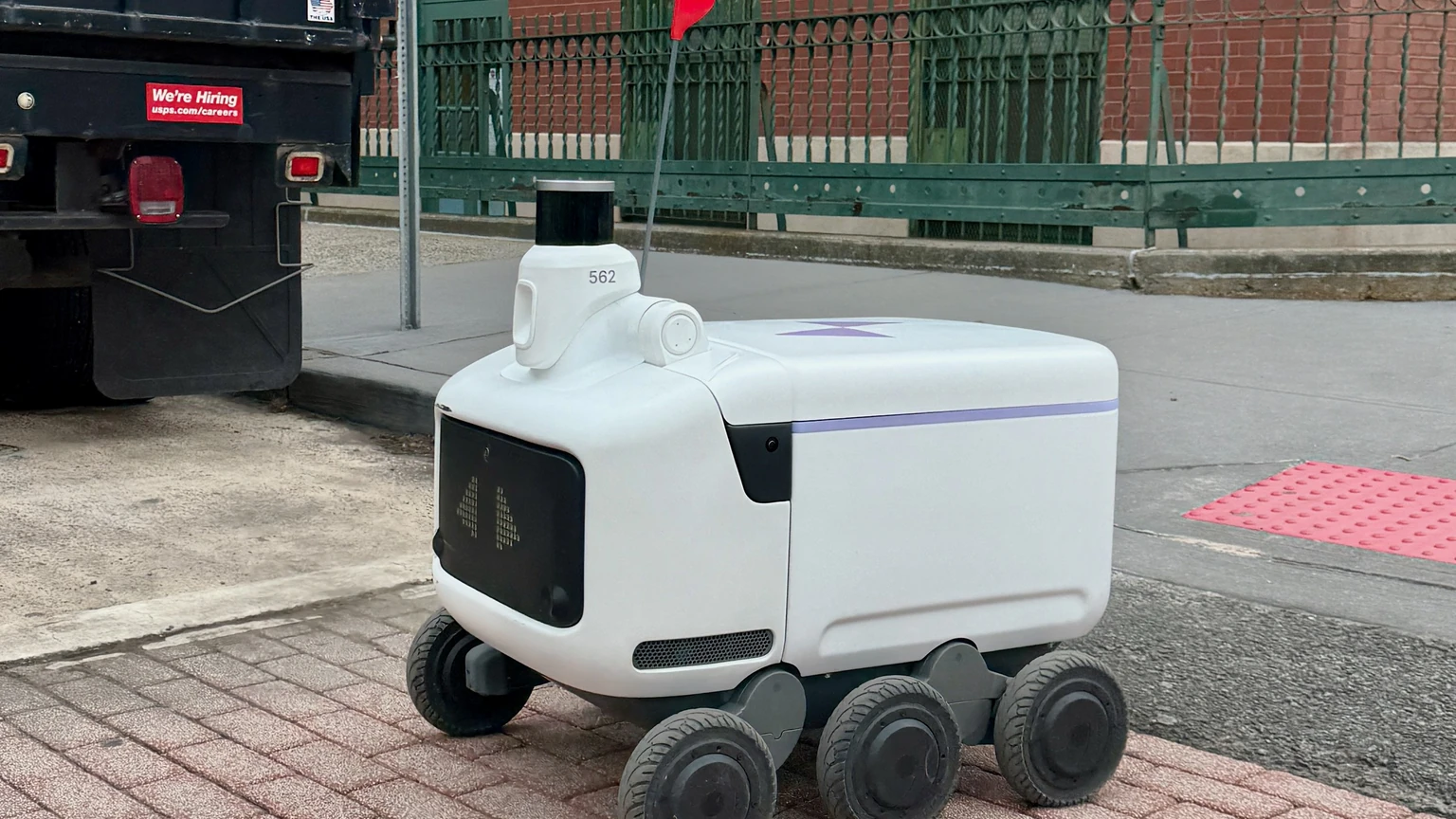
The robots belong to Avride, an autonomous-vehicle and delivery-robot company that works with Uber. In a 10 March 2026 post, Avride said Uber Eats customers in Philadelphia could now choose robot delivery, making the city the fourth for its robots after Austin, Dallas and Jersey City under a multiyear partnership with Uber. Avride said the robots work within a one- to two-mile radius, stay charged for up to 12 hours, travel at up to five miles per hour and keep running in rain, snow and sub-freezing temperatures.
Customers who order from participating restaurants can opt in, track the robot in the Uber Eats app and tap “unlock” to open its hatch when it arrives; it waits up to ten minutes. No tip is required. Service launched daily from 10 a.m. to 10 p.m. across Center City. CBS Philadelphia reported that the robots use cameras and sensors to spot traffic signals and obstacles, that Avride says the cameras blur faces and licence plates, and that a remote human support team can take control if needed. FOX 29 reported that about a dozen restaurants took part at launch and that the zone also covered Chinatown and Old City.
Uber and Avride have not published how many robots run in Philadelphia, how many deliveries they make or how the fleet has grown since March. That makes it hard to judge, from public information, how large a share of local food deliveries the robots now handle.
Seven months of friction on the sidewalk
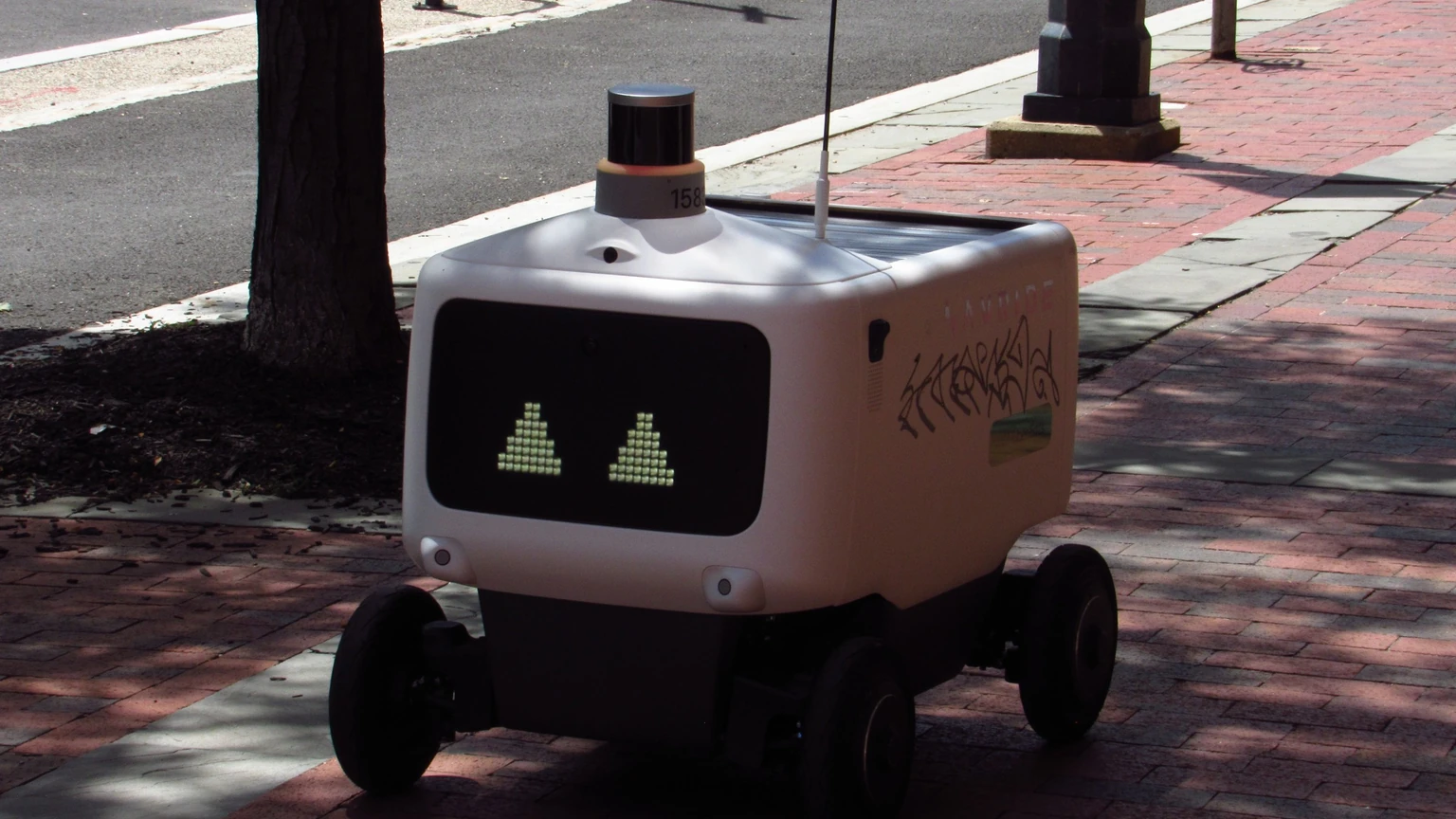
Marvin's protest is the latest in a run of confrontations. Within weeks of launch a passer-by sat on one robot at 15th and Locust Streets, and another was kicked over at Juniper and Locust Streets around midnight in late March, an incident caught on a karaoke trolley's security camera and reported by 6abc and The Philadelphia Inquirer. The Inquirer noted that someone had scrawled “DESTROY ME PLZ” on a robot and compared the episodes to hitchBOT, the hitchhiking robot that was destroyed in Philadelphia in 2015.
Avride's response at the time was that curiosity is expected when robots arrive somewhere new. “Some may try to ‘test’ how the robot reacts - for example, by stepping in front of it or attempting to interact with it directly,” the company told 6abc. It said the robots are designed to respond conservatively, usually stopping and waiting until the person moves on, and that such moments tend to last about a minute. Marvin's protests, which she says last much longer, are a test of that design: a robot built to wait politely has no way to resolve a standoff with someone who does not intend to leave.
Researchers at Temple University told Billy Penn in April that attacks on robots are not unique to Philadelphia. Lindsay Ouellette, whose doctoral dissertation studied abuse of autonomous mobile robots, found in experiments that people harmed robots more for instrumental reasons, such as a reward, than because a robot malfunctioned or seemed to deserve it, and that giving robots humanlike features did not protect them. Her former adviser Donald Hantula suggested companies let the robots be “rectangles on wheels.” Marvin's case is different in kind: she is not damaging the robots but making an open, stated political protest.
What the charge and the rules say
Police charged Marvin with disorderly conduct. As Hoodline summarised, Pennsylvania's statute covers certain conduct in a public place done with intent to cause public inconvenience, annoyance or alarm, or that recklessly risks it. It is normally a summary offence, the lowest level, but can rise to a third-degree misdemeanor when someone persists after a reasonable warning to stop. Police said she was issued a criminal violation notice; they have not said publicly whether the charge was graded higher.
Her defence will rest on the First Amendment, which protects peaceful protest on public sidewalks but generally allows police to enforce neutral rules on blocking traffic or obeying lawful orders. How a court weighs a person standing in front of a machine, rather than a person, may be a new wrinkle; AI Lookout found no published ruling on it, and no hearing date has been reported.
The robots themselves operate under Pennsylvania rules for personal delivery devices. Hoodline, citing the Pennsylvania Department of Transportation, reported limits of 12 miles per hour in pedestrian areas and 25 miles per hour on roads or shoulders; Avride says its robots move at up to five. Philadelphia police told the Inquirer in April that people who damage the robots could face criminal mischief charges or code violations depending on the damage.
The jobs argument behind the protest
Marvin's argument is about work. Delivery couriers on apps such as Uber Eats are paid per job, and the robots take some of those short Center City runs; customers also skip the tip. FOX 29 found residents worried about jobs from the first week, quoting one who said robots were “taking away a lot of jobs.” The same worry is playing out with robotaxis, which Waymo is now taking to Toronto after years in US cities, and with AI agents in offices, where Anthropic's own study of its workforce reported falling junior technical hiring alongside a jump in agent work.
There is little public data yet on how many Philadelphia delivery jobs, if any, the robots have displaced. They cover a small area at walking speed, and customers can still choose a human courier. But the protest lands at a time when governments are deliberately widening the space for robots in public life, such as South Korea's sandbox for 20 humanoid robots in factories and logistics, and when the question of who benefits from that shift is increasingly political.
For companies deploying sidewalk robots, the Philadelphia case points to a practical problem as much as a public relations one. A robot that stops whenever someone stands in front of it is safe, but it gives any determined person a way to halt service, and the only fix is a person: in this case, police.
What is still unknown
Uber did not immediately respond to PhillyVoice's request for comment, and neither Uber nor Avride had published a statement on the arrest when AI Lookout checked on 18 October. It is not known whether Uber or Avride staff called police, how long the robot was held up, or whether the customer's order arrived.
Marvin says she will contest the charge and keep protesting. The next things to watch are the outcome of the disorderly conduct case, any change in how Avride's robots or remote operators handle a person who will not move, and whether Uber publishes figures on its Philadelphia robot fleet and the deliveries it handles.
Common questions
Why was the woman arrested for blocking a delivery robot?
Police say Carolyn Marvin ignored multiple commands to move out of an Uber Eats robot's path on Filbert Street on 14 October, so she was cited for disorderly conduct. She says she was protesting robots taking couriers' jobs.
Who makes the Uber Eats robots in Philadelphia?
Avride, which launched robot deliveries with Uber Eats in Center City in March 2026. The robots travel up to five miles per hour within a one- to two-mile radius and require no tip.
Is blocking a delivery robot illegal in Pennsylvania?
Standing in front of one is not a specific offence, but refusing a lawful police order in public can lead to a disorderly conduct charge. Damaging a robot can be charged as criminal mischief.
Sources & further reading
- Retired Penn professor arrested for blocking Uber Eats robot ↗
- Woman arrested after blocking delivery robot in Center City Philadelphia confrontation ↗
- A woman was arrested in Philly for blocking a delivery robot ↗
- Philadelphia woman charged after blocking Uber delivery robot ↗
- Avride launches first autonomous robot deliveries with Uber in Philadelphia ↗
- Uber Eats launches robot delivery service in Philadelphia's Center City district ↗
- Uber Eats launches robot food delivery service in Center City: What we know ↗
- Uber Eats delivery robot gets kicked in Center City Philadelphia ↗
- Philadelphians are messing with Uber Eats delivery robots. It's hitchBOT all over again. ↗
- Why are Philadelphians attacking Uber Eats delivery robots ↗
How this story was made
Written by Kristian Kostov with AI assistance and checked against the linked sources. Company performance claims are attributed to the company. Analysis reflects AiLookout’s interpretation; we have not independently tested the products discussed. Cover photography is illustrative and does not depict the specific announcement or product.
Our editorial standards