Announced 16 Oct 2026 · Sources checked
What Anthropic published
Anthropic published a report on 16 October 2026 that turns its own workforce into a case study of what heavy AI adoption does to jobs. How employment is changing at Anthropic, written by economists Nathan Wilmers, Regina Catipon, Maxim Massenkoff and Peter McCrory for the Anthropic Institute, draws on internal data on headcount, hiring records, agent telemetry, output metrics, calendars, employee surveys and 17 interviews.
Its main findings are blunt. Anthropic has been hiring a smaller share of junior technical staff. By August 2026, interactive AI agent hours directed by employees outnumbered human hours by six to one. Output per person has risen across engineering, sales, legal and finance, and human attention, rather than model capability, has become the limiting factor. The authors present Anthropic as a possible leading indicator for the wider economy, while warning that much of its situation cannot be copied.
A companion note, Working at the frontier shapes expectations for the future, compares staff with the public. It reports that 91% of Anthropic staff, against 39% of US adults in an August Morning Consult survey of almost 11,000 people, expect AI to make a Nobel-level discovery by 2030.
Fewer junior technical roles
The report says discussion of weaker demand for junior technical employees began inside Anthropic's core technical teams in January 2026, as Claude took over more code writing and bug finding. One person told the researchers that a jump in uplift for performance engineers basically changed overnight what the company was looking for. By April, engineering and research had de-emphasised lower-band hiring, and around a third of machine learning managers and a fifth of software engineering managers said they were hiring less because of AI.
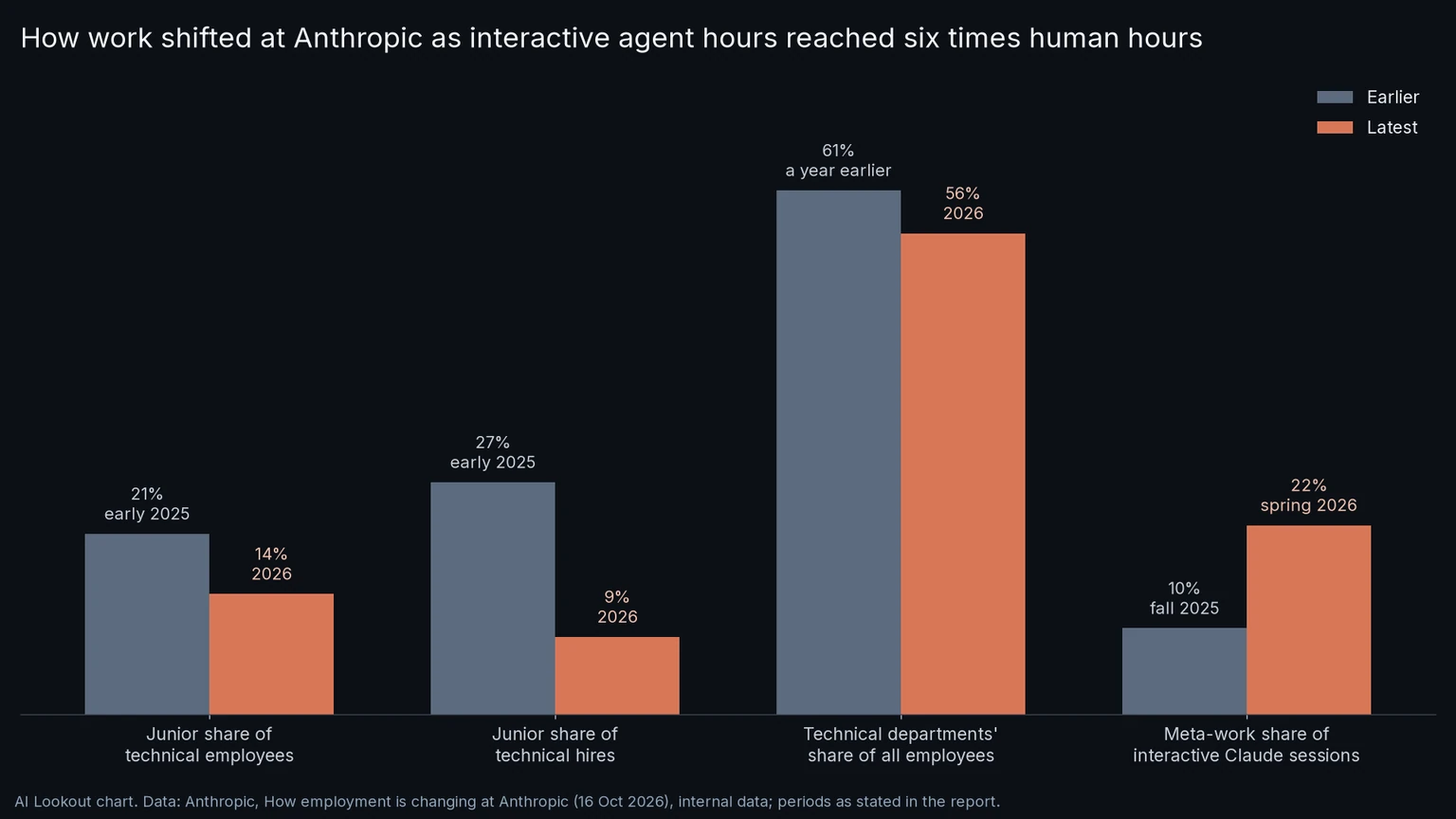
The numbers follow. The junior share of employees in technical departments fell from 21% to 14% since early 2025, and the junior share of technical hires fell faster, from 27% to 9%, with junior postings dropping sharply since December 2025. Technical departments shrank from 61% to 56% of all staff, even as technical hiring kept growing in absolute terms. Administrative roles stayed thin despite rapid growth: an executive assistant said the company had already moved past Claude augmenting entry-level admin work.
Anthropic says it has tripled in size in the last year, so this is a shift in mix, not a layoff story. Employees with at least a year of tenure were 50% more likely to move between departments each month in 2026 than in 2025, and one product writing team rotated into writing prompts and model evaluations.
Agents now outwork their handlers
Agent telemetry shows how quickly the balance moved. In March 2026, combined autonomous and interactive agent work hours passed human work hours for the first time. Counting only interactive sessions directed by individual employees, agents worked six times as many hours as their human handlers by August. The report measures agent time as runtime including inference and tool use, excluding waits over 30 minutes, and assumes 40-hour human weeks.
Non-engineers are coding too. Coding-agent sessions among employees with no code commits at baseline went from 2 a month in August 2025 to 90 in May 2026; a sales representative described building a custom dashboard in three to four hours. The share of technical staff not actively coding fell by almost half, the engineer-to-product-manager ratio is about 17 to 1, and managers' commits doubled. Anthropic's own tools, such as Claude Code Review, now handle part of the checking that this extra code requires.
More output per person, and how Anthropic tested it
Code commits per engineer are about five times their level six months earlier, according to the report, and lawyers, accounts payable staff and salespeople also processed more contracts, invoices and deals. Because Anthropic's revenue was booming at the same time, the authors compared 192 engineers who adopted coding agents with 74 who had not yet done so, using person and calendar-month fixed effects. Code added rose sharply in the months after adoption.
They also checked for low-quality output by comparing agent-written and human-written code by the same person, in the same month and directory, and found no difference in how often lines were later removed or reverted. The authors caution that adoption was not random and that more code does not mean more business value, a point echoed by a Harvard study finding coding agents produce more code but not more shipped software. The report also says engineers who adopted fully autonomous agents were already on a steeper trajectory beforehand.
Human attention becomes the bottleneck
The most vivid section is about attention. Claude interactive sessions spend around 80% of their wall-clock time idle, waiting for a human. The report estimates that even for non-technical groups, reading all the output of their interactive Claude sessions would take more than half the work week. One engineer described facing an army of Claudes, every one asking for attention; another compared it to babysitting children who treat an unopened juice box with the same urgency as a cut finger.
Employees have responded with what the authors call meta-work: writing specs for multi-agent runs, having one agent review another, and building dashboards to monitor pipelines. Meta-work rose from 10% of the average employee's interactive sessions in fall 2025 to 22% in spring 2026, and written standing instructions for agents grew from a few hundred in July 2025 to 8,500 a year later. Meetings did not disappear: median meeting time is up 20% in a year, and 16% even for technical individual contributors.
What hiring managers look for now
Hiring scorecards changed with the work. Interviewers mentioned candidates' track record with AI tools in about 5% of technical and 7% of non-technical assessments in 2024; by 2026 those rates had tripled and quadrupled. For technical roles, the biggest increases were in comments on autonomy and judgment, while domain expertise shrank as a share of the assessment. For non-technical roles, customer and mission orientation rose and execution skills fell.
That pattern fits other evidence that AI gains accrue unevenly by experience, such as a patent-law trial where skill gains went only to senior lawyers. The report's own staff survey adds that Anthropic employees expected AI to be able to do 75% of their work by 2030, against 28% for other Americans.
What Anthropic says employers should do
The authors highlight three features they think matter beyond Anthropic. First, broad employee stock ownership gives workers a stake in successful AI adoption, which they compare to the post-war bargain in which unions accepted reorganisation in exchange for productivity-linked pay. Second, Anthropic is building an early warning system of role-level demand and productivity metrics to flag jobs at risk and move people internally. Third, it prioritises redeployment over replacement.
They are frank about the limits. Protections for current staff do nothing for graduates who are never hired, and the report calls for government policy on retraining and income support. The release lands as Anthropic prepares for a possible listing, with third-quarter revenue reportedly at $16.8 billion, so its account of productivity is also of interest to investors.
Limitations: one unusual company and its own data
This is one company's report on itself, based on internal data that outsiders cannot inspect. Anthropic is an AI lab with unusually early access to its own models, a workforce chosen for comfort with AI, rapid revenue growth and generous equity, so its experience may overstate what other firms will see. Some measures, such as task complexity and meta-work shares, come from Claude-based automated coders applied to session logs, and several survey questions changed wording over time.
The productivity comparison is within-person and controls for calendar month, but adoption timing was chosen by employees, so the effect sizes are best read as indicative. The report does not give absolute headcounts or hiring numbers. Even so, it is one of the most detailed public looks at how an AI-heavy organisation hires, and its finding that junior technical hiring fell first is worth watching across the industry.
Common questions
Did Anthropic cut jobs because of AI?
The report does not describe layoffs. Anthropic says it tripled in size over the year, but hired a smaller share of junior technical staff and moved more employees between departments.
What does six to one agent hours mean?
By August 2026, AI agents running in interactive sessions directed by individual employees logged six times as many working hours as those employees, counting agent runtime and assuming 40-hour human weeks.
Is the data independently verified?
No. It comes from Anthropic's internal records and was analysed by Anthropic economists. The report describes its methods and caveats, but outsiders cannot inspect the underlying data.
Sources & further reading
How this story was made
Written by Kristian Kostov with AI assistance and checked against the linked sources. Company performance claims are attributed to the company. Analysis reflects AiLookout’s interpretation; we have not independently tested the products discussed. The cover places the companies’ own logos, taken from public-domain or openly licensed files credited in the caption, on a plain background. It is not a product photograph, a screenshot, or an endorsement.
Our editorial standards