
Announced 14 Oct 2026 · Sources checked
What did OpenAI publish about AI agents in the EU?
On 14 October 2026 OpenAI published The EU’s next chapter in AI is agentic, introducing a report from its Economic Research team called Europe’s Agentic Opportunity. The nine-page PDF uses OpenAI’s own usage data to describe how businesses in the 27 member states use its agent tools, Codex and ChatGPT Work, as opposed to asking ChatGPT questions. Its argument is in the subtitle: Europe should move ‘from breadth to depth’.
The report starts from a public baseline. It says 20% of EU companies with at least 10 employees used AI in 2025, up from 13.5% in 2024, and argues that broader adoption does not automatically turn into deeper use. The rest of the data comes from OpenAI’s systems: token output at ChatGPT Enterprise and Business accounts, weekly active users at smaller businesses, and a sample of consumer messages classified by type of work.
The report closes with a quote from OpenAI’s chief financial officer, Sarah Friar, who says Europe is ‘now in a new era of AI, with tools that can carry out tasks for people’. The publication follows other Europe-specific moves by the company, including its plan for invisible text watermarks for ChatGPT and Codex in the EU.
How much EU business AI use is now agentic?
The headline figure measures output tokens, the text a model generates. OpenAI says that by 30 September, in a 28-day trailing window, agent tools produced 55% of output tokens at its EU Enterprise and Business accounts: Codex 34% and ChatGPT Work 21%, with ordinary ChatGPT at 45%. The chart begins in May, and ChatGPT Work only launched in July 2026, so much of the shift happened in a single quarter.
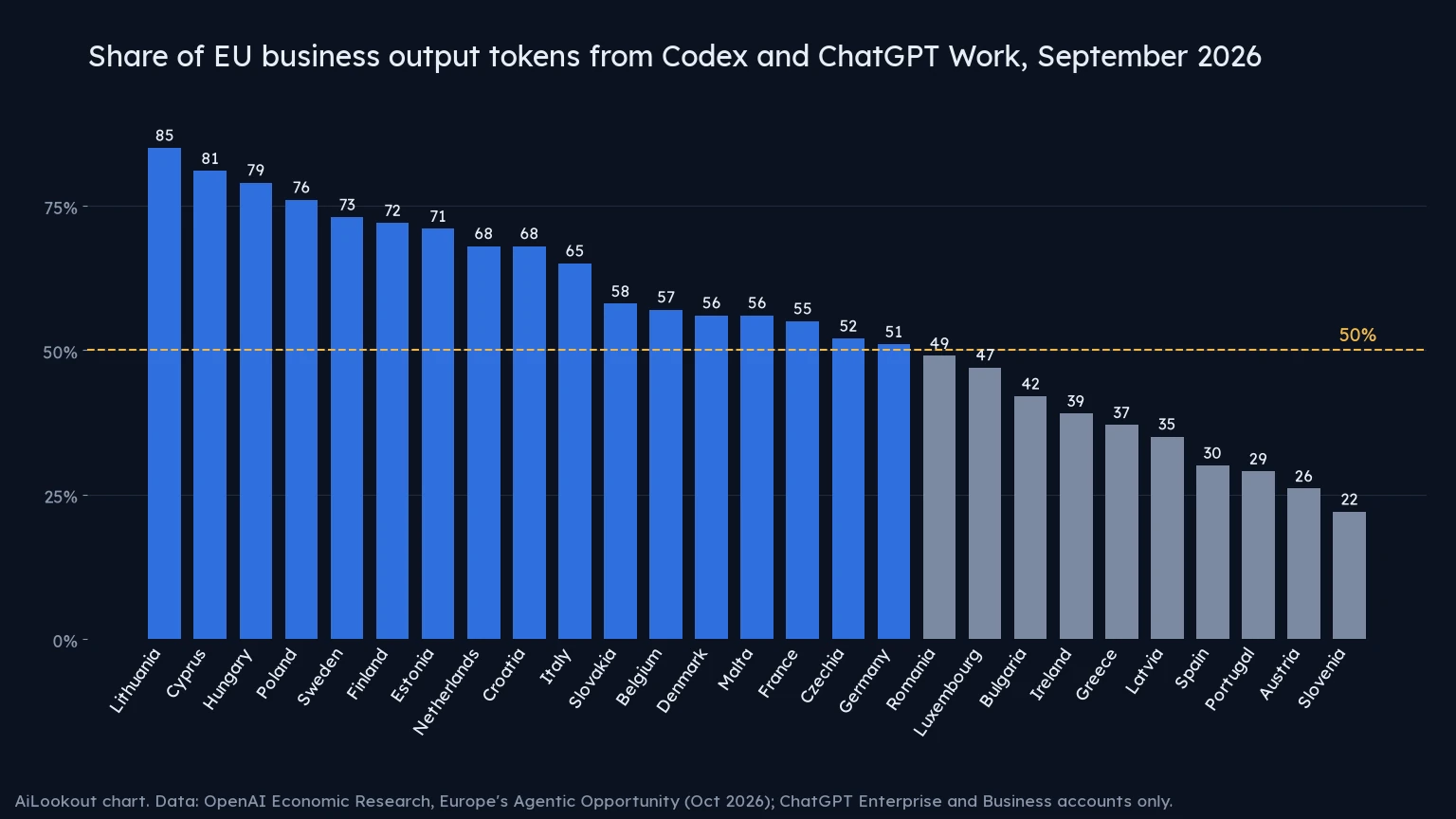
The country spread is wide. In September the agentic share was 85% in Lithuania, 81% in Cyprus and 79% in Hungary, followed by Poland at 76% and Sweden at 73%. Among the largest economies, Italy was at 65%, France 55% and Germany 51%, while Spain was at 30%, Portugal 29%, Austria 26% and Slovenia 22%. OpenAI notes that smaller countries such as Cyprus, Estonia and Lithuania show high agentic use in their larger firms.
A token share is not a share of people or tasks. Coding agents can write long files in one session, so a few heavy Codex users can move a country’s number a long way. The report does not say how many accounts or users are in each country’s sample, which makes it hard to tell a broad shift from a handful of very active customers.
How fast are small businesses adopting agents?
For small and medium businesses, which OpenAI defines as accounts with 200 or fewer associated users, the report measures weekly active users of ChatGPT Work or Codex. Comparing 29 September to 5 October with 1 to 7 May, it says that figure grew 8.1 times across the EU, and more than five times in every member state. OpenAI attributes a major part of the growth to the launch of ChatGPT Work.
Belgium grew fastest at 12.1 times, followed by Italy at 10.8 and Luxembourg at 10.0, then Denmark (9.9), Greece (9.8), Ireland and Malta (9.5 each), and Slovenia and France (9.2 each). Germany came in at 7.5, Poland at 6.5, and the slowest were Bulgaria and Romania (5.9), Latvia (5.8) and Finland (5.1). The table below pairs growth with each country’s enterprise token share.
The two measures do not line up. Slovenia has the lowest enterprise token share but one of the fastest small-business growth rates, and Finland is the reverse. Because the growth figures are relative to a May baseline that the report does not publish, a fast rate may simply mean a small starting point. The report frames the stakes by noting that small and medium businesses account for 63% of EU private-sector employment and over €5 trillion of economic activity a year.
| Country | Growth since May 1–7 | Agentic share of enterprise tokens, Sept. |
|---|---|---|
| Belgium | 12.1× | 57% |
| Italy | 10.8× | 65% |
| Luxembourg | 10.0× | 47% |
| France | 9.2× | 55% |
| Spain | 8.8× | 30% |
| Germany | 7.5× | 51% |
| Poland | 6.5× | 76% |
| Finland | 5.1× | 72% |
What kinds of work do Europeans bring to ChatGPT?
A separate section looks at what people use ChatGPT for at work, using a random sample of 2026 third-quarter messages from Free, Go, Plus and Pro users. OpenAI classified work messages into Intermediate Work Activities, a US Bureau of Labor Statistics taxonomy, and highlights the activity that is most over-represented in each country compared with the EU as a whole.
The results are distinctive rather than dominant. Germany’s standout activity is teaching academic or vocational subjects; in Denmark and France it is explaining financial information; in Austria, researching laws and precedents; in Poland and Romania, preparing legal or regulatory documents; in Portugal, researching healthcare issues; and in the Netherlands, developing business or marketing plans. Six countries, Cyprus, Estonia, Luxembourg, Latvia, Malta and Slovenia, have no published data.
Because each label shows what is unusually common in one country, not what is most common, it is a guide to local flavour rather than to the main uses of AI in Europe, and it comes from consumer plans, not the business accounts behind the agent figures.
How far do EU firms trail the global frontier?
The report’s sharpest finding is about intensity. OpenAI defines frontier firms as the top 10% of business customers by output tokens per active user. In September, it says, EU companies were only about 10% of these frontier firms worldwide, against roughly 65% in North America, 13% in Asia-Pacific and 11% in other EMEA countries. The blog post calls this low given the EU’s higher share of registered companies.
Within Europe the gap is widening. Measured against typical firms in May, output per active user at EU frontier firms reached 6.1 times by September, while typical EU firms reached 1.5 times. Frontier firms outside the EU reached 12.9 times, so the global leaders generated more than twice as much output per user as Europe’s leaders, and frontier EU firms more than four times as much as typical EU firms.
OpenAI’s prescription is general: help businesses move beyond experiments, give workers skills and confidence, and make advanced capabilities cheaper. It does not address the reasons some firms hold back, such as the liability concerns that led JPMorgan to block outside AI agents from moving money in Chase accounts, or the data and compliance work agents need inside regulated companies.
What the report does not show
This is a vendor report about its own customers, and it is written to argue that Europe should use more of the product. Every figure covers OpenAI accounts only. It says nothing about companies that use Anthropic, Google, Mistral or open models, or that do not use AI at all, so it cannot show the EU’s overall adoption of agents.
The metrics also favour the story. Output tokens reward tools that generate a lot of text, and growth multiples hide the size of the starting base. The report publishes no user counts, sample sizes or confidence intervals, and no measure of output quality or productivity. Whether 55% of tokens means more useful work or simply longer outputs is not something token data can answer.
It is still a useful snapshot. It shows how quickly agent tools took over usage at business customers once ChatGPT Work arrived, and it confirms large differences between countries and between leading and typical firms. Policymakers and companies weighing those numbers should look for independent measures, such as Eurostat’s next enterprise survey, before treating them as Europe-wide.
Common questions
What counts as agentic use in OpenAI’s EU report?
OpenAI counts use of Codex, its coding agent, and ChatGPT Work, the agent mode it launched in July 2026, as agentic. The headline share measures output tokens, the text these tools generate, at ChatGPT Enterprise and Business accounts, not the number of people or tasks.
Does the report say how many EU businesses use AI agents?
No. The small-business figure is growth relative to the first week of May, so a country with few early users can grow quickly from a small base. The report gives no absolute user or company counts. It cites a separate figure that 20% of EU companies with at least 10 employees used AI in 2025, up from 13.5% in 2024.
Which EU countries use AI agents the most, according to OpenAI?
By share of enterprise output tokens in September, Lithuania (85%), Cyprus (81%) and Hungary (79%) were highest, and Portugal (29%), Austria (26%) and Slovenia (22%) lowest. By small-business growth since May, Belgium, Italy and Luxembourg led and Finland grew least, at 5.1 times.
Sources & further reading
How this story was made
Written by Kristian Kostov with AI assistance and checked against the linked sources. Company performance claims are attributed to the company. Analysis reflects AiLookout’s interpretation; we have not independently tested the products discussed. The cover places the companies’ own logos, taken from public-domain or openly licensed files credited in the caption, on a plain background. It is not a product photograph, a screenshot, or an endorsement.
Our editorial standards