Announced 21 Oct 2026 · Sources checked
What Coherence raised and from whom
Coherence Neuro, a San Francisco startup building brain implants to detect and treat cancer, has raised a $45 million seed round backed by the OpenAI Startup Fund and Peter Thiel's Founders Fund. The deal was first reported by Wired on 21 October 2026, and the company confirmed the figure in a post on its website signed by its co-founders, Ben Woodington and Elise Jenkins.
The round also brings in Lux Capital, 8VC, Timeless, Olive Capital and Ahren as new investors. Angels include Matthew MacDougall, whom Coherence describes as Neuralink's head neurosurgeon, and Neuralink principal investigator Rory Murphy. Earlier backers including Blackbird, Possible, Topology, Artesian, XEIA, Xtal and Divergent invested again. The company has offices in San Francisco and Cambridge, UK, and did not disclose a valuation.
"Coherence's approach to developing a cancer therapy capable of improving from data is incredibly innovative," Ian Hathaway, a partner at the OpenAI Startup Fund, said in a statement quoted by Wired. "We are proud to be backing them on this exciting mission."
Reading cancer as an electrical signal
Most brain-computer interface companies try to restore lost function, letting paralysed people move a cursor or speak through a synthesiser. Coherence is aiming at something different: using electrodes to watch a tumour and treat it.
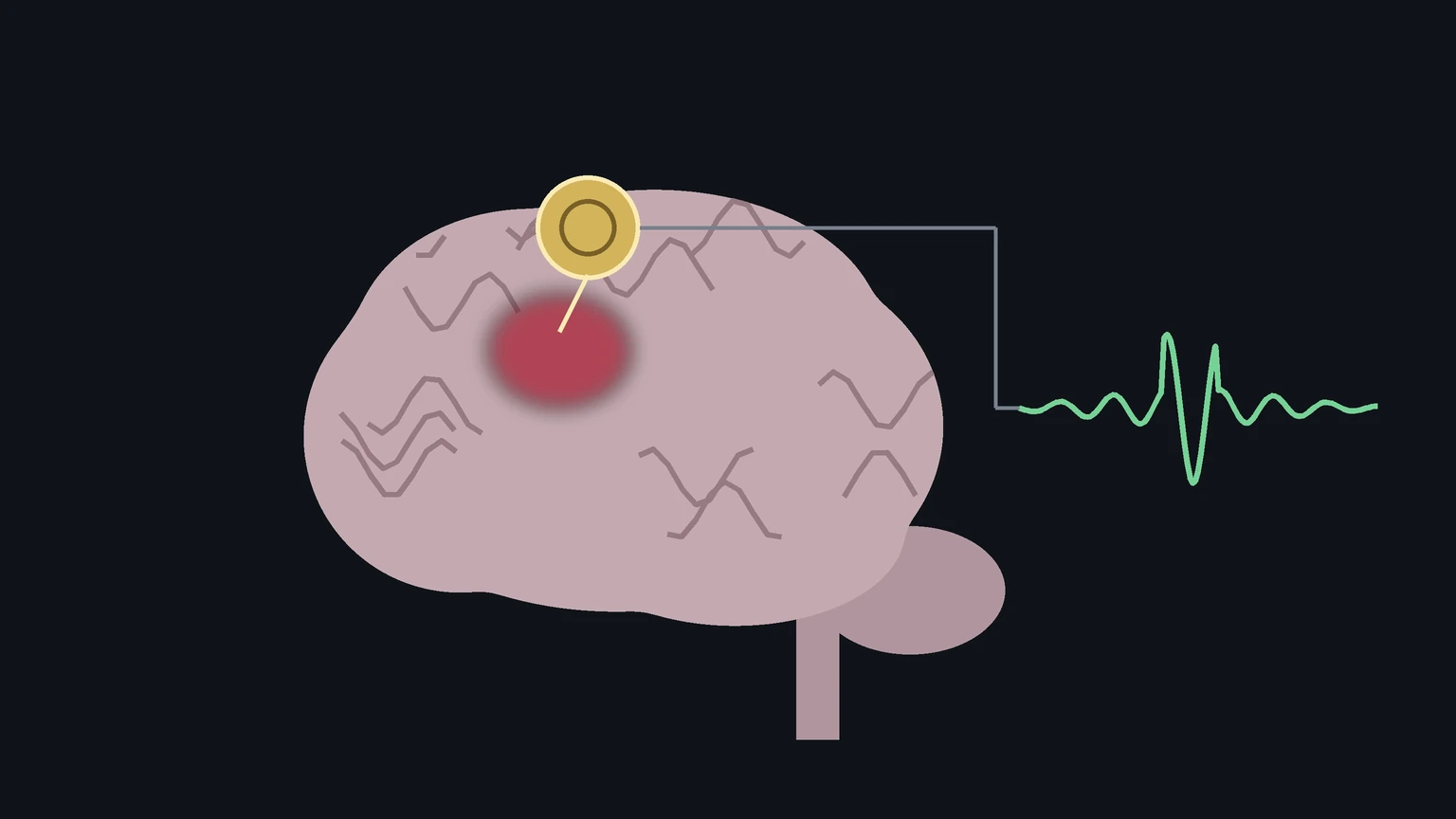
The company's core idea is what it calls an electrical biomarker of cancer. In its post, the founders compare it to threat detection in cybersecurity: as a tumour grows, it changes the electrical signals in the surrounding tissue and nervous system, so continuous recordings compared against normal activity could reveal anomalies. With enough data, they argue, doctors could tell whether a cancer is growing, shrinking or coming back during remission without waiting for the next scan or blood test.
That is where AI comes in. Implants generate far more neural data than people can read, and Coherence says it uses machine-learning models to decode those signals, fingerprint each tumour and personalise therapy. Woodington told Wired that AI is a "perfect use case" for brain-computer interfaces because of the size of the datasets they produce.
From mice to the operating room
So far the strongest evidence is in animals. Coherence says it implanted tiny recording devices next to growing brain tumours in mice and trained a model to predict each tumour's growth trajectory from the neural activity around it. According to the company, the model was tested on mice it had not seen, both untreated and treated with temozolomide, the standard chemotherapy for glioblastoma, and its predictions improved with more days of data. The post links to a paper but gives no accuracy figures in the text.
Human work is at an early stage. In June, Coherence began a first-in-human study of an investigational device called Cipher at the Royal Melbourne Hospital in Australia, led by neurosurgeon Andrew Morokoff, according to MassDevice. Cipher uses a flexible thin-film probe dense with electrodes to record brain activity and deliver stimulation during tumour-removal surgery, and the study was designed to assess safety, basic performance and handling in short procedures.
Wired reports that this summer the implant's recording ability was tested in three people already undergoing tumour surgery, with the device in place for about 30 minutes before removal as an initial safety check. Coherence is now testing both recording and stimulation in seven more patients.
SOMA-1 and the closed loop
The new money is meant to take the company from brief tests in the operating room to a long-term implant. Coherence says it is pushing toward its first chronic human trial in glioblastoma, an aggressive brain cancer, and will seek breakthrough device designation from the US Food and Drug Administration, a programme that can speed review for devices treating serious conditions. It also plans to expand preclinical work to pancreatic cancer and other tumours.
The device it wants to implant long term is SOMA-1, which the company describes as a minimally invasive, MRI-safe implant placed during surgery a patient is already having. Its website shows a wireless, coin-sized implant paired with an over-ear wearable that supplies power and memory, and an app for session history and symptom tracking. The idea is a closed loop: the implant records the tumour's electrical activity, AI models interpret it, and the device delivers mild electrical stimulation intended to slow the tumour, adjusting as the disease changes.
Electric-field therapy for cancer is not new. The founders point out that it is already approved for glioblastoma and some other cancers, delivered through devices worn on the skin. Their argument is that those systems are static and record nothing, so they cannot learn. Coherence's own post notes that its product images are concept renders that may change.
Why AI investors want brain data
The investment is part of a broader pattern of AI companies moving toward biology and brain data. Wired notes that in January OpenAI invested directly in Merge Labs, a brain-computer interface company co-founded by Sam Altman, which launched with $252 million to pursue ultrasound-based brain decoding. Founders Fund has backed Neuralink and CTRL-labs, the neural wristband maker Facebook bought in 2019.
OpenAI has also been building its own life-sciences work. This week it said it ran thousands of GPT-Rosalind agents over a mouse-brain CRISPR atlas, and on 20 October it agreed to buy Orchestra Bio to add drug-programme agents to Rosalind. Coherence is a venture bet rather than an OpenAI product, but it points in the same direction: new kinds of biological data that could train better models.
Woodington put the investor logic plainly to Wired: "The idea of capturing data to train better models and use it to optimize treatments is going to be super important." The company's own post says it aims to build "the largest dataset of disease evolution and brain state in history."
Who gets the data
That ambition raises an obvious question about who sees the data. Woodington told Wired that OpenAI will not get access: "There's nothing in the contracts or arrangements that would mean that we would share, or they would have access to, any brain data or other health data that we're generating."
Wired contrasts that with Merge Labs, where OpenAI said in January that it would collaborate on scientific foundation models. For patients considering a trial, the Coherence assurance is a statement from the company about its current contracts, not a published data-governance policy, and trial consent documents will be where the real terms are set.
What remains unproven
Coherence is open about the risk. Its founders write that "the extraordinary complexity of biology is likely to bring unforeseeable challenges." The key scientific claim, that a tumour's electrical signature can track its growth in humans, has been shown only in mice so far, according to the company's own account. Human testing has involved implants left in place for about half an hour, and no efficacy data in patients has been released.
A long-term trial will need regulatory approval, and implanted devices carry surgical and infection risks that a wearable does not. AI-driven medical predictions also have a mixed record outside the lab; studies such as Mass General Brigham's face-photo survival model show how much validation such tools need before they guide care. And a $45 million seed is large for the stage, but small next to the cost of the trials needed to prove a cancer therapy works.
For now the news is about money and direction: two prominent investors betting that recording disease continuously, and letting models learn from it, could add a new kind of cancer treatment. It sits alongside other early attempts to put AI-designed or AI-guided therapies in front of patients, such as Radical Numerics' AI-designed phages. The proof will come from the glioblastoma trial, which has not yet started.
Common questions
What does Coherence Neuro's brain implant do?
It is designed to record electrical activity around a brain tumour, use AI models to judge whether the cancer is growing or shrinking, and deliver mild electrical stimulation intended to slow it.
Will OpenAI get Coherence's patient brain data?
No, according to CEO Ben Woodington, who told Wired that nothing in the contracts gives OpenAI access to brain or health data. That is the company's statement, not a published policy.
Is the Coherence implant available to patients?
No. It is investigational. Human tests so far placed a recording device for about 30 minutes during surgery, and a long-term glioblastoma trial is planned but has not started.
Sources & further reading
How this story was made
Written by Kristian Kostov with AI assistance and checked against the linked sources. Company performance claims are attributed to the company. Analysis reflects AiLookout’s interpretation; we have not independently tested the products discussed. Cover photography is illustrative and does not depict the specific announcement or product.
Our editorial standards