Announced 19 Oct 2026 · Sources checked
What the study found
Researchers at Mass General Brigham in Boston have built an AI system that estimates a cancer patient's risk of dying from one ordinary photograph of their face. The work was published in The Lancet Digital Health at 23:30 UK time on 19 October 2026, and it describes a foundation model called FAHR-Face, short for Foundation Artificial Intelligence for Health Recognition, plus two tools fine-tuned from it.
The first, FAHR-FaceAge, estimates biological age: how old a person looks to the model, as opposed to the age on their birth certificate. The second, FAHR-FaceSurvival, skips the age step and predicts survival risk directly from the face. The paper says the two tools capture different information, and that putting both into a clinical prognostic model predicted survival better than either one alone.
Hugo Aerts, a co-senior author, told The Guardian that, to the team's knowledge, this is the first demonstration that an AI model can directly predict cancer survival from a simple photograph. The group's earlier FaceAge model, announced in May 2025, only estimated age and then linked that estimate to outcomes.
How FAHR-Face works
FAHR-Face was first trained without any medical labels on more than 40 million facial photographs, learning a general representation of faces. According to the team's arXiv preprint, the foundation model uses a masked autoencoder, a method in which parts of each image are hidden and the network learns to fill them in, trained on the public WebFace42M face dataset.
That general model was then adapted for each task. For age, it went through two rounds of age-balanced fine-tuning on ten public image datasets, so that it would be accurate from childhood to old age. On public benchmarks it reached a mean absolute error of 5.1 years, which the paper says is lower than the benchmark models it was compared with.
For survival, the team fine-tuned the same model on 34,363 photographs of cancer patients treated with radiotherapy at Harvard-affiliated hospitals, using a ranking loss that teaches the model to order patients by risk rather than to predict a date of death. Aerts said this foundation-model approach means new facial health measures can be built from relatively small clinical datasets instead of training each one from scratch.
The code is public in the AIM-Harvard/FAHR-Face repository on GitHub, which contains training scripts for the foundation model, the age model and the survival model. The repository did not show a licence file when checked on 20 October 2026, and the patient photographs themselves are not shared because they contain protected health information.
The numbers behind the headline
The headline result is a risk ranking. Patients the survival model placed in the highest-risk quarter had more than three times the mortality of those in the lowest quarter, an adjusted hazard ratio of 3.23 after accounting for standard clinical prognostic factors. The paper reports that the finding held in an independent cohort and across age, sex, race and cancer subgroups.
The raw numbers are stark. Scientific American reports that in a test group of 3,820 cancer patients, 64 of the 122 people with the highest risk scores died within 90 days of the photograph being taken. The preprint describes the same pattern: more than half of the highest-scoring group died within 90 days, compared with about 2 percent of the lowest-scoring group.
The age model told a similar story. Among US radiotherapy patients, those whom FAHR-FaceAge judged to look five or more years older than their real age had a 21 percent higher risk of dying during an average follow-up of about four years, while those who looked five or more years younger had a 17 percent lower risk. In the paper, FAHR-FaceAge also beat the team's earlier age model at predicting survival.
The external check came from roughly 4,900 radiotherapy patients at the Maastro clinic in Maastricht, the Netherlands, a different health system on a different continent. That validation is the main reason outside experts took the result seriously.
What the model looks at
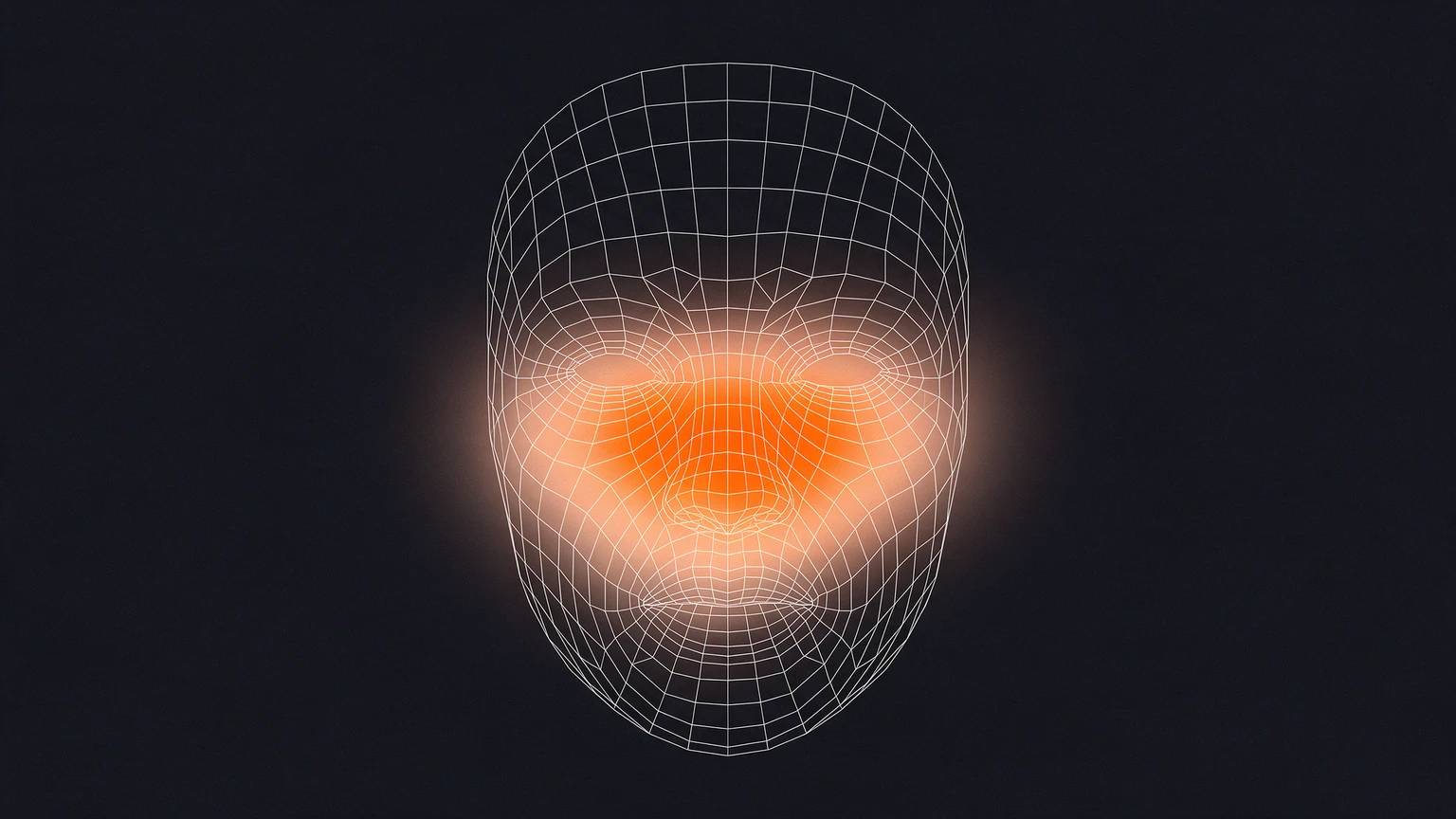
The team used attention mapping, a way of highlighting which pixels drive a model's output, to see where each tool was looking. FAHR-FaceAge relied mostly on the nasolabial folds, the creases that run from the sides of the nose to the corners of the mouth, along with the forehead just above the eye sockets and the temples. FAHR-FaceSurvival focused on the region below the eyes and around the bridge of the nose.
Why those areas track mortality is not known. Raymond Mak, a radiation oncologist and co-senior author, told Scientific American that doctors are trained to walk into a room and form an impression of how frail or sick a patient is, and that the aim is to make that judgment more quantitative and consistent. Some of the signal may reflect known risks: in the age model, heavy drinking, drug use and smoking were linked to looking older.
The researchers also tested robustness. Mak said the age model was consistent across pose, lighting, facial expression and make-up, and stable across most plastic surgery procedures, with a small shift after rhinoplasty, where people were rated slightly older after a nose job.
What outside experts say
The UK Science Media Centre gathered an early reaction from Miroslaw Bober, a professor of video processing and machine learning at the University of Surrey. He called the study interesting and substantial, and said the Dutch validation was an important strength that provides convincing evidence of a statistical link between facial appearance and survival in patients receiving radiotherapy.
He also listed limits. Predicting an outcome is not the same as explaining it, he said, and despite the phrase biological age, the model estimates age from appearance rather than measuring any ageing process. The study did not test whether the AI sees anything a doctor would not, and doctors' own assessments of patients' fitness were not measured, so there is no evidence yet that the tool adds clinically useful information beyond them.
Bober said the press release headline goes further than the evidence. The tool ranks patients by relative risk within a group, but its scores have not been validated as individual survival probabilities. Smiling or changing the lighting shifted the age estimate by about two years on average, and more in some cases, so claims that it could track ageing over time are premature. His summary was that it is a promising proof of concept that is not ready for clinical use.
Bias, consent and who else might use it
The survival model was trained on a Boston-area cancer population that was mostly white; the preprint puts the training cohort at 87.6 percent white and 4.9 percent Black. Bober noted that the facial-age measure was not significantly associated with survival for Black patients after adjustment, although the separate survival model was. Faces have been a weak spot for AI fairness before, as a recent Cornell audit of AI-generated faces and hiring showed in a different setting.
Matthew Liao, director of the Center for Bioethics at New York University, told Scientific American that a tool like this could help find patients who need extra care, but that a wrong answer could mean someone is not treated when they should be. He also raised the prospect of insurers using similar technology to grant or deny coverage, or employers using it to pick candidates who look healthier.
Commercial interest is already there. Mass General Brigham has a patent pending on face health algorithms, and the preprint says the hospital system has filed provisional patents on two next-generation facial health algorithms. Hospitals are increasingly building AI on their own patient records, as in Meta's ten health studies run on five million records, and pathology is moving the same way with deals such as Agilent's planned purchase of Proscia.
What happens next
Mak described the work as launching a new field in medicine but said there is a lot of development and clinical testing ahead. The obvious next steps are prospective trials, comparisons against doctors' own frailty assessments, and testing at more hospitals with more diverse patients. The team says it is widening its training data and has invited the public to contribute photographs for that purpose.
If those tests go well, the researchers see the tool as one more data point when deciding whether a frail patient can tolerate surgery, radiation or chemotherapy, and possibly as an early warning when someone appears to be ageing faster than expected. For now, the published result shows that a face photo carries a measurable survival signal in two radiotherapy populations, not that it should guide anyone's care.
Common questions
Can I use this AI to check my own cancer risk?
No. FAHR-Face is a research model tested on radiotherapy patients. It ranks relative risk within a group and has not been validated to give an individual survival probability or to guide care.
What does the model look at in a face?
Attention maps show the survival model focusing on the area below the eyes and the bridge of the nose, and the age model on the nose-to-mouth creases, forehead and temples. Why those areas matter is not known.
Was the result checked outside Boston?
Yes. Both models were validated on roughly 4,900 radiotherapy patients at the Maastro clinic in the Netherlands, which experts called the study's main strength.
Sources & further reading
- Foundation artificial intelligence models for health recognition by use of face photographs (FAHR-Face): a model development and validation study ↗
- expert reaction to study testing an AI tool using a face photograph to predict cancer survival ↗
- New AI tool can predict cancer survival by a single patient selfie, study suggests ↗
- Can AI predict whether you'll die from cancer from just an image of your face? ↗
- Foundation Artificial Intelligence Models for Health Recognition Using Face Photographs (FAHR-Face) (preprint v1) ↗
- AIM-Harvard/FAHR-Face (code repository) ↗
- AI Tool Uses Face Photos to Estimate Biological Age and Predict Cancer Outcomes ↗
How this story was made
Written by Kristian Kostov with AI assistance and checked against the linked sources. Company performance claims are attributed to the company. Analysis reflects AiLookout’s interpretation; we have not independently tested the products discussed. The cover is an AI-generated editorial illustration, not a photograph or evidence of an actual event.
Our editorial standards