Announced 15 Oct 2026 · Sources checked
What the study found
Ask an image generator for a doctor, a retail worker or simply a person, and the face you get back is likely to be better looking than a photograph of a real one. That is the first finding of Generative AI Produces and Transmits Beauty Bias, a preprint posted to arXiv on 15 October 2026 by AJ Alvero and seven co-authors at Cornell University, the University of Florida and the University of Pennsylvania. The team audited 27 text-to-image systems released between 2022 and 2026 and analysed 51,300 faces they produced, using prompts that never mentioned beauty or appearance.
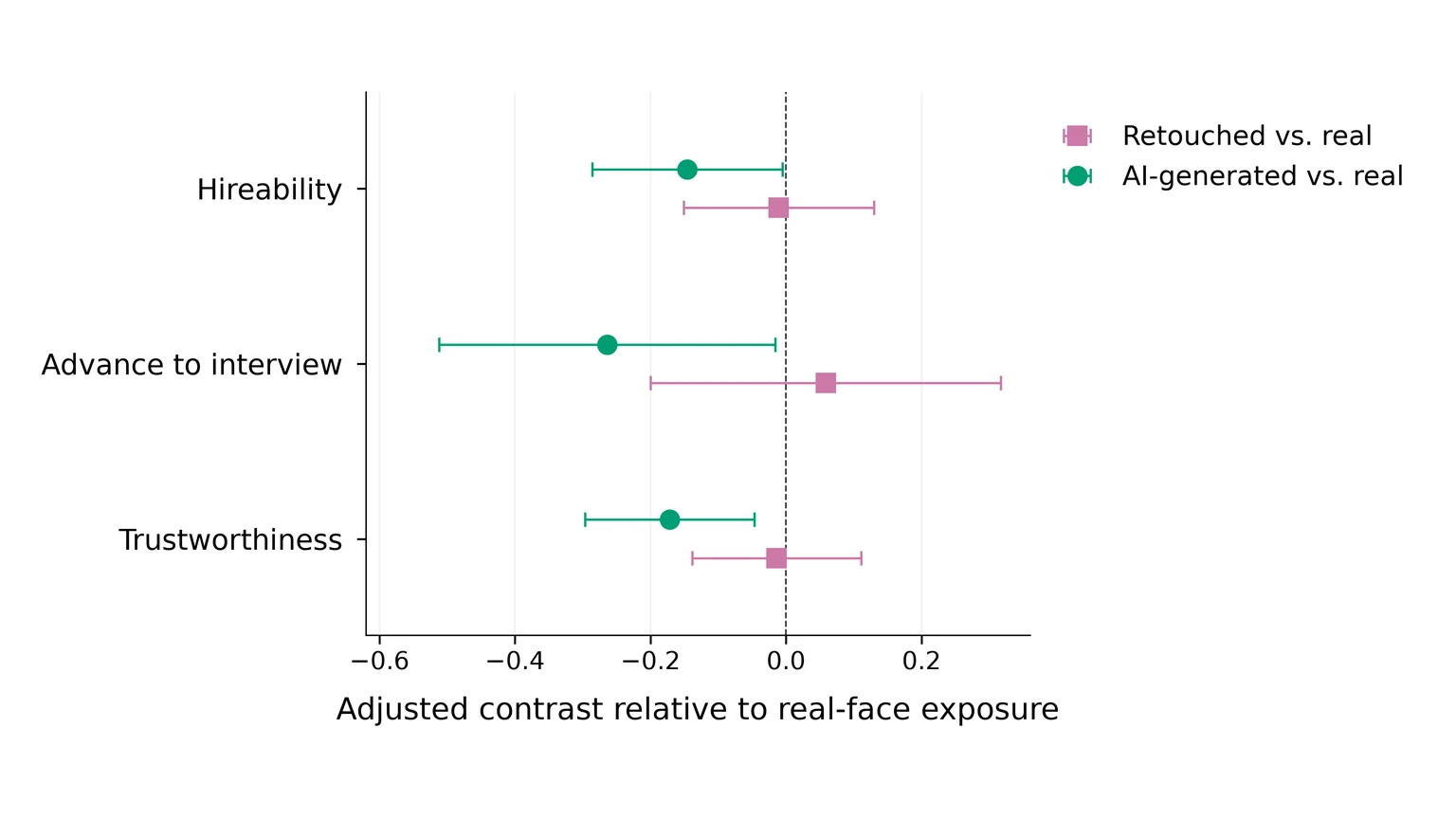
The second finding is about who gets that boost. Across systems, faces prompted as White scored highest, while faces prompted as Black, Ethiopian and Nigerian formed the lowest tier. The third is the one with the most practical weight. In a preregistered hiring experiment with 570 US adults, people who had just seen highly attractive AI-generated faces went on to rate the same real job candidates as less hireable and less trustworthy, and advanced fewer of them to interview. People shown retouched photos of real faces did not.
The paper is a preprint and has not been peer reviewed. Its authors are careful about what it does and does not prove, and those limits are covered below.
How 27 image generators were tested
The audit covers the major consumer platforms, OpenAI, Google, Midjourney and xAI, the most used open-weight families, Stable Diffusion and FLUX, and open models from six other developers. Every system received the same prompts, crossing 14 racial, ethnic and national categories with two sex terms and eight occupations, and each fully specified combination was issued five times. The generated faces were compared with 89,435 photographs of real people, and with more than 160,000 photos once supplementary comparisons are counted.
To score attractiveness at that scale, the authors used two neural networks trained to predict human ratings on established benchmark datasets, SCUT-FBP5500 and MEBeauty, plus a third model that labels facial attributes in celebrity photos as a robustness check. Under both main measures, 24 of the 27 systems made faces that scored significantly above photographs. On average the gap was 1.23 standard deviations under SCUT and 0.94 under MEBeauty. Thirteen systems exceeded photographs by more than one standard deviation when the three measures were averaged.
The gap was not uniform. On SCUT, the 18 open-weight systems averaged 1.49 standard deviations, against 0.72 for the nine consumer platforms. Three recent commercial models, Google's Nano Banana Pro and Nano Banana 2 and xAI's Grok Image, showed no gap or a negative one on the automated scores. Within model families the gap shrank over time: from 0.88 for Midjourney v6 to 0.36 for v8, and from 1.15 for GPT Image 1.5 to 0.65 for GPT Image 2. The open models in the audit include FLUX2 Klein, a predecessor of Black Forest Labs' new FLUX 3 Klein, which was not tested.
What 550 human raters said
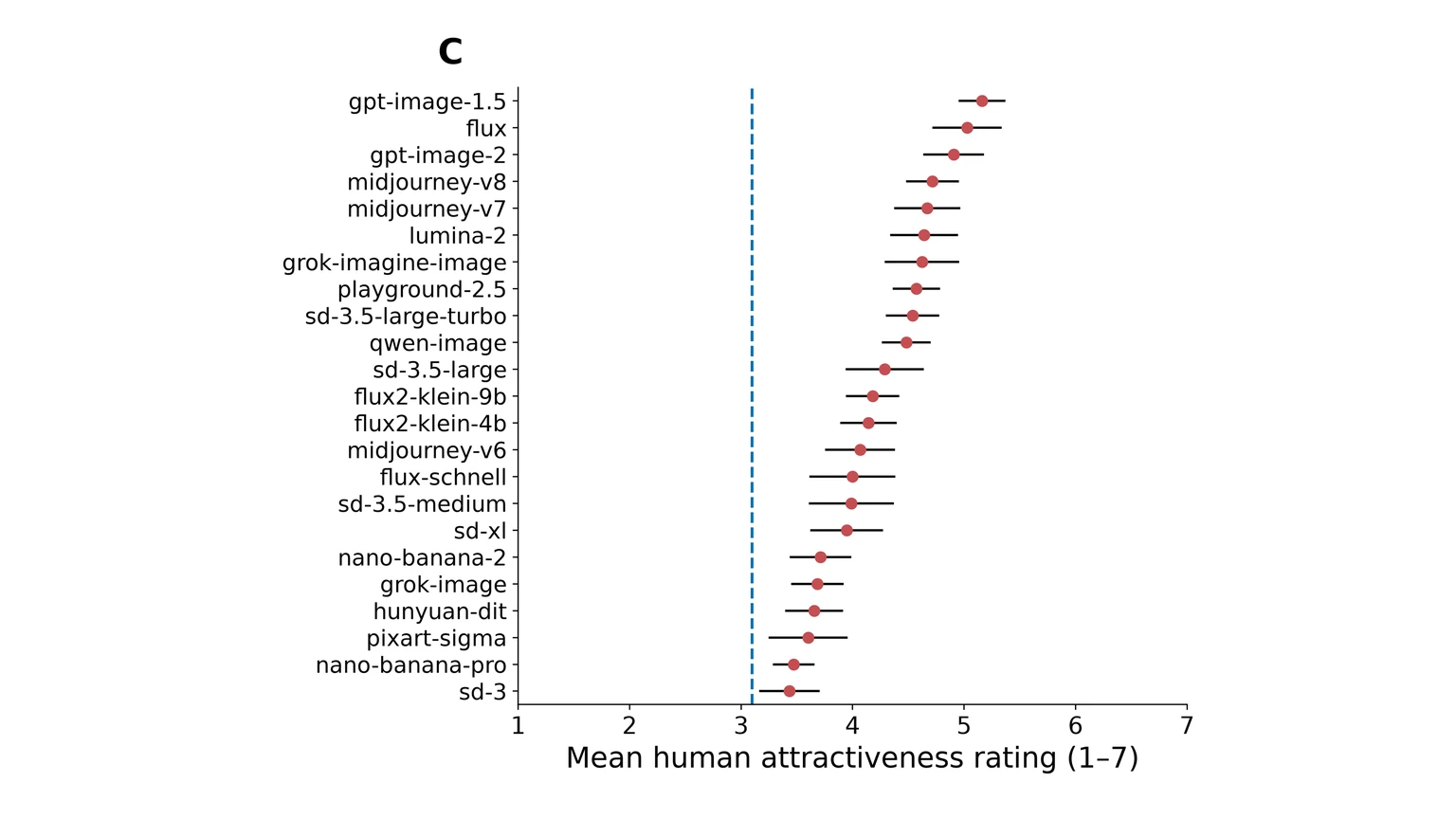
The automated scores only partly agree with people, correlating at 0.48 to 0.61 with human ratings, so the team also asked 550 US adults to rate a stratified set of 1,374 generated and photographed faces on a scale of 1 to 7. Photographs of real people averaged 3.10. Every one of the 23 generators with at least ten rated images was judged more attractive, by between 0.34 and 2.06 points, and every difference survived correction for multiple comparisons. The pattern held within each of six broad racial and ethnic groups.
Here the human and automated results part ways. The three systems that showed no automated gap were still rated more attractive than real photos by people. Human-rated gaps barely moved for OpenAI, from 2.06 to 1.81 points between GPT Image 1.5 and 2, and rose for Midjourney, from 0.97 for v6 to 1.62 for v8, the opposite of the automated trend. The authors therefore rely on the human ratings for claims about what people find attractive. The finding also cuts across the usual story of image models getting more realistic with each release: newer outputs may look more like photos to an automated scorer while still looking better than real people to human eyes.
The team also compared the generated faces with 14,917 profile photos of professional fashion models. On average the models still scored higher. But 23 percent of all generated faces, and 37 percent of female-prompted faces, outscored the median professional model, and one system, Playground 2.5, beat the fashion-model average on both main measures.
A racial ordering in who looks attractive
Averaged across all 27 systems, White-prompted faces scored highest and Nigerian-prompted faces lowest. Under both main measures, White-prompted faces outscored Black- and Nigerian-prompted faces in every single generator. The models also did not treat national and broader labels as interchangeable: Korean-prompted faces ranked above East Asian, Nigerian below Black, Mexican below Hispanic or Latino, and Indian below South Asian.
The obvious objection is that the scoring models may themselves favour White faces. The authors ran two checks. Applied to real photographs, the same measures found much smaller White-Black differences, for example 0.23 against 0.61 for generated faces under SCUT. And comparing generated with photographed faces within each group, generated White faces gained more over real White photos than generated Black faces gained over real Black photos. Adjusting for age, skin lightness, facial fat, blur and 38 further facial attributes left 77 percent of the SCUT White-Black gap and 99 percent of the MEBeauty gap in place. The measures disagreed about which groups ranked highest but agreed closely about which ranked lowest.
The hiring experiment
The second study asked whether these images change how real people are judged. Participants screened applicants for a customer success associate job. After rating the same four anchor candidates, each person was randomly assigned to see eight profiles paired with unmodified real faces, retouched versions of those faces, or AI-generated faces chosen for high attractiveness. The retouching mimicked the one-tap enhance feature of the Facetune app. Mixed in were 12 real test candidates who were identical in every condition, with written qualifications held fixed.
The direct effect was small. Profiles with AI faces received slightly higher hireability and trust ratings, and interview advancement was 84.8 percent against 82.5 percent for real faces, a difference that was not significant. The knock-on effect was clearer. Participants who had seen the AI faces rated the identical real candidates 0.15 points lower on hireability and 0.17 points lower on trustworthiness on the 1 to 7 scale, and advanced 72.5 percent of them to interview against 77.4 percent. Retouched faces changed almost nothing: hireability was 5.26 in both groups and advancement 78.2 against 77.4 percent.
The analyses were preregistered on the Open Science Framework, and the authors report that the results held when they excluded early feasibility-run participants and people who gave the same answer to everything.
What the study cannot show
The experiment shows that exposure mattered, not why. The AI faces differed from the real ones in attractiveness, but also in polish, regularity, familiarity and demographic mix, and the retouched and AI faces were not matched for attractiveness, so the study cannot separate the source of an image from how strong the change was. It used one job, one session and a deliberately attractive set of AI faces, and the authors warn against assuming the effect applies to ordinary output from every generator.
Measurement is a limitation too. Attractiveness cannot be measured independently of the standards used to judge it, all human raters were in the US, and the main automated measure fell just short of the validation threshold the team set in advance. The 27 systems are a broad sample rather than a representative one, and the release comparisons cannot say whether changes came from training data, preference tuning, filtering or architecture. The effect sizes in the hiring study are modest, a fraction of a point on a seven-point scale.
Why it matters for anyone using AI faces
Synthetic people are now routine in advertising, stock imagery, training materials and websites, and the tools to make them are cheap. Labelling efforts such as Google's public SynthID detector address whether an image is AI-made, not what it does to the viewer's sense of normal. This paper suggests that a steady diet of flattering AI faces could shift the baseline against which real people are judged, including in hiring, and that the shift may fall unevenly across racial groups.
For companies, the practical reading is to think twice before using AI-generated people in recruiting material, candidate-facing tools or HR training, and to check generated imagery for who it makes attractive, not just whether it looks real. For model makers, the finding that recent commercial systems narrowed the gap on automated scores but not in human eyes is a reminder that bias audits need human raters. The authors call for work on when beauty bias carries over to judgments of real people and which features of synthetic images drive it.
Common questions
Do AI image generators make people look more attractive than they are?
In this study, yes on average. Human raters judged faces from all 23 generators with enough rated images as more attractive than photographs of real people, by 0.34 to 2.06 points on a 1 to 7 scale, even though the prompts never mentioned appearance.
Which image generators were tested for beauty bias?
27 systems released between 2022 and 2026, including OpenAI GPT Image models, Google Nano Banana models, Midjourney v6 to v8, xAI Grok image models, Stable Diffusion, FLUX and open models from six other developers.
How did AI faces affect hiring decisions in the study?
Participants who first saw highly attractive AI-generated faces rated the same real candidates lower on hireability and trustworthiness and advanced 72.5 percent of them to interview, compared with 77.4 percent after seeing real faces. Retouched photos produced no such drop.
Sources & further reading
How this story was made
Written by Kristian Kostov with AI assistance and checked against the linked sources. Company performance claims are attributed to the company. Analysis reflects AiLookout’s interpretation; we have not independently tested the products discussed. Cover photography is illustrative and does not depict the specific announcement or product.
Our editorial standards