
Announced 6 Oct 2026 · Sources checked
What Google changed in Nano Banana 2.1
Google describes Nano Banana 2.1 as its latest high-efficiency image-generation and conversational-editing model. It is based on Gemini 3.6 Flash and updates Nano Banana 2 with claimed improvements to visual quality, prompt adherence, character consistency across edits and rendering text inside images.
The model accepts text and image inputs and returns images. Google recommends 2.1 for new projects, making this a migration signal for developers already using the Gemini image stack. The model card and API pages were live when checked on October 7, but the pages do not expose a precise publication timestamp, so AiLookout records them as undated rather than inventing one.
Resolution, references and grounded generation
Nano Banana 2.1 supports 1K, 2K and 4K output and can use as many as 14 reference images, according to Google. References are useful for preserving a product, person, style or layout across iterations, although consistency still needs testing on the exact subject and edit sequence.
Google also documents Search grounding for image generation. That can provide current visual context, but it does not transfer permission to reproduce protected imagery and does not guarantee factual accuracy. Every generated image receives a SynthID watermark. Teams should preserve prompts, model identifiers, source references and creation dates.
The ability to combine text, images and iterative instructions makes this a practical multimodal AI system, but a polished result can still contain small factual, counting or geometry errors.
How we ran the comparison
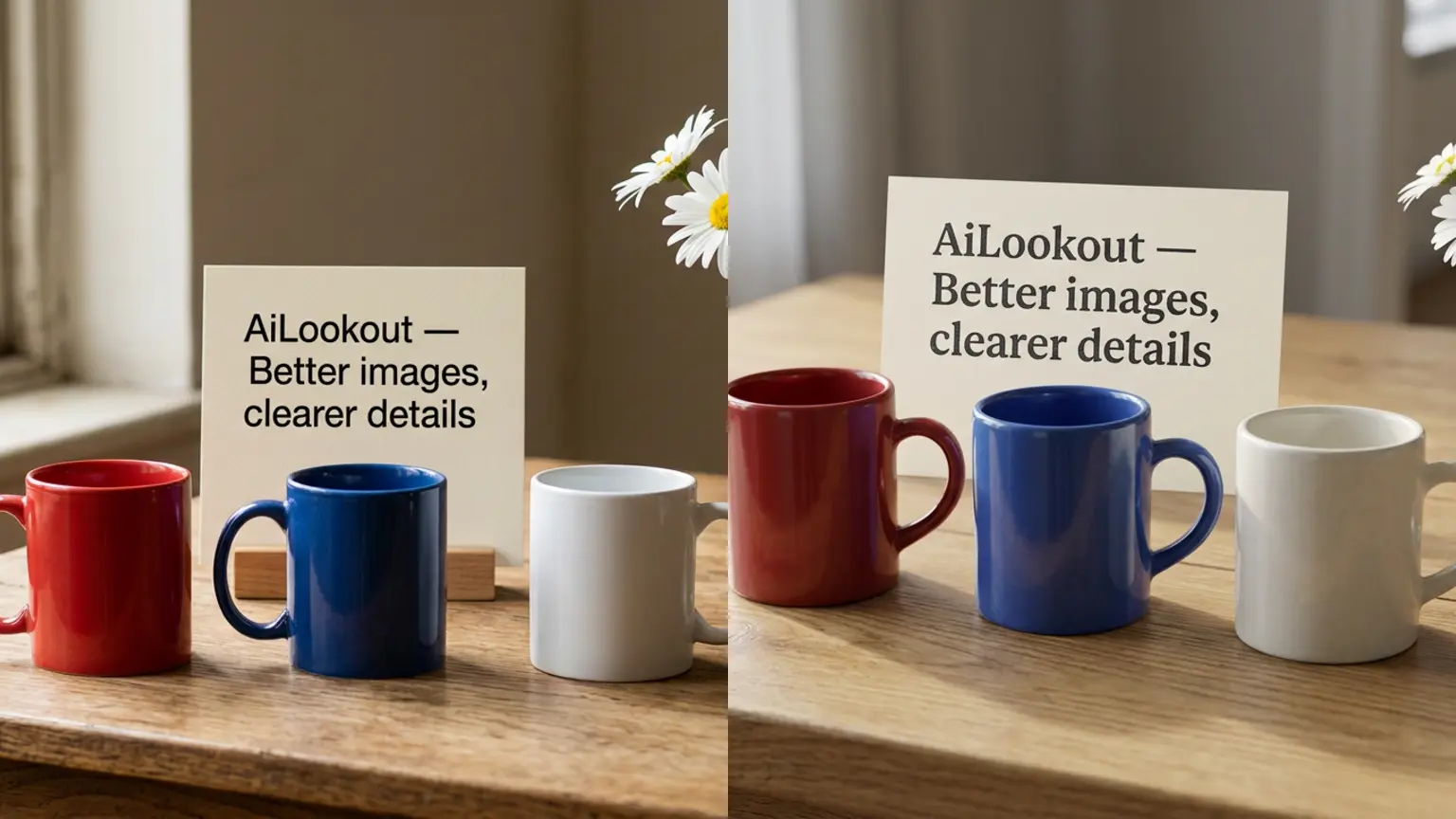
We generated exactly one image with Nano Banana 2 and one with Nano Banana 2.1 through the connected Magnific interface. Both used the same 1K setting, 16:9 output shape and this prompt: “Editorial image-generation comparison test. A realistic tabletop photograph in natural window light: exactly three ceramic mugs, one red, one blue, one white, aligned left to right on an oak table. Behind them a small printed cream card reads exactly ‘AiLookout — Better images, clearer details’. On the right a transparent glass vase with five white daisies. Sharp readable typography, coherent shadows, natural colors, no extra objects, no logos. This is a staged AI-generated test scene, not a real news event.”
Magnific recorded Nano Banana 2 as `imagen-nano-banana-2-flash`, created at 00:46:24 UTC on October 7 with seed 854693. Nano Banana 2.1 was `imagen-nano-banana-2-1`, created at 00:46:16 UTC with seed 78916. The connector generated independent samples, so seeds differ; prompt, resolution class and aspect ratio were held constant. Raw outputs and hashes are retained with the article assets.
The cover places Nano Banana 2 on the left and 2.1 on the right. Both halves are AI-generated test images, not photographs of a real event. The composite only resizes and crops the saved outputs.
What the two images actually show
Both outputs followed the main structure: three mugs appeared in the requested red, blue and white order, a vase appeared on the right, and the printed sentence was legible and correctly rendered. That is meaningful for a prompt combining object count, color order, layout and exact typography.
Nano Banana 2.1 produced a cleaner, more restrained tabletop composition in this sample. Nano Banana 2 used a more rustic scene with stronger background texture. That aesthetic difference is observable, but it is not evidence that one model is universally better.
Both models missed the instruction for exactly five daisies, generating more flowers than requested. This shared counting failure matters because production prompts often depend on exact quantities, inventory-like layouts or compliance details. A convincing image can still be wrong in ways that require deliberate inspection.
How creators and product teams can use 2.1
Useful workflows include product concept images, campaign drafts, localized text variants, iterative background changes and character-consistent storyboards. Developers can send an image back into a conversation and request a targeted edit instead of regenerating everything. Multiple references can help anchor identity, materials and composition.
For production, turn preferences into a small evaluation set: exact text, object counts, brand colors, reference fidelity, edit stability and unwanted additions. The method resembles our prompt engineering guide: specify the constraint, inspect the output and revise after identifying the failure. Human review remains necessary before publication.
Limits, safety and honest interpretation
One output per model is intentionally a small demonstration. It cannot measure average quality, editing consistency, multilingual typography, latency, price-performance or safety. Different seeds can change composition substantially. A useful follow-up would repeat a fixed prompt suite across several seeds and score each requirement before comparing averages.
The test demonstrates why generated images should be checked like other model outputs. Our guide to verifying AI answers applies here: inspect every requested element, not just the overall impression. Exact text success did not prevent a quantity error.
Google’s documentation supplies the model features, while our observations cover only two saved outputs. To avoid turning a demo into marketing, apply the same evidence discipline used for AI benchmark claims. We do not declare a benchmark winner from this sample.
The practical conclusion
Nano Banana 2.1 is meaningful because Google positions it as the default for new image projects and combines fast generation with editing, references, high resolution and grounded context. It is readily useful for creative iteration, especially when exact text and scene structure matter.
Our test also supplies a warning: the new version can produce a cleaner scene and still miss a simple count. Teams should adopt 2.1 with prompt-level acceptance checks, saved provenance and a review step. Better-looking output is not the same as fully compliant output.
Common questions
Is Nano Banana 2.1 publicly available?
Google documents it in the Gemini API and recommends it for new image-generation projects. Availability can still depend on account, region and the interface or provider being used.
Did Nano Banana 2.1 beat Nano Banana 2 in AiLookout’s test?
No broad conclusion is justified. In one pair, 2.1 looked cleaner, both rendered the requested text and mug order correctly, and both missed the exact five-flower count.
Are the comparison images real photographs?
No. Both are AI-generated test outputs created with an identical staged prompt. They are disclosed as generated images and do not depict a real product, place or event.
What to remember
Google’s Nano Banana 2.1 expands the Gemini image workflow with stronger claimed prompt adherence, conversational editing, many reference inputs, 4K output and Search grounding. Our one-prompt comparison found accurate text and object ordering in both versions, a cleaner 2.1 composition and the same exact-count failure in both. Adopt the model for practical work, but evaluate it with repeatable prompts and explicit acceptance checks.
Sources & further reading
How this story was made
Written by Kristian Kostov with AI assistance and checked against the linked sources. Company performance claims are attributed to the company. Analysis reflects AiLookout’s interpretation; we have not independently tested the products discussed. Cover photography is illustrative and does not depict the specific announcement or product. The source photograph was edited with AI for clarity, exposure, color, and framing.
Our editorial standards