Announced 20 Oct 2026 · Sources checked
What Radical Numerics said
The AI biology start-up Radical Numerics says one of its models designed viruses that were given to a sick patient, in what the company calls the first clinical use of AI-generated phages. It described the work in a technical post published on 20 October 2026 and confirmed the patient treatment to The New York Times.
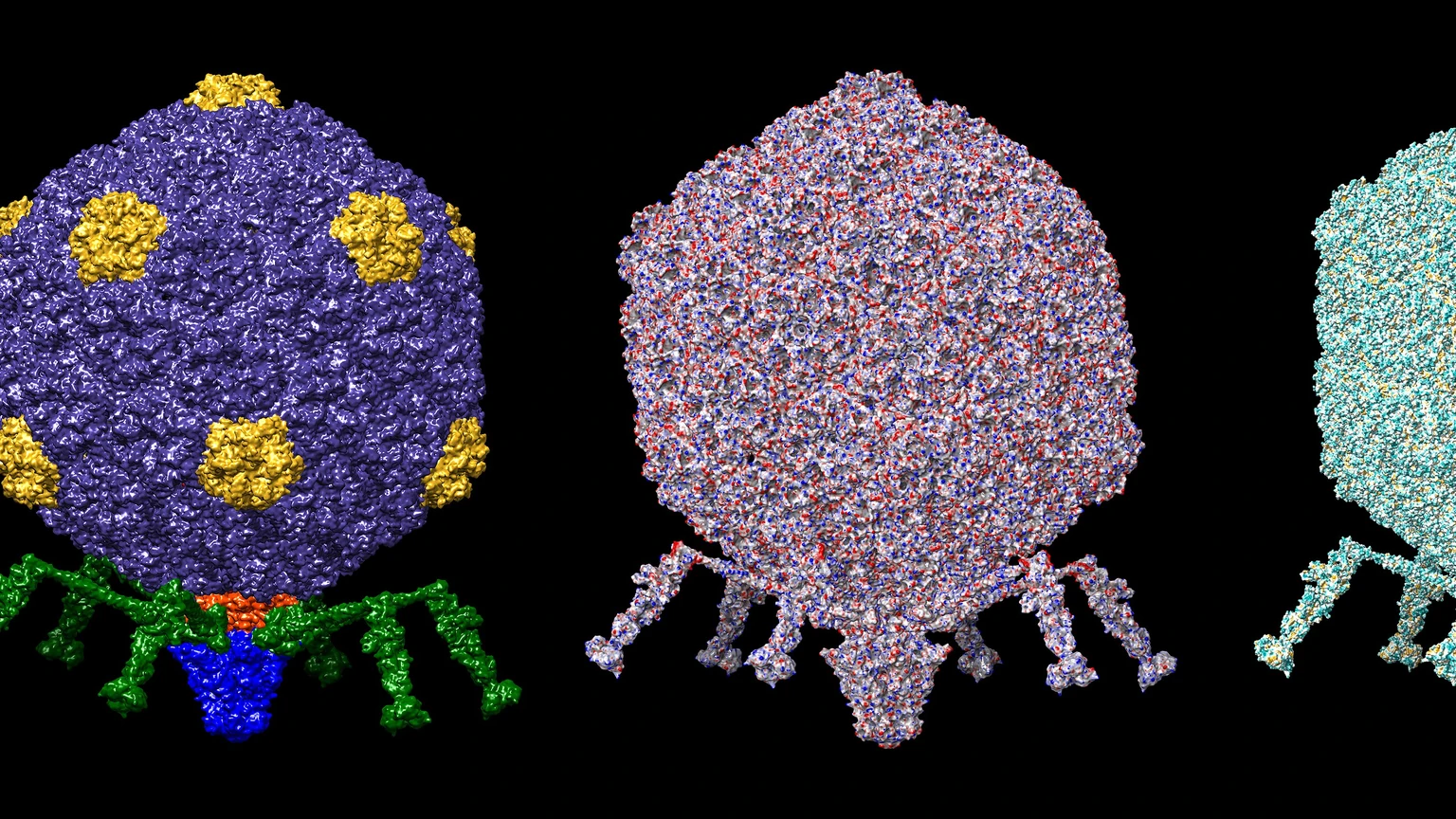
The viruses are bacteriophages, or phages: viruses that infect bacteria and leave human cells alone. The company trained a genome model called Omnii-1 to redesign a well-studied phage so it would attack the drug-resistant bacteria causing one patient's infection. The designed phage cocktail was administered under a physician-led compassionate-use pathway that the company says the US Food and Drug Administration authorised.
Radical Numerics is careful about what it is and is not claiming. It says the cocktail wiped out the patient's resistant bacterial sample in a dish, but it will not disclose the patient's clinical course or outcome, citing privacy, and the report has not been peer-reviewed. Chief executive Eric Nguyen told the Times the company intends to publish its findings through peer-reviewed research.
Why phage therapy is so hard to scale
Antibiotic resistance is one of the slower-moving crises in medicine. Radical Numerics cites an estimate that resistant infections could be linked to roughly 40 million deaths over 2025 to 2050. When antibiotics stop working, phage therapy is one of the few remaining options, and it is more than a century old.
The catch is that every phage infects only a narrow set of bacterial strains. To treat a patient, doctors normally have to hunt through phage collections, soil and water samples for a virus that happens to kill that person's exact strain, then test it. For someone with a severe infection, that search can take longer than they have.
Radical Numerics frames its model as a way to shorten that hunt by designing a phage to order. That is the same logic driving other recent AI-in-biology work, from Claude's designed protein binders against scorpion toxins to Google Research agents running wet-lab experiments to find cancer-target binders.
How Omnii-1 designs a phage
Omnii-1 is what Radical Numerics calls a multimodal genome language model: it is trained on DNA and other biological data, then fine-tuned on phage genomes. The company says it does not design a whole new virus from scratch. Instead it rewrites a chosen region of an existing phage while keeping the rest of the genome intact, the way a language model fills in a blank using the words on either side.
The target of the redesign was the phage's receptor-binding proteins, the parts that decide which bacteria it can latch onto. The company worked with T7, a much-studied phage that infects E. coli and has a roughly 40,000-letter genome, more than seven times the size of the tiny phage used in an earlier demonstration. By changing the DNA for T7's tail fibres, Omnii-1 could explore new patterns of which bacteria the phage recognises.
Radical Numerics also trained Omnii-1 to predict which phages will infect which bacterial strains, so it can prioritise the most promising designs before anyone grows them in a lab. The team was founded by people who previously built Evo, the Arc Institute genome model that generated viable phage-like genomes in 2025; the Times notes three Evo researchers, including Nguyen, left to start the company.
What the lab tests showed
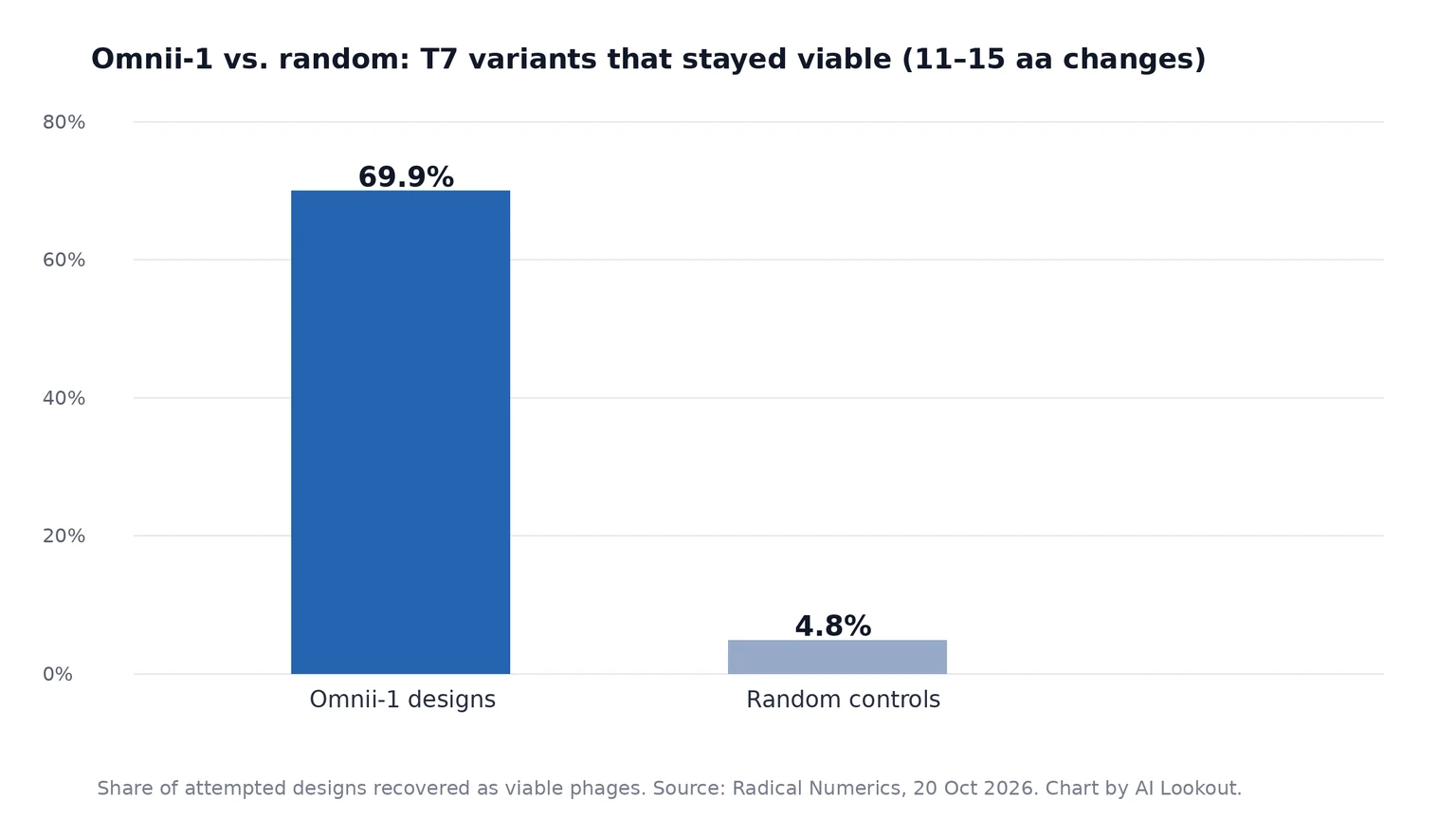
The company reports two main laboratory results. First, its designs stayed alive far more often than random changes would predict: among variants with 11 to 15 amino-acid changes from the natural phage, 69.9% were recovered as viable phages, against 4.8% of random controls. The advantage held across a wide range of edits, up to roughly 30 changes.
Second, many designs still worked. Of 6,694 variants with measurable activity, 2,161 beat the natural phage, some with as many as 28 amino-acid changes, while random controls that beat wild type had at most five. When asked to rank designs for specific bacterial strains, Omnii-1 put high-activity variants near the top: for two strains, 96 and 97 of its top 100 picks cleared the activity bar.
Radical Numerics also reports that Omnii-1's predictions of phage-host compatibility generalised to E. coli strains and to a second species, Pseudomonas aeruginosa, that were held out of training. These are the company's own numbers, drawn from its design campaigns, and have not been independently reproduced.
From the lab to a single patient
For the treatment itself, the company says it trained Omnii-1 on a specific resistant strain and asked it to design T7 phages whose tail fibres could grab that strain. The team built the DNA, grew the resulting phages, and confirmed in the lab that a cocktail containing the designed variants killed the patient's isolate in a dish.
Only then, Radical Numerics says, was the investigational cocktail given to the patient under compassionate use, a route that lets people with serious conditions try unapproved therapies when nothing else is left, subject to regulatory oversight. The company says it cannot share any clinical details because even a little information could identify the patient.
That silence is the heart of the caveat. The world-first claim is about designing and administering the phages, not about a cure: there is, so far, no public evidence of whether the patient got better.
What outside scientists make of it
Outside scientists quoted by the Times greeted the news with interest and caution. Michael Baym, a microbiologist at Harvard who was not involved, said that if it works, 'that's incredible', but added that his impulse was 'to be skeptical' until the treatment finishes and researchers can judge how novel the viruses really are.
Brandon Berryhill, an evolutionary microbiologist at Uppsala University, told the paper there is no guarantee AI-designed phages will work in a body, because lab activity does not reliably predict how a phage controls a real infection. Marisa Azad, an infectious-disease clinician at the Ottawa Hospital who is collaborating with the company, described how time-consuming phage hunting is today.
The common thread is a wait-and-see stance. Phage therapy can run for days or weeks, and doctors often watch patients for months to see if an infection rebounds, so the real test of this approach will not be settled quickly.
The safety and biosecurity questions
Designing viruses with AI revives a biosecurity debate. The same generative tools that can build a helpful phage could, in principle, be pointed at dangerous pathogens, a worry already raised about AI-designed proteins slipping past safety screening and about open genome models. Phages themselves do not infect human cells, which lowers the direct risk, but the design capability is general.
Radical Numerics says it is committed to biosafety and biosecurity precautions, including containment, disposal and data-sharing measures that it will adapt as the models improve, and that it is working with others in the field on responsible governance norms. The company did not publish the detailed safeguards in the post.
Independent experts also note a practical limit on misuse: predicting complex traits such as transmissibility is still unreliable, and turning a designed genome into a working virus takes real expertise and lab equipment.
What to watch next
Three things will tell whether this is a milestone or a press release. The first is peer review: Radical Numerics says a scientific paper is coming, which would let other researchers scrutinise the methods and the recovery and activity numbers.
The second is the patient. Any eventual disclosure of the clinical outcome, with appropriate consent, would show whether the designed phages actually helped. The third is repetition: a single compassionate-use case cannot establish safety or efficacy, so the approach has to work across more patients and more bacterial species before it means much.
For now, the honest summary is the company's own: this is an early step in moving AI-designed biology from a computer screen to a clinic, not a proven treatment. It joins a run of 2026 work, including DeepMind's agent that found an antimicrobial peptide candidate, testing how far generative models can reach into real-world medicine.
Common questions
Did the AI-designed phages cure the patient?
Unknown. Radical Numerics says the cocktail killed the patient's resistant bacteria in the lab and was then given under compassionate use, but it has not disclosed the clinical outcome, citing patient privacy.
Are these viruses dangerous to people?
Phages infect bacteria, not human cells, and are generally considered safe. The designed phage targets E. coli. The work does raise broader biosecurity questions about AI designing viruses, which the company says it is addressing with safety and governance measures.
Has the work been peer-reviewed?
No. The company posted a technical report on its own website and says it intends to publish peer-reviewed research later. The reported numbers have not been independently reproduced.
Sources & further reading
How this story was made
Written by Kristian Kostov with AI assistance and checked against the linked sources. Company performance claims are attributed to the company. Analysis reflects AiLookout’s interpretation; we have not independently tested the products discussed. Cover photography is illustrative and does not depict the specific announcement or product.
Our editorial standards