Announced 2 Nov 2026 · Sources checked
What Omen AI actually bought
Omen AI, a startup founded in 2024 that builds sensors for the fluid cooling AI chips, said on November 2 that it acquired Aquatic Labs for $16 million in cash and stock, according to its announcement. The deal is small by data center standards and specific by any standard: one company that measures what is dissolved in cooling fluid bought another that measures how acid that fluid can get.
Aquatic Labs founder Allan Adams joins as chief science officer and will lead research and development across Omen's sensing technologies, bringing his team, the company's intellectual property and its sensor research into the combined business. Omen said the acquisition is meant to speed up a longer project: cooling systems that maintain their own fluid instead of waiting for a human to send a sample to a laboratory.
The two technologies were built for the same job from opposite ends. Omen's sensors looked for elements in the water, while the Aquatic Labs sensor tests its alkalinity, the measure of how well a fluid neutralises acid. Putting both in one device produces a "much richer picture of the water and the fluid," Adams told TechCrunch.
The deal came together after Omen founder Zach Laberge was introduced to Adams by an investor in the filtration space. Both startups were chasing real-time water sensing, and both had concluded that sending fluid out for testing was the weak link in keeping a cooling system healthy.
Why coolant monitoring became a data center problem
United States data centers use 17 to 19 billion gallons of water to cool their hot-running chips each year, and that number is expected to triple in the next five years, according to The Water Foundation as cited by TechCrunch. That is both expensive and politically awkward for investors pouring billions into AI infrastructure, which is why water efficiency has moved from a sustainability footnote to a line item with an owner.
Monitoring is still mostly manual. Operators send fluid samples to a laboratory and wait days for results, which means a failing valve or a bacterial bloom can develop in the gap between tests. The failure modes are physical: bacteria growth can choke off flow, and off-spec fluid can corrode the metals it touches.
When the fluid goes out of range, operators usually dump it rather than risk damage to equipment worth more than the water. That means shutting down operations until the loop is refilled and treated, which is the expensive part. Continuous monitoring, the argument goes, lets a facility keep the same fluid longer and catch a drifting parameter before it becomes an outage.
Adams frames it as a waste-stream question as much as a cooling question. "Water goes into data centers, and then it comes out and gets dumped into municipal water, and you want that whole process to happen in a way that's as safe and responsible as possible — and that means you got to measure stuff," he told TechCrunch.
Inside the Sentry 1.2 sensor
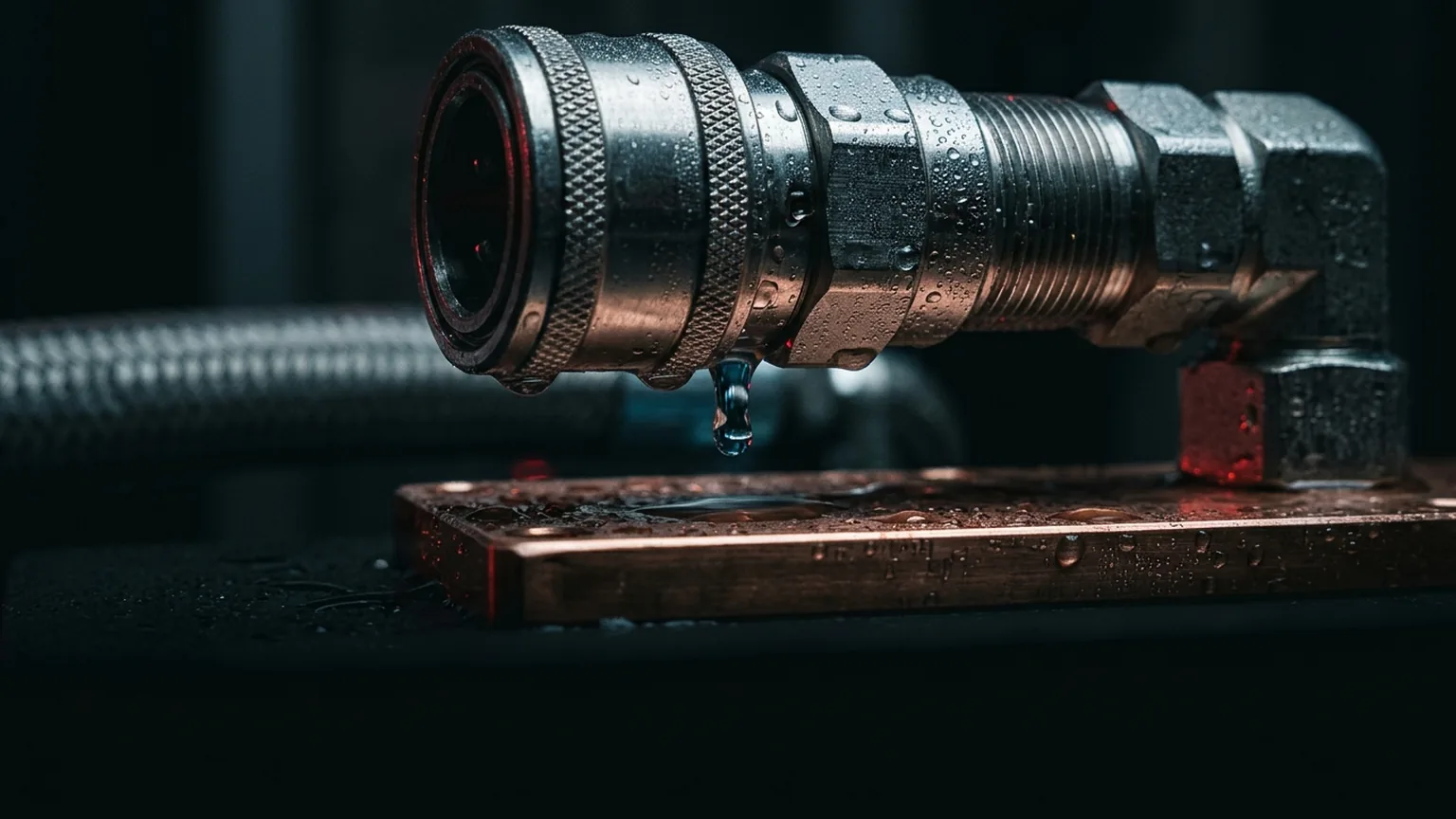
Omen's current hardware is not a laboratory on a pallet; it is a rack appliance. Public documentation for the Sentry 1.2, as reported by Unite.AI, describes a 4U optical fluid sensor in a 19-inch rack-mounted chassis measuring 7 by 19 by 18 inches. Two half-inch OCP UQD08 couplings tap the cooling loop in parallel bypass, which leaves the primary flow untouched, and the unit draws fluid automatically and runs multi-channel analysis on every sample.
The measured parameters are pH, total alkalinity, glycol concentration, conductivity, temperature and pressure. Readings stream to Omen Cloud over MQTT and into a facility's building-management system over Modbus TCP/IP through an RJ45 Ethernet connection. Each parameter is displayed beside its healthy band, and leaving that band opens an alert.
The specified operating range covers fluid pressures of 0 to 80 PSI and temperatures of 0 to 65 degrees Celsius, which puts it inside the envelope of a normal liquid-cooled rack rather than at the exotic edge. The bypass design matters commercially: it means the sensor can be retrofitted onto loops that were designed and financed before anyone thought about continuous fluid analytics.
That retrofit detail is also the reason Omen's team argues it is insulated from the current wobble in AI infrastructure spending. Its product goes onto machines that already exist.
The customers, the funding and the size of the bet
Omen announced a $31 million Series A led by Nava Ventures on June 30, 2026, reporting total funding of $41.5 million at the time. Other participants included CRV, Sheryl Sandberg, Vanderbilt University, Mann+Hummel and executives from Bridgestone, GM, Johnson Controls and TensorWave. With this acquisition the company reports $46 million in total funding and ongoing work in data centers with more than 10 GW of combined capacity.
The commercial numbers are targets rather than bookings. Omen's initial sensors will be monitoring chips pulling in 250 to 300 MW of power by the end of the year, worth about $5 to $7 billion, Laberge told TechCrunch, with the hope of being installed on the equivalent of 1 GW of chips by the end of 2027. Those are capacity figures for the equipment being monitored, not revenue for Omen.
Laberge argues the timing works because Omen sells into the operational side of the buildout rather than the financing side. "We're working customers on stuff they're building today or have already built, and so it doesn't really affect us because all of those projects were financed 12 months ago," he told TechCrunch. And on the broader mood: "Our view is, if there's tightness, this is still going to be the biggest market in human history, even if you sliced it in half."
The demand-side context is real, though not settled. AI companies once estimated as much as $4 trillion would be spent on AI infrastructure by 2030, but some investors have grown skeptical of the buildout, sending hyperscaler stocks down in recent days. Water and cooling costs sit inside that uncertainty, because every megawatt of liquid-cooled capacity creates a fluid loop that somebody has to keep in specification.
Two founders, two very different routes in
Laberge dropped out of high school to pursue his first company, which did similar fluid analysis for large construction machines that depend on hydraulics. That is a useful pedigree for data center cooling: hydraulic systems and coolant loops fail in the same unglamorous ways, through contamination, aeration and slow chemistry drift rather than dramatic blowouts.
Adams came from the opposite direction. He was trained as a physicist and spent much of his career developing advanced ocean sensing technology as an MIT professor of physics and a visiting oceanographer at the Woods Hole Oceanographic Institution before founding Aquatic Labs. His argument for why the two companies fit is unusually concrete: "The same chemistry corals use to build reefs also causes scale buildup in coffee machines and fouls data center cooling loops."
Adams will now run research and development across Omen's sensing technologies, which in practice means turning a physics-grade instrument into something a data center technician can install and trust. That translation step is where most sensor startups either make it or do not.
The parts that need watching
The public timelines do not agree. TechCrunch reported that the combined teams expect to have an integrated sensor on the market by early next year. Unite.AI reported that Omen expects to begin shipping products with the additional monitoring capabilities by the end of 2026, with automated adjustment of coolant chemistry left as a longer-term program. The difference between late 2026 and early 2027 is the difference between a revenue story this fiscal year and one that slips.
Omen has not published named customers, unit pricing or independent uptime results. The 250 to 300 MW and 1 GW figures are company targets, and the case that continuous monitoring reduces downtime rests on the operator's willingness to change procedures, not only on sensor accuracy.
There is also the integration bet itself. Combining an elemental analyser and an alkalinity sensor into one unit is a hardware problem with a chemistry problem inside it, and the two companies were competitors with separate engineering cultures until this month. Omen's own framing is that the harder goal, systems that treat their own fluid, needs both readings before automation is possible.
None of that makes the acquisition irrational. It makes it early. The interesting question is not whether coolant monitoring is useful, which is obvious, but whether it becomes a standard part of the cooling loop or a premium add-on bought only by operators who have already been burned.
What happens next
The near-term test is the integrated product: whether the combined sensor ships on the timeline Omen's own announcements imply, and whether existing Sentry installations can be upgraded in place rather than replaced. The medium-term test is standardisation, because a monitoring layer only becomes durable infrastructure when procurement teams specify it by default.
The read-across for the wider AI buildout is that cooling is turning into a measured subsystem, the way power monitoring did a decade ago. Every operator now knows what its racks draw. Fewer know what is growing inside the water.
Common questions
How much did Omen AI pay for Aquatic Labs?
Omen AI acquired Aquatic Labs for $16 million in cash and stock, announced on November 2, 2026. Aquatic Labs founder Allan Adams joined Omen as chief science officer and leads research and development.
What does Omen AI's sensor actually measure?
Per Omen's public Sentry 1.2 documentation, the rack-mounted unit measures pH, total alkalinity, glycol concentration, conductivity, temperature and pressure, drawing fluid from a parallel bypass on the cooling loop.
Does Omen AI only sell into new data centers?
No. The sensor taps the cooling loop through OCP quick-disconnect couplings in a bypass arrangement, so it is designed to retrofit onto loops that are already running.
Sources & further reading
How this story was made
Written by Kristian Kostov with AI assistance and checked against the linked sources. Company performance claims are attributed to the company. Analysis reflects AiLookout’s interpretation; we have not independently tested the products discussed. The cover is an AI-generated editorial illustration, not a photograph or evidence of an actual event.
Our editorial standards