Announced 11 Nov 2026 · Sources checked
What does New York's RAISE Act require?
The Responsible AI Safety and Education (RAISE) Act, signed earlier this year by Governor Kathy Hochul, takes effect at the start of 2027.
It mandates that large frontier AI developers with more than $500 million in annual revenue register with the state through a newly launched online portal. Companies like OpenAI and Anthropic are explicitly on the hook.
Once registered, these developers must publish safety frameworks on their websites, report critical safety incidents within 72 hours, and issue public model transparency reports.
The law is enforced by the newly formed Office of Digital Innovation, Governance, Integrity, and Trust (DIGIT), which opened the registration portal on Tuesday.
"Tech moguls tell us that their vision for AI is inevitable," Governor Hochul said during a press briefing. "They tell us get on board or get left behind.
That any collateral damage is worth it as long as we win the race to the AI cliff."
What are the penalties for non-compliance?
Violations carry stiff financial consequences. A first offense can result in a penalty of up to $1 million, while subsequent violations can reach $3 million.
The state can also bring enforcement actions against companies that fail to register, though a DIGIT spokesperson declined to provide specifics on what those actions might entail.
The penalties position New York as one of the most aggressive state-level enforcers of AI safety rules, surpassing the compliance costs companies face in other jurisdictions.
For companies operating at OpenAI's or Anthropic's scale, even a single violation represents a meaningful cost, but the reputational damage from a publicly reported safety incident could be far greater.
How does this compare to other state AI laws?
New York's RAISE Act joins a growing patchwork of state-level AI regulations across the country.
California's SB 53, which took effect in January, also requires frontier AI labs to publish safety frameworks, enact whistleblower protections, and report critical safety incidents within 15 days.
Illinois' SB 315, effective at the start of 2027, adds independent safety compliance audits to similar requirements.
New York's 72-hour incident reporting window is the strictest of the three, signaling a deliberate escalation in enforcement speed.
The RAISE Act also goes further by establishing a dedicated oversight body in DIGIT and an independent research center to evaluate AI systems.
Companies operating across multiple states now face a compliance puzzle: each jurisdiction has slightly different deadlines, reporting thresholds, and audit requirements.
What is the New York Center for AI Responsibility and Research?
Governor Hochul also announced the launch of the New York Center for AI Responsibility and Research (NYCAIRR), based at SUNY Binghamton.
The center will bring together more than 80 researchers from across the state to independently test and evaluate advanced AI systems for safety and security. It marks the first state-level initiative of its kind in the country.
World-renowned computer scientists Greg Morrisett of Cornell Tech and Jeannette Wing of Columbia University will serve as interim co-directors.
Morrisett is the Dean and Vice Provost of Cornell Tech, and Wing is the Executive Vice President for Research at Columbia University.
Both have spent their careers studying how complex computing systems operate, where they can fail, and how to make them more secure.
The center is supported by Empire AI, Governor Hochul's $500 million public-private initiative for AI research, plus an initial $30 million philanthropic gift from a group of donors led by Binghamton alumnus and Bloomberg LP co-founder Tom Secunda, paired with an initial $25 million research investment from SUNY.
"While the federal government fails to act, New York is leading the way on AI safety and holding big tech accountable," Hochul said. "The stakes are too high to simply take AI companies at their word.
That's why we are bringing together our world-class researchers and the computing power of Empire AI to independently test powerful AI systems, understand their risks and put that knowledge to work protecting New Yorkers."
NYCAIRR's founding mission is to advance the science of AI and use AI to accelerate discoveries across scientific fields.
Its research will focus on understanding how increasingly powerful systems work, developing ways to test their safety and security, ensuring they behave as intended, and exploring how AI can be used responsibly to advance scientific discovery.
One of its first objectives is a national recruiting effort for experts in foundational limits and mathematical theory, formal methods and verification, agentic and complex systems, hardware security and privacy, interpretability and alignment, and scientific AI and biosecurity.
What other AI safety laws has New York passed?
The RAISE Act is not New York's only AI safety legislation.
Last year, the state began enforcing a law requiring AI companion operators to notify users they are speaking with a bot and to make reasonable efforts to detect suicidal ideation and self-harm.
In October, Hochul signed a separate chatbot safety law for minors, banning deceptive human-like interactions, emotionally manipulative or sycophantic responses, and encouragement of behaviors like suicide or disordered eating. That law takes effect June 1, 2027.
Together, these laws form one of the most comprehensive state-level AI regulatory frameworks in the country, covering everything from frontier model development to consumer-facing chatbot interactions.
The approach mirrors the tiered strategy seen in European AI regulation: higher obligations for the most capable systems, combined with consumer protections for everyday AI use.
What does this mean for the AI industry?
The RAISE Act represents a significant shift in the regulatory landscape for AI companies. While federal AI legislation has stalled, states are moving aggressively to fill the gap.
For frontier AI labs, compliance is no longer optional — it is an operational requirement with real financial teeth.
The 72-hour incident reporting requirement, in particular, forces companies to maintain continuous monitoring and rapid response capabilities that many have not yet built.
The creation of NYCAIRR also signals that independent evaluation will play a growing role in AI governance.
Rather than relying solely on companies' self-assessments of their models' capabilities and risks, New York is building institutional capacity to verify safety claims with its own testing.
This could set a precedent for other states and potentially influence federal policy down the line, especially as the debate over a national AI safety framework continues without resolution.
For now, the immediate task for companies like OpenAI and Anthropic is clear: register by January 1, 2027, or face the consequences. The portal is open, the clock is ticking, and New York has made its position unmistakable.
Common questions
Which companies are affected by New York's RAISE Act?
The law targets frontier AI developers operating in New York, with additional requirements for large frontier developers with more than $500 million in annual revenue. OpenAI and Anthropic are explicitly among those required to register.
What are the penalties for violating the RAISE Act?
Violations carry penalties of up to $1 million for a first offense and up to $3 million for subsequent violations, enforced by the new Office of DIGIT.
How does New York's law compare to other state AI regulations?
California's SB 53 took effect in January with similar safety framework requirements and 15-day incident reporting. Illinois' SB 315 takes effect at the start of 2027 and adds independent safety compliance audits.
New York's 72-hour reporting requirement is the strictest nationally.
Sources & further reading
How this story was made
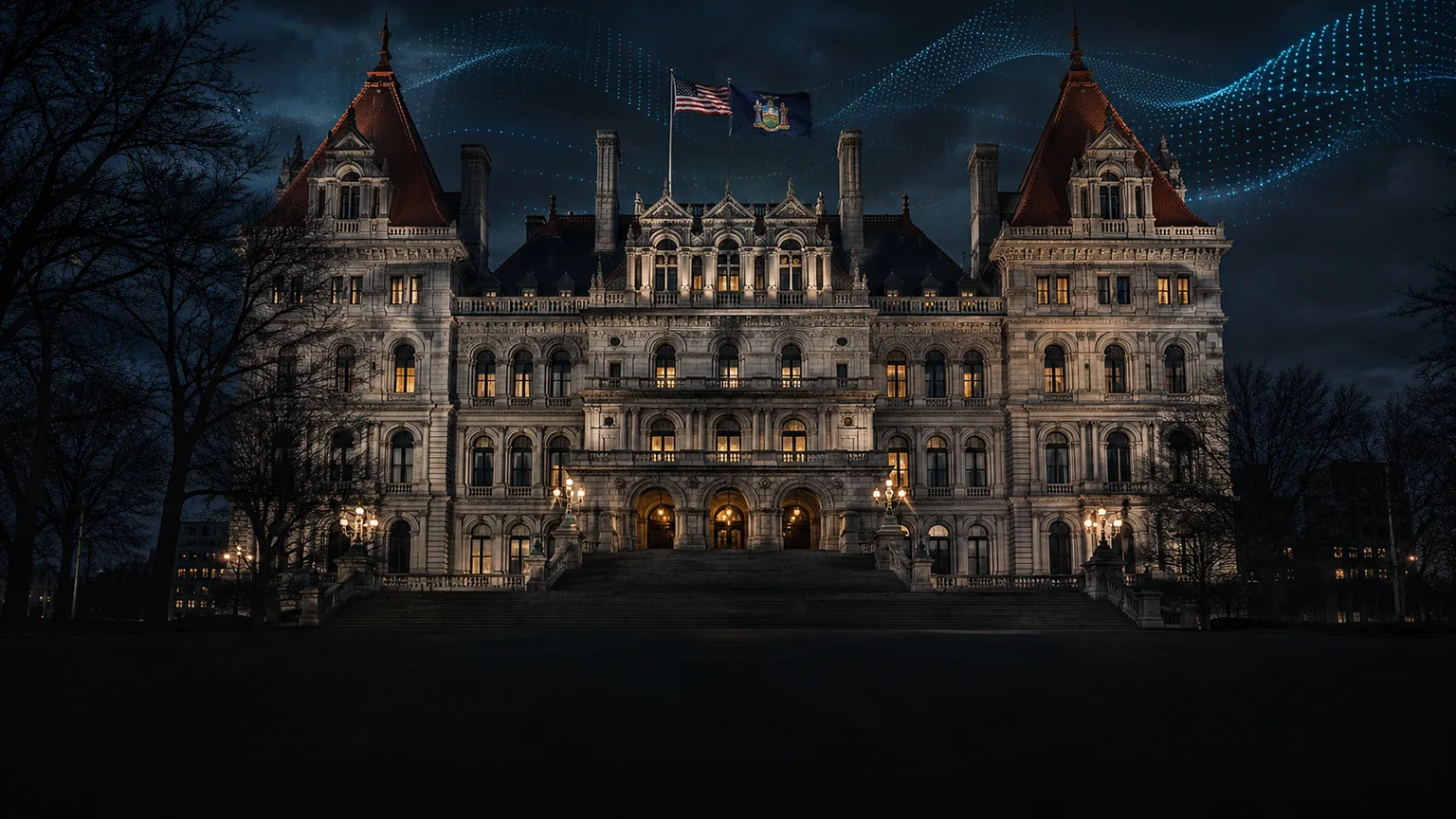
Written by Kristian Kostov with AI assistance and checked against the linked sources. Company performance claims are attributed to the company. Analysis reflects AiLookout’s interpretation; we have not independently tested the products discussed. The cover is an AI-generated editorial illustration, not a photograph or evidence of an actual event.
Our editorial standards