Announced 12 Oct 2026 · Sources checked
What did Intel announce at OCP 2026?
Intel used the 2026 OCP Global Summit to give its long-promised inference GPU a name. In a newsroom release on 12 October, the company said the chip code-named Crescent Island will be sold as the Intel GPU D-series, and it published the final headline specifications of the first card, the GPU D270.
Intel’s pitch is economy rather than peak speed. It describes the D-series as designed to “improve the economics of sustained, memory-intensive AI inference”, the kind of work that AI agents generate when they keep long contexts in memory across many steps and many users. Anil Nanduri, Intel’s vice president for AI products, said the aim is to make high-capacity inference “practical to deploy and economical to scale”.
Crescent Island has had a long run-up. Intel first announced it at the 2025 OCP summit as an interim product after cancelling two successors to its Ponte Vecchio data-centre GPU, and showed the architecture at Hot Chips 2026 in August. It is Intel’s first commercial AI-focused data-centre GPU since Ponte Vecchio in 2021, according to ServeTheHome.
What are the Intel GPU D270’s specifications?
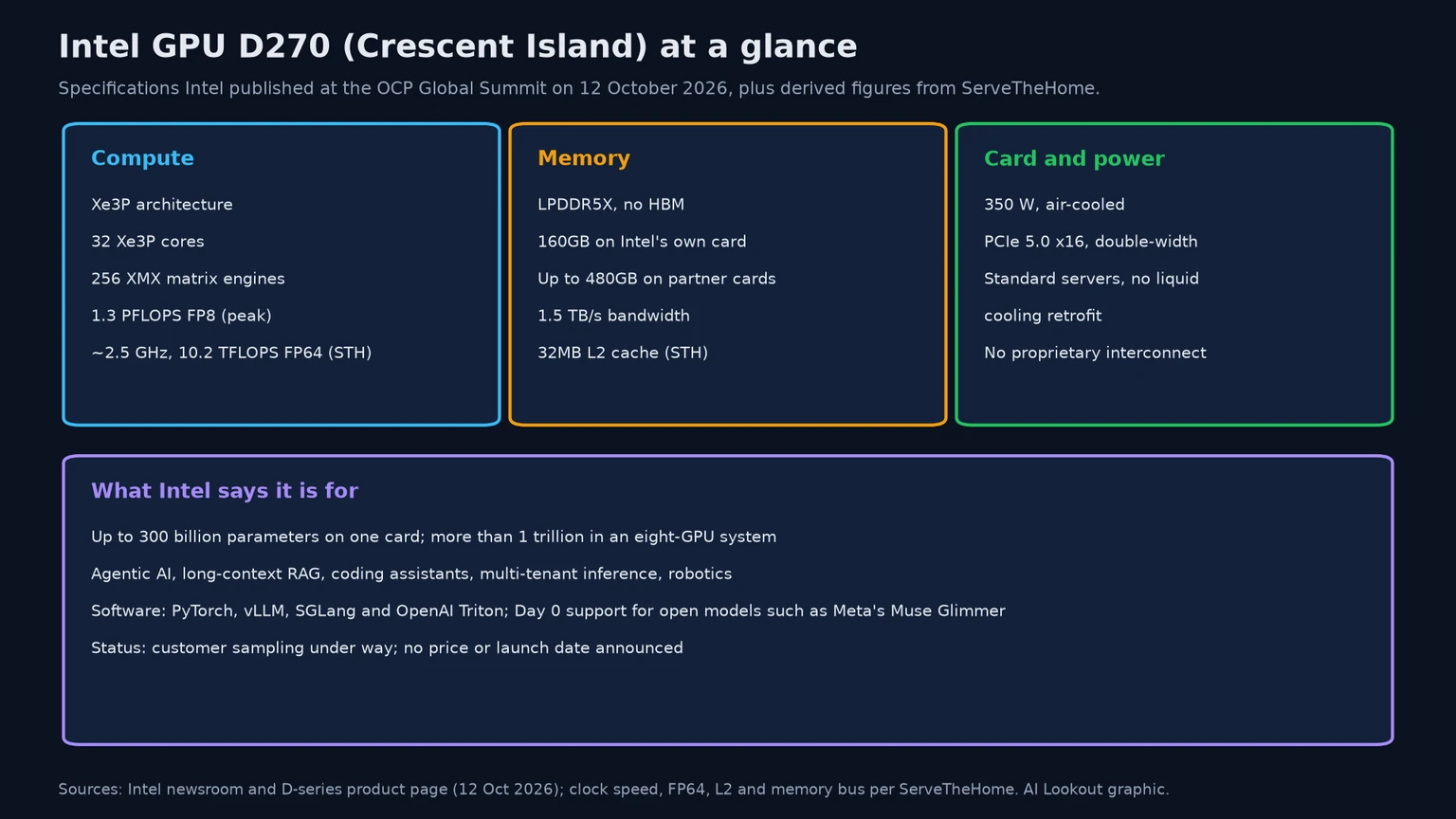
According to Intel’s D-series product page, the D270 has 32 Xe3P cores and 256 XMX matrix engines, built on Xe3P, an enhanced version of the Xe3 graphics architecture in which die area normally spent on graphics and ray tracing goes to matrix compute instead. Intel quotes 1.3 petaflops of FP8 compute and 1.5 terabytes per second of memory bandwidth, and says the chip also handles FP64 for scientific work.
The card is a standard double-width PCIe 5.0 card rated at 350 watts and cooled by air, so it can go into existing servers without liquid-cooling retrofits or a proprietary interconnect. ServeTheHome worked out the rest from Intel’s numbers: a clock speed of roughly 2.5GHz, 10.2 teraflops of FP64 vector throughput, 32MB of L2 cache, ECC memory, and a 1,280-bit LPDDR5X bus built from 20 memory chips running at about 9,375 megatransfers per second.
Memory comes in two sizes. Intel’s own branded card carries 160GB of LPDDR5X. Partner manufacturers can build cards with up to 480GB using larger memory chips, which ServeTheHome notes is more than any other PCIe accelerator announced so far. Intel says that is enough for models of up to 300 billion parameters on one card and more than a trillion in an eight-GPU server.
Why does Intel use LPDDR5X instead of HBM?
Most AI accelerators use high-bandwidth memory (HBM), stacked chips that deliver several terabytes per second but are expensive and in short supply. LPDDR5X, the memory used in laptops and phones, is far cheaper per gigabyte and easier to buy in bulk, but much slower. Intel’s bet is that for inference, especially for agents, capacity matters more than raw bandwidth.
Intel’s product page puts it plainly: agents “read far more than they write”, with long contexts and multi-step workflows in which much of the compute goes on prefill, the stage where a model processes the prompt. Keeping the whole model and a 100,000-token context resident on one card avoids splitting work across several GPUs. That trade-off is why the balance of memory, bandwidth and compute matters as much as the headline teraflops. Token generation is usually limited by bandwidth, so long, chatty outputs will be slower on 1.5 TB/s than on HBM cards with several times that figure.
How does the D270 compare with AMD and NVIDIA cards?
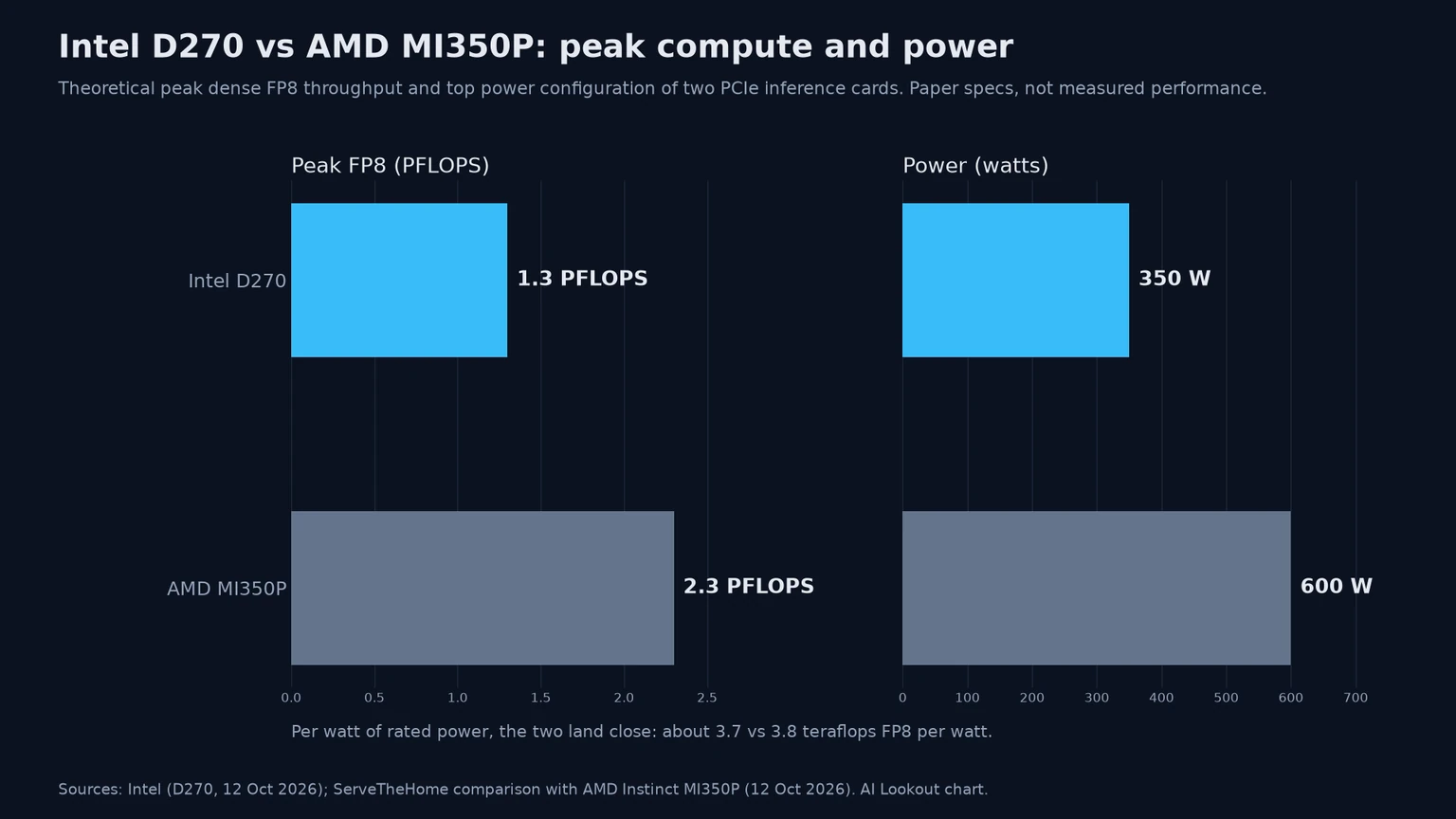
ServeTheHome compared the D270 with AMD’s Instinct MI350P, a PCIe card of similar form that offers 2.3 petaflops of dense FP8, about 40% more than Intel’s 1.3. But the MI350P’s fastest configuration draws 600 watts against the D270’s 350, so on rated power the two land close, at roughly 3.7 and 3.8 teraflops per watt. The MI350P is also the GPU AMD offers in its Helion enterprise rack, shown at the same summit.
The D270 is not meant to compete with flagship chips such as NVIDIA’s Blackwell Ultra or AMD’s MI455X, which are far larger and more expensive parts. Intel’s own product page claims an advantage over NVIDIA’s RTX Pro 6000 on memory capacity at comparable bandwidth, based on public information and Intel’s analysis as of February 2026. Theoretical specs often mislead across architectures, and no independent benchmarks exist yet.
Who is the Intel GPU D-series for?
Intel lists enterprise AI, software-as-a-service companies, GPU cloud providers and government or sovereign-cloud deployments as targets. Workloads include agentic AI, long-context retrieval-augmented generation, coding assistants, document understanding, multimodal models, diffusion models and high-concurrency serving, plus robotics and other latency-sensitive jobs.
On software, Intel promises support for PyTorch, vLLM, SGLang and OpenAI’s Triton, with Day 0 support for new open models; it cites Meta’s Muse Glimmer as a recent example. Phoronix notes that open-source Linux driver support for Crescent Island has been landing upstream, which should help by the time cards ship at scale. Intel has struggled to build a software following for its earlier data-centre GPUs, so this will matter as much as the hardware.
What else did Intel show at the summit?
The D-series was one part of a wider message about “open, heterogeneous infrastructure”. Intel showed Xeon-based rack designs built with partners on OCP’s Open Rack v3 standard, saying some Xeon 6+ configurations exceed 46,000 cores per rack at 133.45 kilowatts. Its AI for Enterprise Agent Toolkit runs on Xeon today and is designed to extend to Intel GPUs.
Intel also highlighted its work in OCP’s Open Adapter Card group on a standard sub-rack accelerator card form factor, and says it has made 116 contributions to OCP since 2011. The summit’s other big hardware news included NVIDIA opening its Vera Rubin rack designs and Meta’s new liquid-cooled switches. Nicolas Dubé, the Intel corporate vice president who runs its Data Center Systems and Solutions Group, is due to give a keynote titled “Put Every Prompt in Its Place” on 13 October.
What is still unknown?
Intel has not announced a price, a launch date or which server makers will ship D270 systems, and it has not said whether cards will ship this year. ServeTheHome expects buyers to look to 2027. Price will decide whether LPDDR5X’s cost advantage reaches customers.
All performance figures are theoretical peaks from Intel or derived from them. Intel has published no measured throughput, latency or tokens-per-second results for real models, and the 300-billion-parameter claim depends on precision and context length, which Intel does not specify. We have not tested the card; this article is based on Intel’s release and product page and reporting by ServeTheHome and Phoronix.
Common questions
What is the Intel GPU D270?
The first card in Intel’s GPU D-series, formerly code-named Crescent Island: a 350-watt, air-cooled PCIe inference GPU with 1.3 petaflops of FP8 and up to 480GB of LPDDR5X memory.
When will the Intel GPU D-series be available?
Intel says customer sampling is under way but has announced no launch date or price. ServeTheHome expects availability in 2027.
Why does the D270 use LPDDR5X instead of HBM?
LPDDR5X is cheaper and easier to source, allowing up to 480GB per card. Intel trades bandwidth for capacity, aiming at long-context and agent inference.
What to remember
Intel has branded Crescent Island as the GPU D-series and published D270 specs: 1.3 petaflops FP8, 1.5 TB/s and up to 480GB of LPDDR5X at 350 watts in a standard PCIe card. It is sampling to customers, with no price or date yet.
Sources & further reading
How this story was made
Written by Kristian Kostov with AI assistance and checked against the linked sources. Company performance claims are attributed to the company. Analysis reflects AiLookout’s interpretation; we have not independently tested the products discussed. Cover photography is illustrative and does not depict the specific announcement or product.
Our editorial standards