Announced 14 Oct 2026 · Sources checked
What Gartner published
On 14 October 2026, research firm Gartner published a newsroom release arguing that more than $3.5 trillion of artificial-intelligence infrastructure spending could be exposed to impairment by the end of 2030 if providers keep investing at their current pace. The same note predicts that by 2030, cost pressure and a thin differentiating product will push more than 80% of neocloud providers to stop operating as independent companies.
The release centres on one arithmetic claim. Gartner says AI providers are on track to spend nearly $1 trillion on AI infrastructure in 2026 and another $6 trillion between 2027 and 2030. Against that build-out, Will Sommer, a senior director analyst at Gartner, says enterprise and consumer AI revenue will not be enough to support profitable returns on every planned capital project in the period.
Secondary write-ups in The Hindu Business Line and AI Affairs repeat the same headline numbers from the press release. The underlying Gartner note for clients, Prepare for AI Market Consolidation: Capital Write-Downs Could Exceed $4 Trillion by 2032, is behind the firm’s paywall; this article sticks to figures Gartner put in the public release.
The revenue gap behind the $3.5 trillion figure
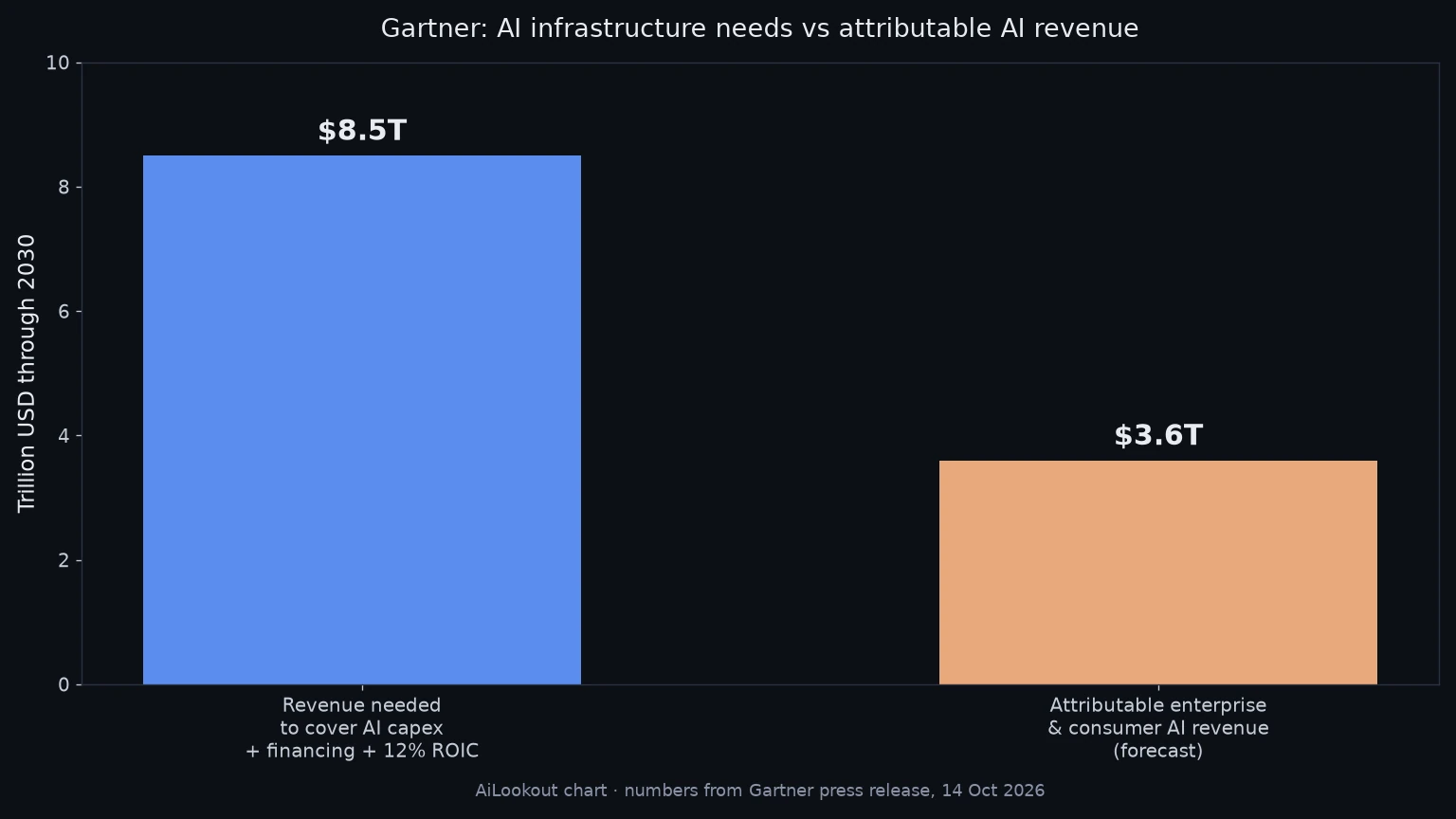
Sommer’s quoted bridge from capex to impairment is explicit. Through 2030, he says, AI data-centre owners would need about $8.5 trillion in cumulative revenue to cover announced capital spending, financing costs, and a 12% return on invested capital that Gartner treats as the hurdle rate. In the same window, Gartner forecasts that total enterprise and consumer AI revenue attributable to AI data centres will reach no more than $3.6 trillion.
That $8.5 trillion versus $3.6 trillion gap is the heart of the story. Gartner adds that most AI-native product companies run asset-light models, so it expects less than half of AI revenue to be earned by the firms that actually own large AI infrastructure. If returns stay weak on assets that depreciate quickly, the release says write-downs become almost certain.
On the longer horizon, Gartner’s public note says a continued investment path could leave more than $4 trillion of asset value exposed to write-down risk through 2032, and that the 12% ROIC would not arrive before the end of 2032 in that scenario. Those are Gartner’s modelled outcomes, not audited impairment charges already booked by named operators.
Why neoclouds look most exposed
Gartner singles out neoclouds — specialist AI cloud providers that sell GPU-heavy capacity rather than a full hyperscale suite — as the group most exposed to the revenue-capex mismatch. Hyperscalers, the release notes, have large and diversified revenue bases that could keep funding AI builds for years. Neoclouds, by contrast, need returns on AI-optimised infrastructure-as-a-service and related platforms soon enough to stay independent.
The public release gives one demand path for that market: AI-optimised IaaS spending growing from $66 billion in 2027 to $174 billion in 2030. Sommer’s quoted warning is that even that growth is too low for most AI compute providers to recover their investments before the current generation of AI semiconductors is replaced. Chip refresh cycles shrink the payback window; that is why the impairment language is timed to this decade rather than a vague long run.
The 80% neocloud-exit prediction is a consolidation call, not a list of companies Gartner says will fail. The release does not name which specialists it counts as neoclouds, nor which of today’s GPU-cloud brands it expects to be acquired, wound down, or folded into larger clouds.
What this does and does not say about hyperscalers
Nothing in the public note says Amazon, Microsoft, Google, Meta, or Oracle must take a $3.5 trillion write-down. The headline exposure figure is a sector-wide sum of planned AI infrastructure spend that Gartner thinks may not earn the assumed return, not a single balance-sheet loss. Diversified hyperscalers can fund AI projects from other businesses even when AI returns lag; Gartner’s sharper warning is aimed at pure-play capacity sellers.
That distinction matters next to other infrastructure stories we have covered. Physical damage can remove capacity overnight, as when drone strikes hit Yandex data centres housing AI systems. Policy can change who may buy or sell advanced gear, as in China’s draft export-control catalogue for AI technologies. Gartner’s warning is financial: even if racks stay powered and chips keep shipping, the cash needed to justify the build may not arrive on the schedule investors are underwriting.
Consumer and edge hardware is a related but separate spend line. NVIDIA’s RTX Spark laptop launch is about local inference devices, not the multi-trillion data-centre programme Gartner models. Mixing those markets would blur who is actually exposed to the impairment path Gartner describes.
How the warning sits next to other AI-spend stories
Gartner’s note lands in a week when AI politics and labelling are also in flux. The IMF committee wording fight over super-intelligence language is about how governments talk about advanced systems; Gartner is talking about whether the hardware stack behind those systems can earn a hurdle-rate return. Both are claims about AI ambition outrunning the supporting apparatus, but one is diplomatic and the other is capital.
Read narrowly, the release is a sell-side research warning dressed as a press note: if announced AI data-centre programmes proceed without a matching revenue path, Gartner expects write-downs and neocloud consolidation. Read broadly, it is a reminder that model-lab valuations and GPU order books are not the same as attributable AI revenue that can service the metal.
Investors already debate AI bubble risk in markets coverage; Gartner’s contribution is a quantified capex-versus-revenue frame with a named ROIC hurdle and an explicit neocloud consolidation share. Whether those inputs hold is a separate question from whether the firm stated them clearly.
Limits of the forecast
Several limits sit in the public text. Gartner does not publish the full model, the company-by-company capex list, or the method for attributing enterprise and consumer AI revenue to data centres. The 12% ROIC is an assumption Gartner labels as its hurdle rate, not a regulatory requirement. The $3.5 trillion impairment exposure and the $4 trillion write-down exposure through 2032 are scenario outputs if spending continues on the current path.
The release also does not separate training clusters from inference fleets, owned racks from leased capacity, or United States builds from Middle East and Asian projects. Those mixes change who books an impairment and when. Client research may go deeper; outsiders only have the newsroom numbers.
Finally, impairment is an accounting outcome after management and auditors judge recoverable value. A research forecast of exposure is not the same as a filed write-down. Markets can reprice equity long before any company records the charge Gartner’s scenario implies.
What to watch next
Watch for three follow-ups. First, whether named neoclouds announce mergers, distressed sales, or capacity freezes that match Gartner’s consolidation language. Second, whether hyperscalers slow or stretch AI data-centre programmes in earnings calls after this note. Third, whether Gartner publishes a public update that revises the $8.5 trillion need, the $3.6 trillion revenue ceiling, or the 80% neocloud-exit share.
Until then, the usable decision rule is modest: treat multi-trillion AI infrastructure plans as exposed to write-down risk when attributable AI revenue and semiconductor refresh cycles cannot clearly cover the capex at a stated return — and treat Gartner’s figures as one quantified warning, not a completed round of impairments.
Common questions
Did Gartner say a specific company will write down $3.5 trillion?
No. The figure is sector-wide exposure if planned AI infrastructure spending continues without matching returns. The release does not assign that sum to one balance sheet.
What is a neocloud in this release?
Gartner uses the term for specialist AI cloud providers that depend on AI-optimised IaaS returns. It does not publish a named list of companies in the public note.
Is the 12% return a hard rule?
No. Gartner states 12% ROIC as the hurdle rate it assumes for invested capital in the scenario. Other investors may use different hurdles.
Sources & further reading
How this story was made
Written by Kristian Kostov with AI assistance and checked against the linked sources. Company performance claims are attributed to the company. Analysis reflects AiLookout’s interpretation; we have not independently tested the products discussed. The cover places the companies’ own logos, taken from public-domain or openly licensed files credited in the caption, on a plain background. It is not a product photograph, a screenshot, or an endorsement.
Our editorial standards