Announced 11 Oct 2026 · Sources checked
What happened to Yandex's data centres
Three of Yandex's data centres were hit by drones in four days, and two of them, the sites that hold the company's AI supercomputers, were shut down completely. Yandex, the Russian search and AI company, said in a statement on 9 October that its data centre in Sasovo, in the Ryazan region south-east of Moscow, had been "seriously damaged in a drone attack" overnight on 7 to 8 October and "completely shut down". The same morning a second site, in Kaluga, was attacked and "part of its infrastructure is out of service". No employees were hurt.
The third strike came early on 11 October. Yandex's cloud unit said in a service alert that operations at its Vladimir data centre had been "completely suspended", Al Jazeera reported, and it warned customers that "the remaining resource configuration is considered unstable". Yandex Cloud told customers to switch to their own disaster-recovery plans while the platform ran in emergency mode.
Yandex's own statement speaks only of drone attacks; Reuters and Russian regional officials attributed them to Ukraine. Meduza reported that the Sasovo fire started on the grounds of a sanctioned machine-tool plant whose former buildings Yandex has used since 2014, and that it was unclear whether the plant or the data centre was the target. Speaking on 8 October, President Volodymyr Zelensky said Ukraine was able to hit Russian data centres and "always responds in kind", after weeks of Russian strikes on data centres in Kyiv, according to Kyiv Independent reporting cited by Supercomputing News. Ukraine has not formally claimed each attack.
The AI supercomputers inside
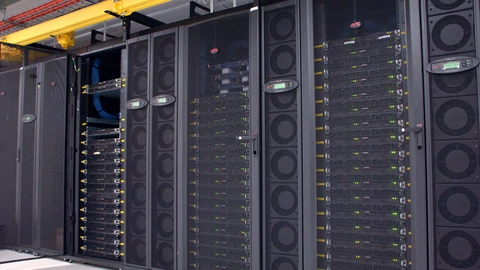
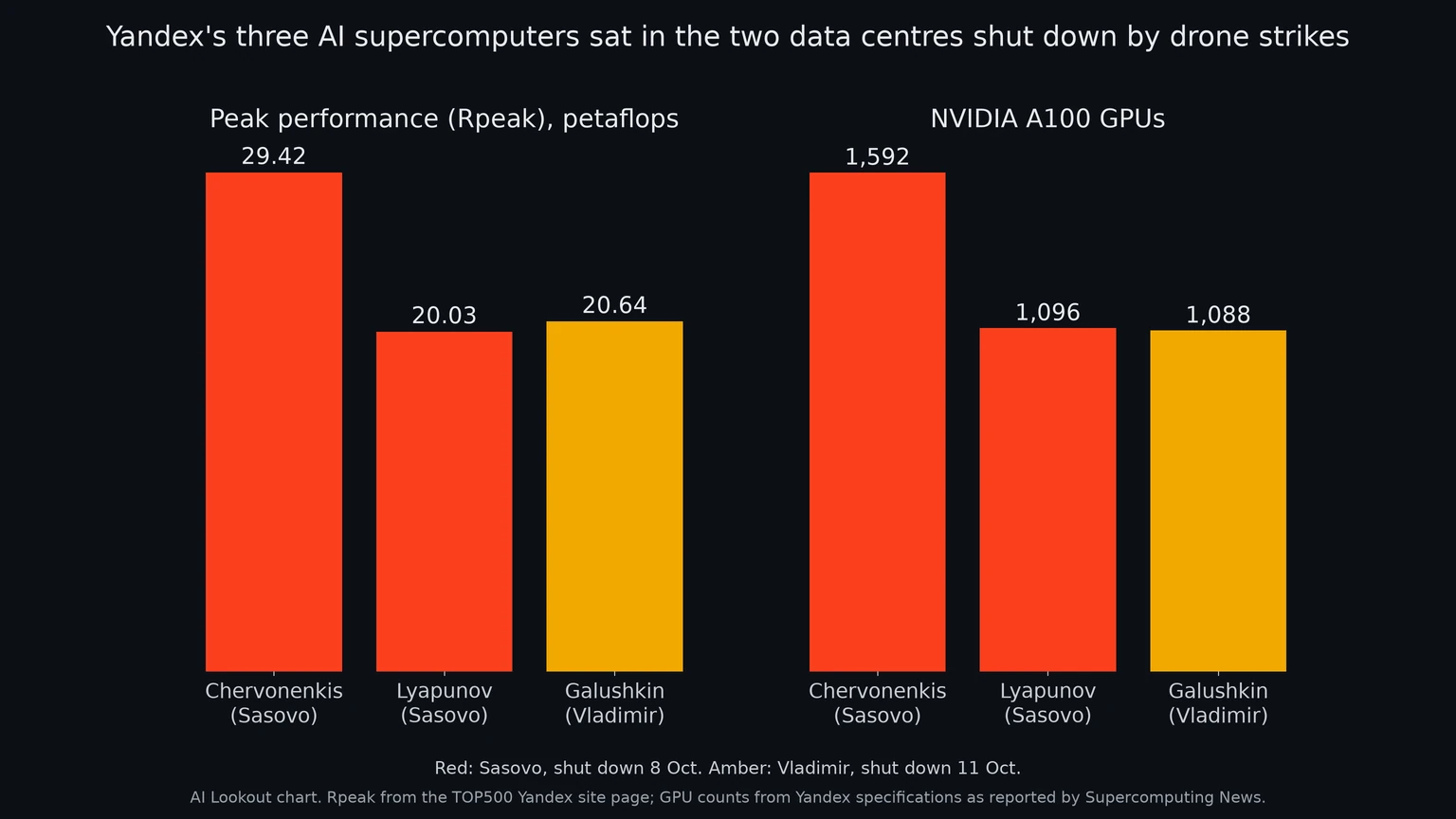
Yandex has three supercomputers that it built to train neural networks, and all of them sat in the two sites that went dark. Chervonenkis and Lyapunov were in Sasovo; Galushkin was in Vladimir. The TOP500 list still ranks them as Russia's three most powerful systems, at 101st, 134th and 161st in the world in June 2026, down from 19th, 36th and 40th when they entered the list in 2021.
Chervonenkis is the largest, with a theoretical peak of 29.4 petaflops; Galushkin and Lyapunov are each rated at just over 20 petaflops. All three pair AMD EPYC processors with NVIDIA A100 GPUs on InfiniBand networks. By Yandex's published specifications, they hold 3,776 A100s between them: 1,592 in Chervonenkis, 1,096 in Lyapunov and 1,088 in Galushkin.
In 2021 Yandex said it used the machines to train models for Translate and advertising and its YaLM language models behind Search answers and the Alice assistant; a later job listing tied them to YandexGPT. Reuters, in a report carried by The Straits Times, described the Sasovo machines as two of the three supercomputers used to develop Yandex's AI model. Whether Yandex's newest training runs still depend on these 2020 and 2021 machines has not been made public.
What broke for Yandex users and AI developers
The outages spread far beyond research. Yandex said on 8 October that it could not yet confirm "whether it is possible to restore the data centre equipment in Sasovo", which Reuters described as one of its five large data centres, hosting tens of thousands of servers. Over the following days, St Petersburg paper Fontanka reported disruption to Yandex search, maps, taxis, mail, Alice and payments, and to outside companies on Yandex Cloud, including the website of Pulkovo airport.
Supercomputing News reported that the two shut-down sites powered the only Yandex Cloud zones where customers could rent A100 and V100 GPU servers. Yandex arranged for rival providers VK Cloud, Selectel and K2Cloud to take in affected customers on a fast track, and Russia's digital ministry helped it find extra sites for key systems, according to Fontanka.
For AI developers, the clearest picture came from a Yandex Cloud status update on 14 October, summarised by Fontanka. Its chat and Responses APIs were working again with YandexGPT 5.1, YandexGPT 5, Alice AI LLM and hosted open models including DeepSeek V4.1 Flash and Qwen 3.6 35B, as were embeddings, image generation, its MCP Hub, code interpreter and fine-tuning. Three services were still down: Workflows, the Batch Inference API and Dedicated Models, which run customers' models on their own servers. Yandex warned that quotas for new resources could be limited across all services.
Why the GPUs are hard to replace
Yandex has not said whether any of the supercomputers was physically damaged, and it gave no recovery date. "For now, it is very difficult to say when the equipment at the data centers will be back up and running," its 9 October statement said.
Outside specialists quoted by the Russian science outlet T-invariant believe all three systems were badly damaged, partly because smoke and soot can ruin air-cooled servers that the flames never reached. They suggested cleaning and repairs could take up to six months, and replacing hardware one to two years, as Factum summarised. Those are expert estimates, not Yandex's assessment.
Replacement is the harder problem. Since February 2022, US export rules have required licences, reviewed under a policy of denial, for A100-class chips going to Russia, and NVIDIA said in 2022 that it does not sell products to customers there. Any lost A100s cannot simply be reordered. That makes the strikes a test of how far export controls bite once existing hardware is gone, the same lever China is now reaching for with its proposed controls on AI technologies.
A Ukrainian report links the outages to quieter bot networks
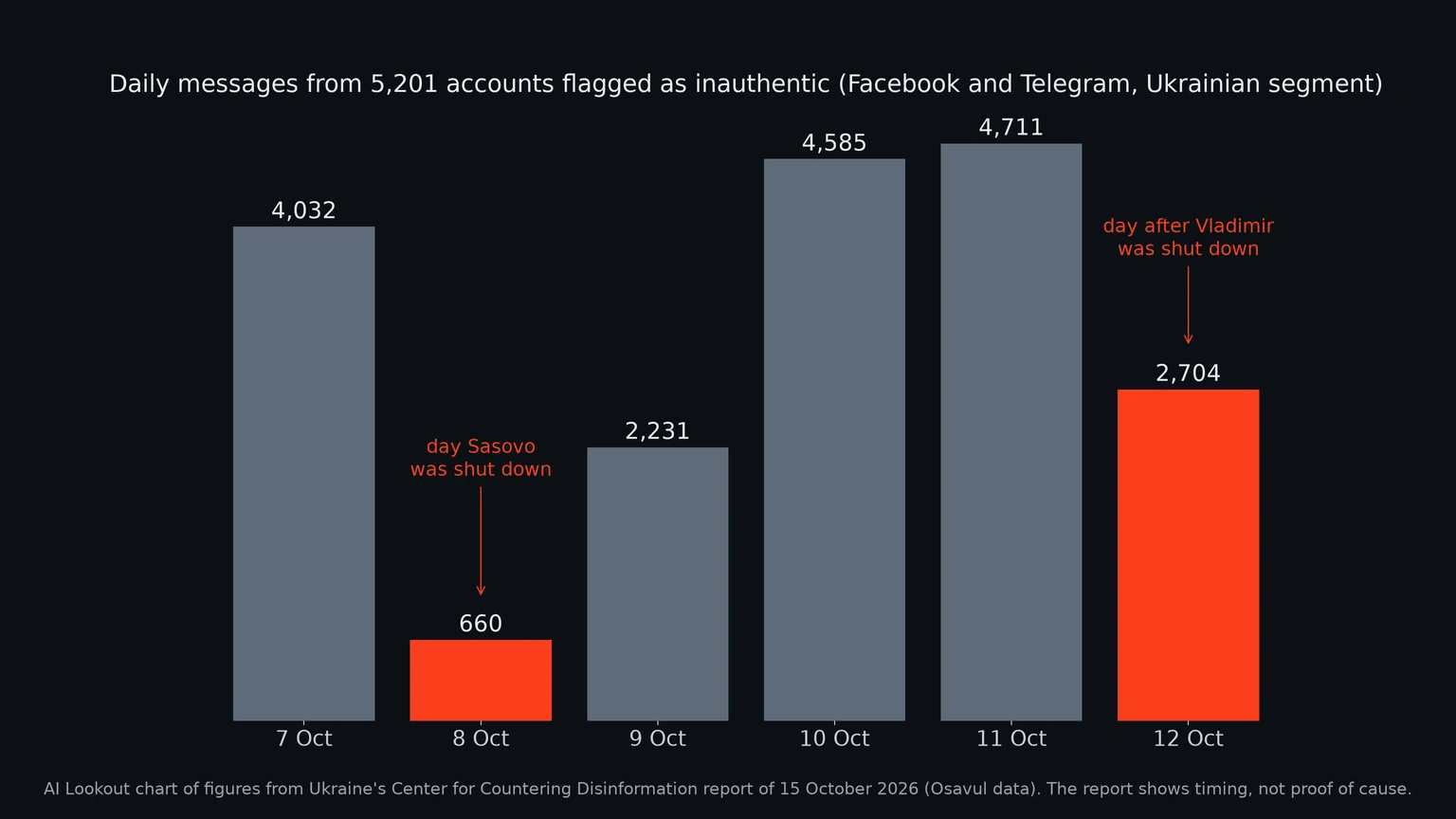
Ukraine's Center for Countering Disinformation, a government body, published a report on 15 October arguing that the outages briefly silenced pro-Russian bot networks. Using data from the Osavul monitoring platform, it tracked 5,201 Facebook and Telegram accounts it flagged as inauthentic across 26 topics in the Ukrainian segment of social media between 6 and 12 October.
On 8 October, the day Sasovo went down, those accounts' messages fell from 4,032 to 660, a drop of 83.6%, and active accounts fell by 83.1%. Activity recovered within two days, then fell again by 42.6% on 12 October, the day after Vladimir shut down. The partial damage at Kaluga was followed by no drop. A subset of 98 accounts that posted calls for violence, conspiracy claims or justifications of the invasion showed the same pattern.
The centre concludes that strikes on data centres "can significantly constrain" automated influence networks, but that the effect looks short-lived. Its report shows timing only. It does not show that the accounts ran on Yandex servers or used Yandex AI models, and the centre is a party to the war. Influence operations do use AI tools: OpenAI recently described banning accounts tied to a Russia-origin false-front operation.
What this means for AI infrastructure
The strikes show that AI compute has become a physical target in a war. Data centres are large, easy to find and hard to harden; one expert told T-invariant that Yandex built its centres "in peacetime and for peacetime". Ukrainian officials have called their own data centres civilian infrastructure, while Russia has struck at least eight in Kyiv since late September, by The Moscow Times' count, cited by Supercomputing News.
The episode also shows that cloud availability zones are not designed for this. Yandex Cloud's own documentation promises isolation from hardware and software failures in other zones; it was not designed for losing two buildings in four days. Training clusters are the hardest part to spread out, because a large run needs thousands of GPUs on one network in one building. Debates about AI's footprint usually focus on electricity and siting; physical security is now part of that list.
There is a corporate footnote. The Yandex hit here is the Russian company. Its former Dutch parent sold the Russian business in 2024 and now operates separately as Nebius, which runs its own AI cloud outside Russia.
What is still unknown
Yandex has not published a damage inventory, a list of surviving racks or a restoration timeline. It has not said whether training of its YandexGPT and Alice models has paused, moved to other clusters or continued on hardware elsewhere, or how much GPU capacity it had beyond the three named supercomputers.
The causes of the bot slowdown are also unproven, and the CCD's figures have not been checked by an independent group. We will update this article if Yandex publishes a damage assessment or recovery date, restores its remaining AI cloud services, or confirms the state of Chervonenkis, Lyapunov and Galushkin.
Common questions
Which Yandex data centres were hit?
Sasovo in the Ryazan region on 8 October, Kaluga on 9 October and Vladimir on 11 October 2026. Sasovo and Vladimir were shut down completely; part of Kaluga's infrastructure went out of service.
Were Yandex's AI supercomputers destroyed?
Yandex has not said. Its three supercomputers were in the two shut-down sites, and outside experts believe they were badly damaged, but no inspection results have been published.
Are YandexGPT and Alice still working?
Yes, mostly. A 14 October Yandex Cloud update said its chat APIs with YandexGPT 5.1 and Alice AI LLM were available again, while batch inference, workflows and dedicated models were not.
Sources & further reading
- What is happening to our data centers, the iron heart of Yandex ↗
- Russia's Yandex says unclear whether data centre can be restored after Ukraine strike ↗
- Russia's Yandex says data centre in Vladimir shut down after drone attack ↗
- Ukraine strikes Yandex data center housing two of the company's supercomputers ↗
- Drone Strikes Shut Down the Yandex Data Centers Housing Russia's Highest-Ranked TOP500 Systems ↗
- Yandex reports status of AI services after outage (in Russian) ↗
- Yandex After Drone Strikes: What Works and Recovery Timeline ↗
- Yandex: TOP500 site systems history ↗
- Analytical report: When bots go silent: what the strikes on Yandex data centers affected ↗
How this story was made
Written by Kristian Kostov with AI assistance and checked against the linked sources. Company performance claims are attributed to the company. Analysis reflects AiLookout’s interpretation; we have not independently tested the products discussed. The cover places the companies’ own logos, taken from public-domain or openly licensed files credited in the caption, on a plain background. It is not a product photograph, a screenshot, or an endorsement.
Our editorial standards