Announced 17 Oct 2026 · Sources checked
What the IMF committee said
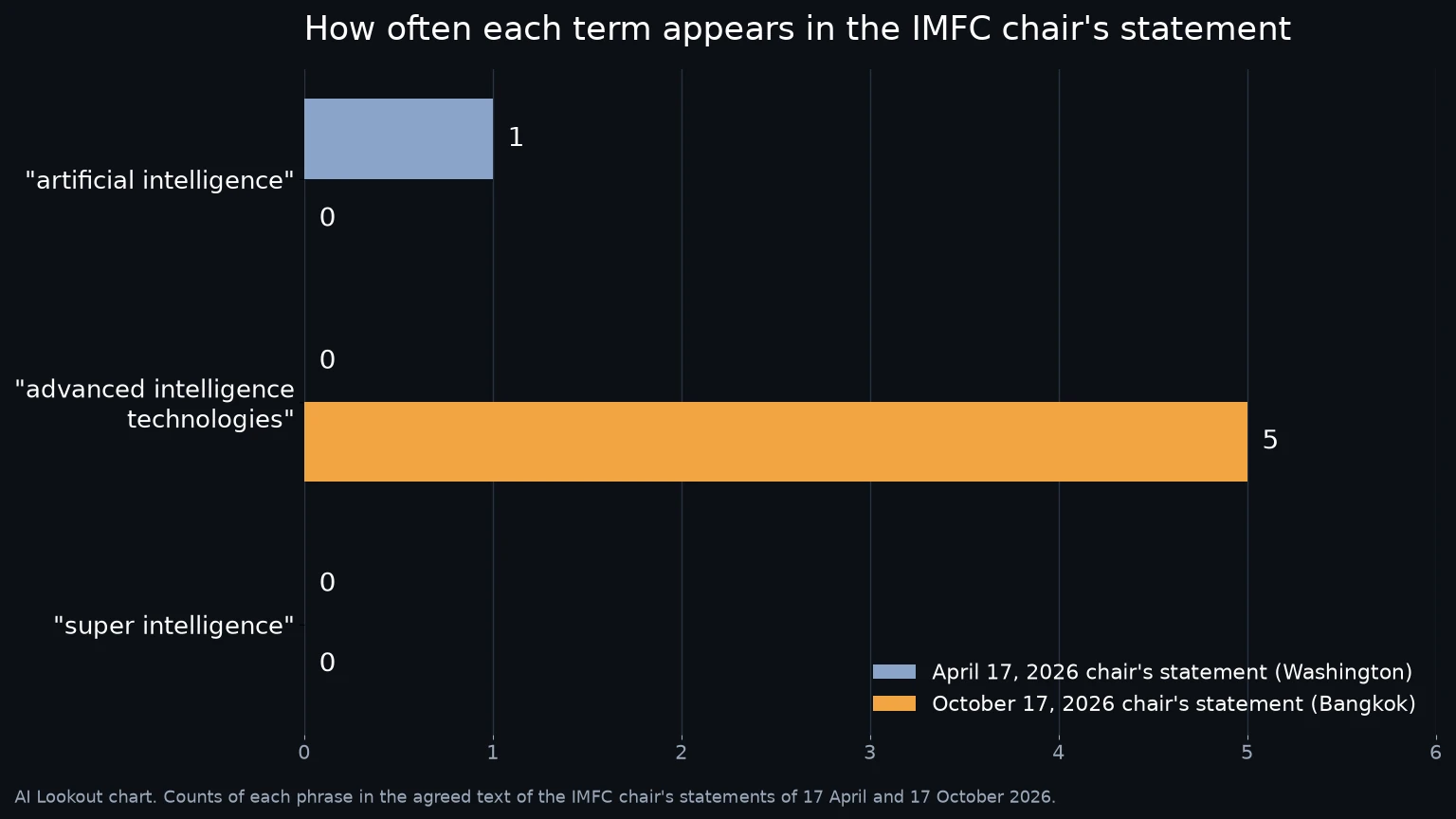
The International Monetary Fund's steering committee ended its October meeting in Bangkok with a statement that never uses the words artificial intelligence. The chair's statement of the fifty-fourth meeting of the International Monetary and Financial Committee (IMFC), issued on Saturday 17 October 2026 by Saudi Finance Minister Mohammed Aljadaan, refers instead to "advanced intelligence technologies" five times.
The text under the heading "IMFC members agreed on the following text" says that "rapid progress in advanced intelligence technologies have been boosting investment and trade, and could lift productivity." It also warns that "uncertainties regarding the impact of advanced intelligence technologies on economic and financial issues" could, together with rising bond yields and high public debt, "amplify macro-financial vulnerabilities."
The choice is new. Six months earlier, the committee's April 2026 chair's statement promised to strengthen "surveillance of systemic risks stemming from artificial intelligence, non-bank financial institutions, and digital assets." Same committee, same chair, different word.
Why the wording changed
The change followed a public push by the United States to get the IMF to say something else entirely. In an interview with Reuters on Thursday 15 October, carried by CNA, US Treasury Under Secretary for International Affairs Erin Browne said Washington was negotiating with other IMF shareholders to use the term "super intelligence" in the IMFC statement.
"President Trump has been really clear on this, and he's, you know, using the term SI, and I think it's a clear priority for the US to use that term, and we think that more appropriately encapsulates the technology at hand," Browne said. She added that the United States, which holds the rotating presidency of the Group of 20, wanted the change to take hold internationally, and that "many countries are looking to the US to set the standards."
Browne declined to say whether Washington would block a consensus statement without the new term. Reuters cited a source familiar with the talks as saying US officials had suggested they would insist on it, which raised eyebrows among other members, and that one possible compromise was to drop both SI and AI in favour of a phrase such as "new technology."
That is roughly what happened. According to Reuters, in a report published by The Straits Times, Aljadaan said the language of the final statement was agreed by all members. Reuters noted that the final version "contained no reference to artificial intelligence." Super intelligence does not appear either.
What the US executive order requires
The US position comes from Executive Order 14434, Inaugurating the Era of Super Intelligence, signed by President Donald Trump on 29 September 2026 and published in the Federal Register on 2 October. It argues that today's systems "far exceed what was envisioned when the term 'Artificial Intelligence' first came into use" and "increasingly represent not merely artificial intelligence, but a new era of Super Intelligence."
The order makes it policy that, "to the maximum extent permitted by law," the executive branch "shall use the terms 'Super Intelligence' and 'SI' in place of 'Artificial Intelligence' and 'AI' and will not acknowledge the usage of 'Artificial Intelligence' and 'AI' in any applicable setting." Agencies must make the switch in official correspondence, public communications, websites, reports and policy documents.
It is narrower than the slogan suggests. Section 2(b) says nothing requires changing previously issued regulations, contracts, grants or historical documents. Section 3(a) defines super intelligence as exactly the technology already covered by the statutory definition of artificial intelligence in 15 U.S.C. 9401(3). So, for now, SI is a new label for the same systems, not a claim that any system has reached superintelligence in the research sense.
The order also sets a deadline. Within 60 days, the Assistant to the President for Science and Technology must send the President proposed legislative language for a federal definition of super intelligence, including whether it should modify or supersede the statutory AI definition and what conforming amendments Congress would need. Counting from 29 September, that falls at the end of November.
How the compromise reads
Read closely, the IMFC phrase works as a bridge. "Advanced intelligence technologies" avoids the word artificial, which the US order rejects, and avoids super intelligence, which other members evidently did not accept. It even keeps the initials AI, although the statement never abbreviates it. That last point is our observation; neither the IMF nor Reuters described the phrase that way.
The phrase does real work in the text. Beyond the risk paragraph, members commit to "harnessing advanced intelligence technologies and digitalization to raise productivity while addressing associated risks and promoting a broad sharing of the benefits." They welcome the Fund's "ongoing work on the macroeconomic and related policy implications of advanced intelligence technologies," and support the IMF's own "prudent internal adoption" of them.
Spoken language did not follow the text. Reuters reported that at the closing news conference Aljadaan listed risks linked to the rapid development of artificial intelligence among the challenges facing the world economy, and that IMF Managing Director Kristalina Georgieva said many lower-income countries outside the AI value chain feared falling behind. Those are Reuters' paraphrases, not quotes from the statement.
Super intelligence is already federal vocabulary
Inside the US government the new vocabulary is already in use. The White House runs SI.gov, which calls itself "America's home for Super Intelligence policy" and opens with the line "America is in a race for Super Intelligence. We intend to win it." It groups the Genesis Mission science program, a K-12 SI education task force and a Presidential SI Challenge for schools under the new name.
A client alert from the law firm Wiley says NIST, the agency that writes voluntary AI standards, posted a statement that it "is working to update its communications to incorporate the term 'super intelligence' as directed." Readers of our earlier coverage will have seen the same shift in agency names, such as NIST's Center for Advancing Innovation and Standards for Super Intelligence, cited in the UK AI Security Institute's priorities list, and the White House's Super Intelligence Force.
Wiley expects agencies to carry the term into solicitations, guidance and procurement documents. It also flags a practical risk: if federal terminology diverges from the AI language used in international standards, state laws and corporate compliance programmes, companies may face inconsistent frameworks.
Why a word fight matters to the AI industry
For most readers, the label on an IMF communique changes nothing about how chatbots or models work. The stakes are in documents with legal or financial weight. Multilateral statements are negotiated line by line and often reused as reference text for later meetings, so the vocabulary chosen in Bangkok may reappear in G20 or other finance-track texts while the United States holds the G20 presidency.
The episode also shows the limits of the US push. Washington could keep "artificial intelligence" out of an IMF text, but it did not get "super intelligence" in. Other governments are not bound by an executive order, and, by Reuters' account, the IMFC chair and the IMF managing director still spoke of AI at the closing news conference.
The Bangkok meetings were heavy with AI arguments in any wording. On the same day, Anthropic co-founder Jack Clark told the IMF's Per Jacobsson lecture audience that the singularity has begun, and the meetings came a day after China proposed export controls on 23 AI technologies. Finance ministers are treating the technology as a macroeconomic force, whatever they call it.
What the statement still says about AI risk
Strip out the naming fight and the IMFC's substantive view is cautious. The statement credits advanced intelligence technologies with boosting investment and trade to date, but says they "could lift productivity" rather than that they have. It warns that growth is diverging, with low-income countries and fragile states at risk of falling further behind.
It lists the technology's uncertain impact alongside rising sovereign bond yields and refinancing needs as possible amplifiers of financial vulnerability. Compared with April, it drops the explicit promise to strengthen surveillance of systemic risks from AI and instead backs the Fund's continuing analysis "within the Fund's mandate." Whether that is a softer stance or just different drafting is not stated in the text.
The meeting also had a sharper split. Reuters, in a report carried by CNBC, said nearly half of delegates walked out while Russian Finance Minister Anton Siluanov spoke, according to Bundesbank President Joachim Nagel. Members still agreed the text.
What to watch next
The next fixed date is the end-of-November deadline for the White House's proposed legal definition of super intelligence. If Congress takes it up, the change would move from public relations wording into the statutes that govern AI research funding, standards and procurement.
Internationally, watch the G20 finance texts under the US presidency and the IMFC's next meeting, which the statement says is expected in April 2027 in Washington. A US host may press again for super intelligence; other members may keep reaching for neutral phrases. For now, the record shows the IMF's steering committee choosing a third term rather than either side's.
Common questions
Why does the IMF statement say advanced intelligence technologies?
The United States pushed for super intelligence in line with President Trump's executive order, and the agreed text used neither that nor artificial intelligence. Reuters reported the final language was agreed by all members.
What is Executive Order 14434?
Signed on 29 September 2026, "Inaugurating the Era of Super Intelligence" tells US executive agencies to use Super Intelligence and SI instead of Artificial Intelligence and AI in official communications, while keeping the existing legal definition of AI for now.
Does super intelligence mean AI has become superintelligent?
No. The order defines super intelligence as the same technology covered by the statutory AI definition in 15 U.S.C. 9401(3). It is a change of label, not a technical milestone.
Sources & further reading
- Chair's Statement of the Fifty-fourth Meeting of the International Monetary and Financial Committee (IMFC) ↗
- Chair's Statement, Fifty-Third Meeting of the IMFC ↗
- Inaugurating the Era of Super Intelligence (Executive Order 14434) ↗
- US Treasury pushes global partners to rename AI as 'super intelligence' (Reuters) ↗
- IMF members call for more support amid war shocks, 'advanced intelligence' risks (Reuters) ↗
- IMFC chair says global economy resilient; delegates walk out on Russian official (Reuters) ↗
- Executive Order Rebrands AI as Super Intelligence and Signals Potential Federal Legislative Changes ↗
- SI.gov: America's Super Intelligence Initiatives ↗
How this story was made
Written by Kristian Kostov with AI assistance and checked against the linked sources. Company performance claims are attributed to the company. Analysis reflects AiLookout’s interpretation; we have not independently tested the products discussed. The cover places the companies’ own logos, taken from public-domain or openly licensed files credited in the caption, on a plain background. It is not a product photograph, a screenshot, or an endorsement.
Our editorial standards