Announced 17 Oct 2026 · Sources checked
What happened in Bangkok
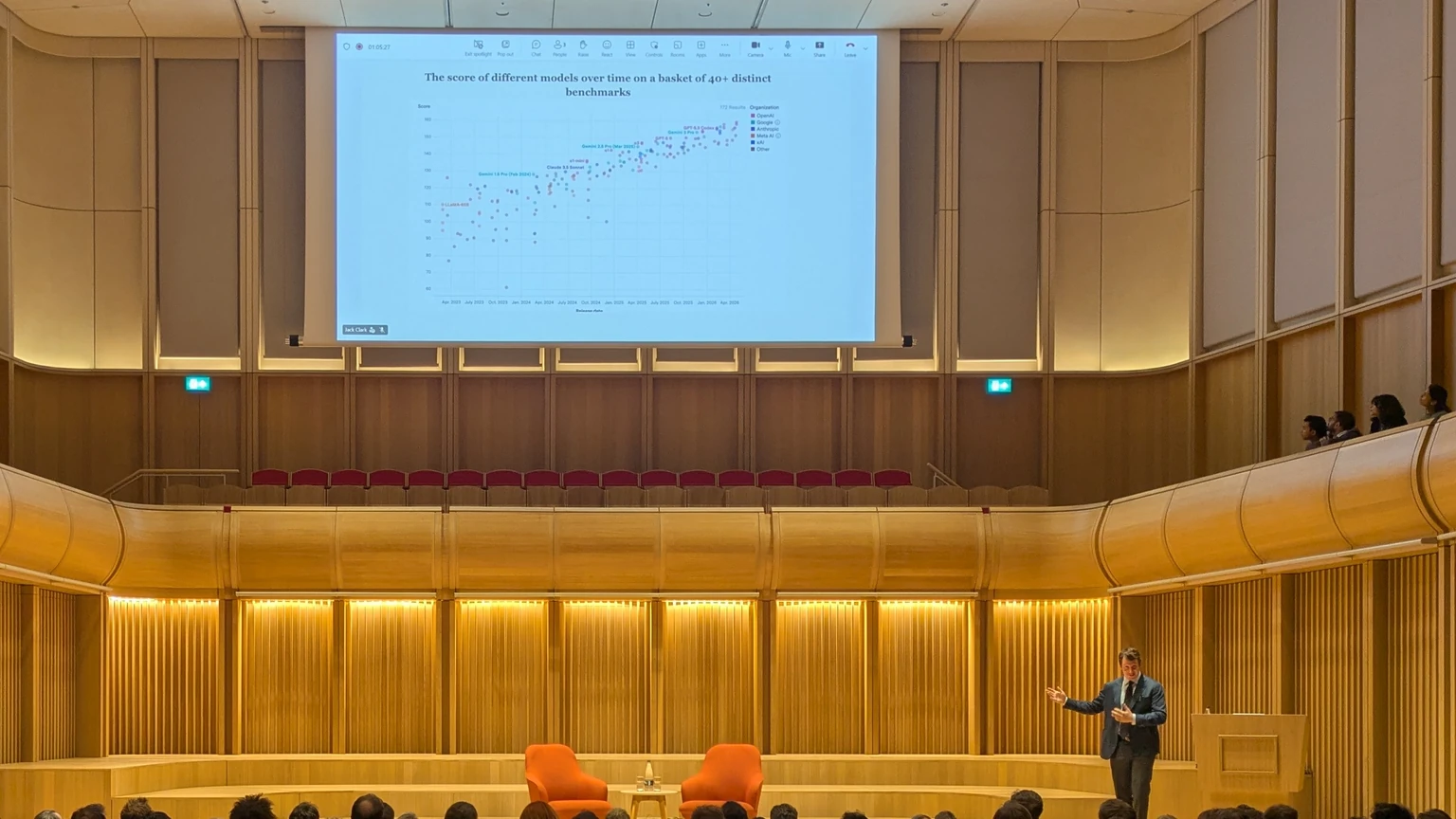
Anthropic co-founder Jack Clark used one of the international financial system's most established stages to argue that a technological singularity is under way. He gave the 2026 Per Jacobsson Foundation Lecture on 17 October at the IMF and World Bank annual meetings in Bangkok, in a session the IMF streamed as "Inside the Event Horizon". Five days earlier he had promised to "make the case that we are entering a period of massive, sudden change catalyzed by the advancing capabilities of AI systems."
The event was opened by IMF Deputy Managing Director Nigel Clarke and moderated by Raghuram Rajan, the former IMF chief economist who chairs the Per Jacobsson Foundation. The discussants were Yan Shen, an economics professor at Peking University, and V. Anantha Nageswaran, Chief Economic Adviser to the Government of India.
Clarke acknowledged the choice was unusual. The lecture has gone to central bank governors, finance ministers and economists for more than six decades, and he said the board had asked itself how it would work to invite "a co-founder of a company that is not even five years old." His answer: "So yes, from a historical perspective, this year's choice is unusual. But frankly, so is this moment."
Clark did not hedge his thesis. Citing the science-fiction writer Vernor Vinge, who forecast the singularity in 1993, he said: "I believe that this year, we've gained convincing evidence that it has now begun." A few sentences later he put it more bluntly: "The singularity is here."
Clark's evidence: from coding to unpublished physics
Clark's case rested on science rather than chatbots. Coding came first: he said Anthropic's researchers now produce almost ten times as much code as they did in the company's first four years, an increase he said tracks AI capabilities directly, and he noted that better coding has also made AI systems better at cyber attacks.
He then listed 2026 results in mathematics, biology and laboratory robotics, naming the Navier-Stokes Millennium Prize problem, the Jacobian conjecture and open Erdos problems as areas where AI systems have proposed solutions. Some of those claims are still being checked; OpenAI's Navier-Stokes work, for example, remains unverified.
On benchmarks, Clark said top systems scored 8% on Humanity's Last Exam when it launched in January 2025, and that the best score this week was Claude Opus 5.5 at 67.7%. On FrontierMath, released in November 2024, he said the best systems have gone from 2% to 94%. These are his figures as stated in the talk; we did not check them against the benchmark leaderboards.
His closing piece of evidence was TheoPhysEval, a set of 50 unpublished theoretical physics problems written by working physicists. Quoting co-author Suvrat Raju, Clark said the models, especially GPT-6 Astra, insisted they were right when graders marked them wrong, and that experts then found "subtle errors buried deep inside their calculations." Astra ended at 49 of 50. Clark compared it to the film scene in which "the teacher becomes the student."
Virtual scientists and the $44 trillion scenario
Clark's argument about growth runs through research. Economists have argued that good ideas are getting harder to find, because each breakthrough takes more researchers. AI could change that by adding researchers on demand. "What would it mean to be able to run hundreds or thousands of copies of me simultaneously?" he asked, adding that this is "what the next few years will be like for large swaths of the economy."
He cited UNESCO's estimate of roughly 10 million scientists worldwide and asked the room to imagine "a billion virtual scientists directed by our own 10 million. Or 10 billion."
That led to the line that made headlines. Clark said Anthropic's economists had modelled different AI trajectories, and that if models can autonomously complete a broad range of tasks and spread quickly through the economy, one model shows US GDP "potentially reaching 44 trillion by 2030, which sounds very outlandish, I know. But it's implicated by the technology continuing to get better." If GDP grew that much, he added, new industries and inventions would have to have been created, which is what autonomous AI science implies.
What the $44 trillion number actually is
Several outlets described the $44 trillion figure as an internal Anthropic forecast. Clark corrected that on X a few hours later: "this isn't an internal model, it's the public economic scenario explorer we published a while ago - and this is under the "extreme" parameter setting."
The tool is Anthropic's economic scenarios explorer, based on a technical report by Korinek and colleagues. It describes three futures for 2030. In the modest one, AI's impact resembles the internet's. In the substantial one, AI can do half of all knowledge work and the economy grows at twice its normal rate. In the extreme one, AI is more productive than people at most knowledge tasks, does nearly all of them autonomously and creates almost no new knowledge tasks for people; Anthropic says this "would likely require recursively self-improving AI" and has annual GDP growth reaching 15%, doubling the economy every 4.5 years.
The explorer is explicit about the cost: in the extreme case, "unemployment has risen beyond typical recessionary levels." The Financial Express reported the tool's 2030 GDP figures as $34.1 trillion, $36.3 trillion and $44.4 trillion for the three scenarios, at 2025 prices, against a current US economy the page puts at over $30 trillion. So $44 trillion is the tool's top case, not Anthropic's central forecast.
Build labs and robots, not just data centres
Clark's policy advice started with a regret. For ten years, he said, he told governments that the best way to prepare was to build electricity and data-centre capacity. "Not many policymakers listened," he said; capacity is now concentrated in the United States, China and the Middle East, and prices are rising.
The next phase, he argued, is physical: AI systems running experiments and operating robots. Countries should build scientific equipment and robotics capacity now, or "we'll see history repeat itself." He pitched this as an opening for developing countries that supply raw materials, which could build testing facilities and "leapfrog". He also warned about downstream bottlenecks: "An avalanche of proposed new drugs is of little use if only a handful can ever be tested."
The choices Clark says the world has to make
The second half of the lecture was about restraint. Clark said AI-driven biological research needs the strictest human oversight, and that labs including Anthropic must decide how much oversight to apply to AI-driven AI research, where "we could lose control of the technology." He also asked how much humans need to understand discoveries they did not make, as AI begins to design its own scientific equipment.
He closed by quoting Carl Sagan and saying the world has "a handful of years" rather than millennia to become wiser, calling for "unusual and serious rules for this technology" and for its makers, and for what he called the "most noble quality of people, which is restraint."
In the discussion, Clark said Anthropic funds a program called Claude Corps that aims to create 1,000 paid jobs for recent graduates at non-profits in the United States. Responding to a call for firms to publish entry-level hiring data, he pointed to Anthropic's own report on hiring and said "we absolutely should just mandate that firms share that stuff." Asked whether humanity was doomed, he said no, and that regulators already apply "basic safety testing standards, transparency standards, disclosure standards" to cars and food. The day before, at a panel reported by The Economic Times, he said Anthropic tests its systems and shares the results, but that this should not all be voluntary. Anthropic has also given Congress a draft bill setting when a model could be halted.
Pushback from India and China
The discussants were not all persuaded. Nageswaran listed five risks: firms hiring fewer juniors and drying up the pipeline of future experts; erosion of human skills; safety, where "nobody pays the lab for restraint," a structure he compared to banking before 2008; debt-heavy, off-balance-sheet financing of data centres; and public finances. He noted that Anthropic's own extreme scenario has labour's share of income falling from about 60% to 45%, and asked finance ministries to keep AI's productivity dividend out of their forecasts until it shows up in the data.
Shen presented Chinese data: about 700 million generative AI users in the first half of 2026 and roughly 30% adoption among large firms, but no measurable lift yet in the profitability of listed companies. Her conclusion was that China invests heavily but is not at the frontier, and that AI may worsen deflationary pressure by raising supply faster than incomes.
What to watch next
The lecture capped a busy week of economic claims from Anthropic, after revenue figures given to investors and its employment study. The IMF has posted the full event video; as of 17 October the Per Jacobsson Foundation's lectures page had not yet posted a text of the talk, as it has for earlier lectures.
For readers, the useful split is between evidence and extrapolation. The benchmark and TheoPhysEval results are concrete and checkable. The $44 trillion figure is the top setting of a public scenario tool, not a forecast, and Clark's own panel pushed back on the jobs, finance and distribution side. Policymakers in the room heard both.
Common questions
What did Jack Clark say at the IMF?
In the 2026 Per Jacobsson Foundation Lecture in Bangkok, the Anthropic co-founder said AI systems are starting to do frontier science and that "the singularity is here." He urged countries to build scientific and robotics capacity and to set serious rules for AI.
Did Anthropic predict US GDP will reach $44 trillion by 2030?
No. Clark said the figure comes from the extreme parameter setting of Anthropic's public economic scenarios explorer. That scenario assumes AI beats people at most knowledge work, 15% annual growth and unemployment above typical recession levels.
Where can I watch the Per Jacobsson Lecture 2026?
The IMF streamed the event on YouTube as "Per Jacobsson Foundation Lecture: Inside the Event Horizon", and the full recording of about 81 minutes, including the panel, is on the IMF channel.
Sources & further reading
- Per Jacobsson Foundation Lecture: Inside the Event Horizon (event recording) ↗
- What will our economic future look like? (economic scenarios explorer) ↗
- Jack Clark posts announcing the lecture and clarifying the $44 trillion figure ↗
- $44 trillion US economy by 2030? Anthropic's extreme AI scenario explained ↗
- AI could boost US GDP to $44 trillion by 2030, Anthropic model forecasts ↗
- Anthropic's Jack Clark says common-sense standards are needed for AI ↗
How this story was made
Written by Kristian Kostov with AI assistance and checked against the linked sources. Company performance claims are attributed to the company. Analysis reflects AiLookout’s interpretation; we have not independently tested the products discussed. Cover photography is illustrative and does not depict the specific announcement or product.
Our editorial standards