Announced 19 Oct 2026 · Sources checked
What Exa announced
Exa, which sells a web search API built for AI agents, released Exa 3.0 on 19 October 2026. In its launch post the company calls it "the largest improvement to search quality we've ever released" and says it ranks first on every benchmark Exa tested, from public evaluations to coding, finance and go-to-market research.
The release has three parts that matter to developers. There is a new search type called Lite, priced at $4 per 1,000 requests for cost-sensitive applications. Dynamic Highlights, a feature that decides how much text to return from each result page, is now generally available at no extra charge. And Exa says it has added billions of documents to its index, including product listings, local businesses, flights, events, sports and weather.
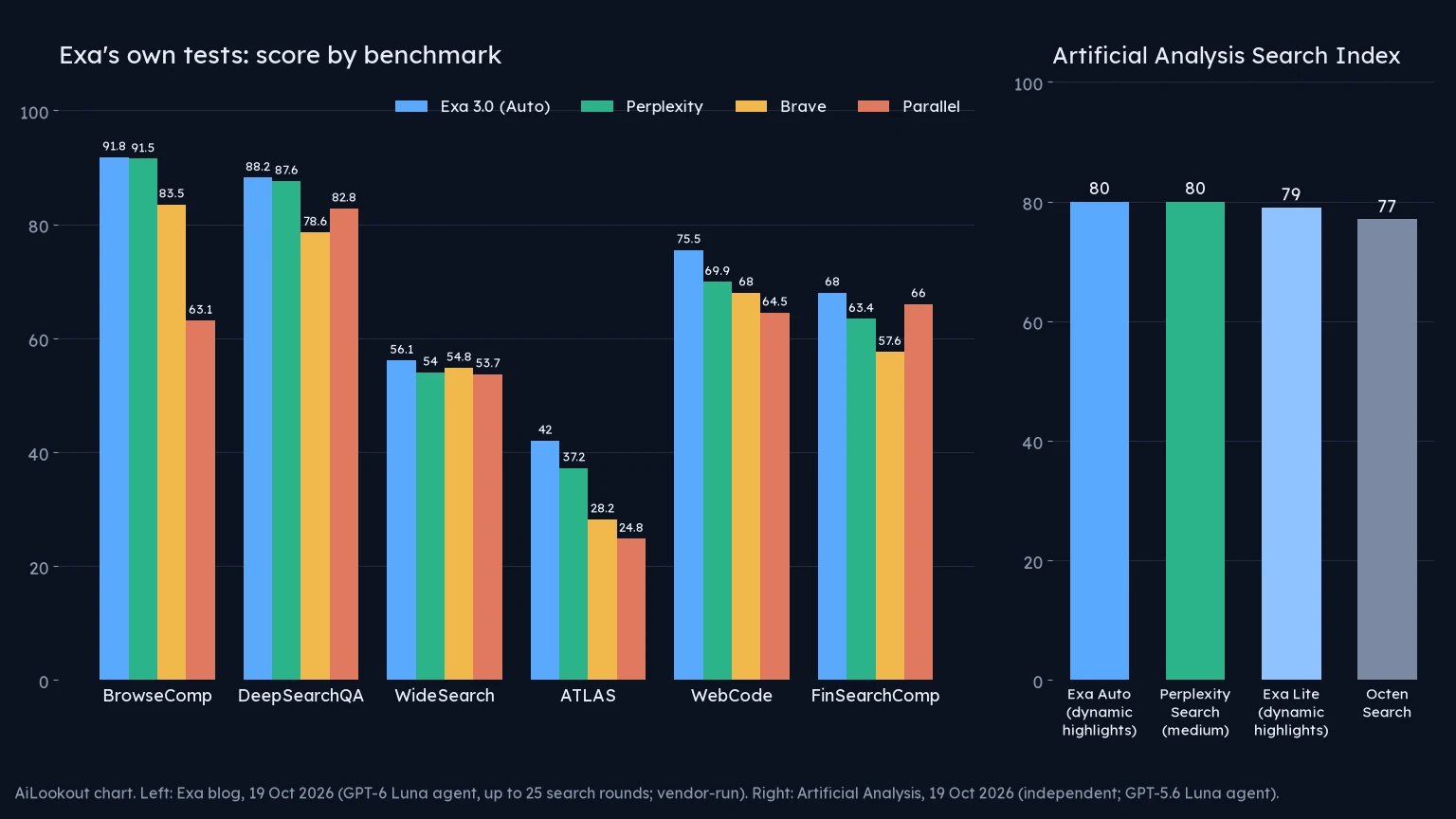
The same day, the independent benchmarking firm Artificial Analysis published results that partly back Exa's claim. On its Search Index, Exa's upgraded Auto mode scored 80, tying Perplexity Search for first place, rather than beating it. Exa is hosting a live question-and-answer session on Wednesday, 21 October, at 1pm Pacific time, which is 10pm in Paris.
Three changes under the hood
Exa attributes the quality gains to three changes in its retrieval stack, and says every search type benefits from them. First, it trained a larger embedding model, the component that turns queries and pages into numbers that can be compared, with more compute and data than any of its previous models. The post gives no size, training data or benchmark for that model on its own.
Second is Dynamic Highlights, covered below. Third is the index itself. Exa runs its own crawler and an independent index rather than reselling another search engine's results. It says it tracks more than 2 trillion URLs and serves 100 billion pages, and that it grows the index around what its customers search for.
The new data is aimed at personal AI assistants, which Exa says have driven an explosion in usage. The index now includes 1.27 billion e-commerce listings with prices and availability, more than 211 million local businesses with hours and ratings, real-time news, sports, weather and market data, and flights, local events, transit and podcasts. The local-business data first arrived on 5 October as Exa Places, at no extra charge across all endpoints.
Dynamic Highlights leaves preview
Search APIs for agents usually return either whole pages or short snippets. Whole pages are expensive and fill a model's context window; snippets are cheap but can miss the answer. Exa released Dynamic Highlights as a research preview on 28 August with an example: an agent wants to know the current mayor of San Francisco, the answer fits in about nine tokens on one page, but most search tools pull more than 10,000 tokens across many pages.
Exa says its older highlights were extracted from each page separately. The new model instead selects tokens across all results together, giving more space to the best pages and cutting repeated information. Exa says the result uses 95 percent fewer tokens than full page text while improving answer quality.
Exa's documentation changelog gave more modest numbers for the preview: about 49 percent better token efficiency and 2.4 percent higher quality for single-turn retrieval with Exa Auto, and about 30 percent fewer tokens with 1 percent higher quality across complete agent runs. The 95 percent figure compares against full page text, not against Exa's previous highlights, so the two sets of numbers measure different things. With Exa 3.0, the feature is out of preview and Exa says model efficiency improvements have made it substantially faster and cheaper to run.
Lite, Auto and the new price list
Lite runs on the same index as Exa Auto. The difference is compute: Exa says Auto spends more of it across candidate generation, highlights and ranking, while Lite trades some quality for a lower price. The company says the two together set a new cost-quality frontier for search.
The changelog adds practical details. Lite serves page content from Exa's cache and never fetches a page live. It supports a focused set of parameters, including query, result count, highlights and text, categories such as company and people, domain and date filters, location and moderation. A parameter Lite does not support returns an error that names it, so an option never silently fails to apply. Exa now tells customers on its older instant type to use Lite, and those on fast to use Lite, which it says runs the same search, or Auto when they need a parameter Lite lacks.
On the pricing page, Lite costs $4 per 1,000 requests with up to 10 results, Auto $7 and Deep $12, with $1 per 1,000 for each extra result above 10. Page contents cost $1 per 1,000 pages. A free tier gives $10 of credit a month. That puts Lite above DeepSeek's new search API at $0.75 per 1,000 calls, although the two products are not directly comparable in what they return.
What Exa's own benchmark table shows
Exa's launch post includes a table comparing Exa 3.0 Auto with Perplexity, Brave and Parallel on eight tests. Exa says it used each provider's highest-scoring single-step endpoint: Perplexity Web, Brave LLM Context and Parallel Advanced. Every provider ran in the same agent harness, with a GPT-6 Luna agent allowed up to 25 search rounds and 10 results per search, evaluated in October 2026.
Exa comes first in every row, but the margins vary widely. On BrowseComp, a test of hard-to-find facts, Exa scores 91.8 percent against Perplexity's 91.5, a gap of just 0.3 points with no error bars reported. On DeepSearchQA it leads 88.2 to 87.6, and on WideSearch 56.1 to 54.8 over Brave. The larger gaps are on ATLAS, 42.0 against 37.2 for Perplexity, on the WebCode coding test, 75.5 against 69.9, and on FinSearchComp, 68.0 against 66.0 for Parallel.
Two rows count found entities rather than percentages. On Company FindAll Exa averages 15.4 correct companies per task against 14.2 for Perplexity, and on People FindAll 7.6 against 6.8. ATLAS is Exa's own benchmark, previewed on 8 October with 547 tasks; when it launched, Exa wrote that even the most expensive search agents miss about a third of the correct results.
What Artificial Analysis measured
Artificial Analysis tests search APIs by swapping only the provider. Its methodology uses the same answer model, GPT-5.6 Luna at medium effort, and the same open-source agent harness, called Stirrup, for every product. The Search Index is the plain average of three scores: DeepSearchQA, a hard 200-question subset of BrowseComp, and AA-Omniscience accuracy. The firm says it benchmarks 29 search products from 14 providers.
In a thread on X, Artificial Analysis said it tested two Exa 3.0 modes ahead of release. Auto with Dynamic Highlights scored 80, level with Perplexity Search at medium effort for first place, and Lite with Dynamic Highlights scored 79. On DeepSearchQA alone, Auto (85.6) and Lite (84.9) ranked first and second, four to five points ahead of Perplexity at 80.8.
Exa's Auto mode made 7.6 searches per task, the fewest of any API on the leaderboard, down from 9.4 with standard highlights. Cost per task fell 21 percent, from $0.083 to $0.066, of which about $0.053 is search and $0.012 is model inference. Lite cost $0.044 per task. Artificial Analysis said both modes sit on its cost-versus-quality frontier, ahead of Octen, which scores 77 at $0.024 per task, meaning no product scores higher for less money.
Fewer tokens, slower answers
The independent numbers also show a trade-off that Exa's post does not mention. With Dynamic Highlights, Auto took 43.7 seconds per task, 48 percent slower than Auto with standard highlights at 29.5 seconds, even though it made fewer searches. Artificial Analysis traced that to slower individual searches, 3.27 seconds each against 2.10 seconds.
Lite is the faster option. It took 29.0 seconds per task, about the same as the old Auto setting, and averaged 0.85 seconds per search. Tokens per task fell sharply in both modes: from 299,000 to 157,000 for Auto, a 47 percent cut, and to 164,000 for Lite. Only two Perplexity settings used fewer tokens per task, at 127,000 and 137,000.
For builders, that means the choice depends on what is expensive in their own system. If model tokens dominate the bill, Dynamic Highlights in Auto mode saves money. If a user is waiting for an answer, the extra 14 seconds per task may matter more than the token savings, and Lite looks like the better default.
Limits and open questions
Exa's table is a vendor benchmark. Exa chose the tests, the harness, the agent model and the competitor endpoints, and one of the eight tests is its own. The numbers are not directly comparable with Artificial Analysis's, which used a different agent model; Exa's DeepSearchQA score is 88.2 in its own setup and 85.6 in the independent one. Neither set of results gives confidence intervals or repeated runs.
The competitor scores in Exa's table were produced by Exa, not by Perplexity, Brave or Parallel. Exa has not published the size or training details of its new embedding model, or how it measured the 95 percent token reduction. Lite's cache-only design is cheaper, but the changelog's wording suggests that a page updated since Exa last crawled it will come back in its older form, which could matter for breaking news or prices. AI Lookout has not run any of these benchmarks itself.
The wider context is that search quality is now measured mainly by how well agents do with the results, and the results themselves are getting harder to verify, as rank trackers found when Google began swapping their search results. Independent, repeatable tests such as Artificial Analysis's provider-swap setup are becoming the main way buyers can check vendor claims.
Why it matters for agent builders
Search is one of the biggest running costs in agent systems, because a single research task can trigger dozens of queries and pull hundreds of thousands of tokens into a model. Exa's pitch is that better retrieval and tighter excerpts cut both. Other companies are attacking the same cost from the model side, as with Perplexity's small late-interaction embedders, which let a tiny query model search a much larger index.
What Exa 3.0 shows is how close the top of this market now is. On the independent index, Exa and Perplexity are tied, with Octen, Parallel and Brave a few points behind, so price, speed and the kind of data each index holds may decide more choices than benchmark scores do. The things to watch next are whether Perplexity or Parallel answer with their own updates, whether Exa publishes details of its embedding model, and whether Lite's cache-only results hold up on fresh information.
Common questions
How much does Exa 3.0 cost?
Exa lists Lite at $4 and Auto at $7 per 1,000 requests with up to 10 results, Deep at $12, and $1 per 1,000 for each extra result. Dynamic Highlights and the new data sources cost nothing extra, and a free tier gives $10 of credit a month.
Is Exa 3.0 better than Perplexity Search?
On Exa's own tests it scores higher on all eight benchmarks, sometimes by tiny margins. On the independent Artificial Analysis Search Index, Exa Auto and Perplexity Search are tied at 80.
What does Dynamic Highlights do?
It chooses which parts of the search results to return to the model, sharing a token budget across all pages instead of trimming each page separately, so agents read less repeated text.
Sources & further reading
- Introducing Exa 3.0 ↗
- Exa API pricing ↗
- Changelog (Lite search, recommended search types, and search warnings) ↗
- Dynamic Highlights (research preview) ↗
- ATLAS: Evaluating Agents on Search-Intensive Tasks ↗
- Exa 3.0 on the Artificial Analysis Search Index (X thread) ↗
- Artificial Analysis Search Index: Search API Benchmarking Methodology ↗
- Artificial Analysis Search Index: Search API Benchmark & Leaderboard ↗
How this story was made
Written by Kristian Kostov with AI assistance and checked against the linked sources. Company performance claims are attributed to the company. Analysis reflects AiLookout’s interpretation; we have not independently tested the products discussed. The cover places the companies’ own logos, taken from public-domain or openly licensed files credited in the caption, on a plain background. It is not a product photograph, a screenshot, or an endorsement.
Our editorial standards