Announced 19 Oct 2026 · Sources checked
What DHS ordered
The US Department of Homeland Security has ordered every federal civilian agency to stop buying DeepSeek products and to remove the ones it already uses, including third-party products and services built on DeepSeek. A notice filed for public inspection at the Federal Register on 19 October 2026, and scheduled for formal publication on 20 October, sets out the order as document 2026-21447 under DHS docket DHS-2026-0628.
The order has two parts. First, it excludes information technology products and services developed by DeepSeek, and by entities affiliated with it, from federal civilian procurement, effective immediately. The order says that includes agency-approved product lists, service provider equipment lists, e-commerce markets and similar channels agencies use to buy hardware, software and services.
Second, it requires agencies to remove DeepSeek products, products from DeepSeek affiliates, and "third-party products and services developed using DeepSeek implementations" from their IT systems immediately, unless they ask for and receive an exception. The notice also bars DeepSeek from federal civilian contracts, as Engadget noted in its report on the filing.
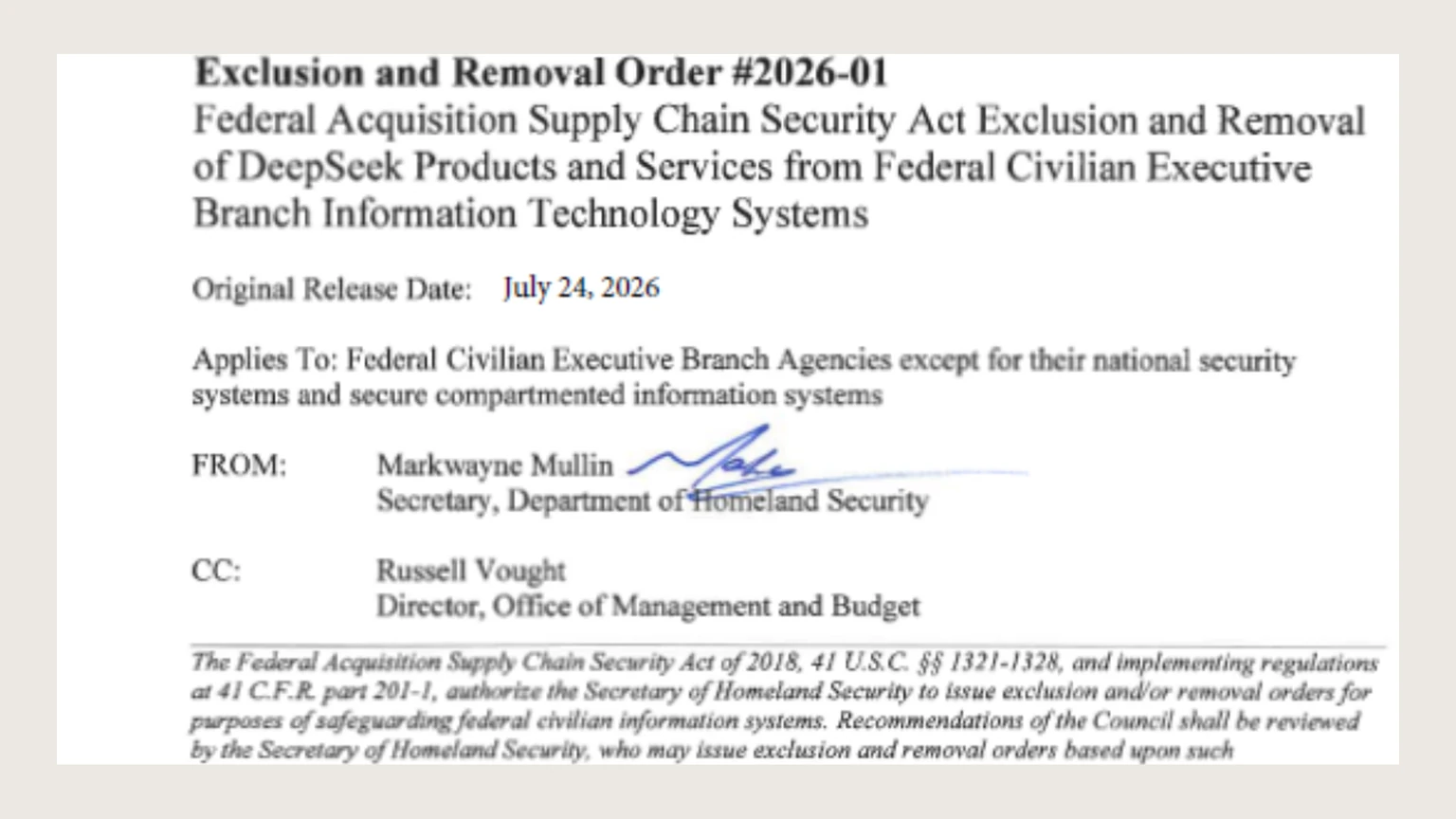
The order was signed in July
The legal basis is the Federal Acquisition Supply Chain Security Act of 2018, known as FASCSA, and its rules at 41 CFR part 201-1. That law created the Federal Acquisition Security Council, which can recommend excluding or removing risky products from government purchasing and systems. The Secretary of Homeland Security can then issue binding orders for civilian agencies after reviewing the council's recommendation, which the notice says happened here.
The signed order, attached to the notice as an appendix, is titled Exclusion and Removal Order #2026-01. It is issued by Secretary of Homeland Security Markwayne Mullin, copied to Office of Management and Budget Director Russell Vought, and carries an original release date of 24 July 2026. In other words, agencies appear to have been working under the order for almost three months before it reached the public record. The notice itself is signed by DHS General Counsel James H. Percival II.
The order covers federal civilian executive branch agencies but not their national security systems or secure compartmented information systems. Those fall under the Defense Department and the Director of National Intelligence, which have their own FASCSA order authority. Implementation questions go to a FASCSA Order Implementation Team in the Cybersecurity and Infrastructure Security Agency, CISA.
Why DHS says DeepSeek is a risk
The order's risk summary describes DeepSeek as a privately owned company in the People's Republic of China that offers several AI applications widely and for free. It makes five main points. DeepSeek's servers are in China. Chinese law, it says, gives government cyber and intelligence agencies broad authority to access private company infrastructure. For DeepSeek-hosted versions of its models, account sign-up collects personal information and may track and digitally fingerprint users.
Because DeepSeek's chat apps work by sending prompts to the model, the order argues that government employees or contractors using them could transfer sensitive data to China, and that this information, alone or combined with public data, could produce "actionable intelligence" on Americans or government programs. It adds that the models themselves "may contain malware or other security vulnerabilities."
As evidence for the app risk, the order cites a February 2025 analysis of DeepSeek's iOS app by mobile security firm NowSecure. NowSecure reported that the app sent some registration and device data over the internet without encryption, used the outdated Triple DES algorithm with a hard-coded key in one component, stored credentials insecurely, and sent data to servers run by ByteDance's Volcengine. Other footnotes cite DeepSeek's own privacy policy and an April 2025 report by the House Select Committee on the Chinese Communist Party.
Products built on DeepSeek are covered too
The widest part of the order is its reach beyond DeepSeek's own apps and API. A footnote says the removal requirement is meant "to include third party implementations of DeepSeek used to provide products and services to civilian agencies." That matters because DeepSeek publishes open-weight models, which other companies can download and run on their own servers, outside China.
DeepSeek's latest release, V4.1-Flash-1017 with open weights, came out days before the notice, and the company has also been selling Search and Fetch APIs to agent builders. A US cloud product, coding assistant or internal tool that runs a DeepSeek model would appear to fall within "products and services developed using DeepSeek implementations," even if no data ever touches a DeepSeek server.
The order does not define "implementation" further, and it does not say whether models fine-tuned or distilled from DeepSeek weights are covered. That is AI Lookout's reading of the text, not guidance from DHS. Vendors that sell to civilian agencies will likely need to show which underlying models their products use.
Exceptions and stopgaps
Agencies can ask the DHS issuing official for an exception, for example to exempt a specific product or delay compliance. Requests must be in writing within 60 days of the order's issuance and must identify the product, explain the exception sought, give a "compelling justification" such as mission-critical impact or national security work, and describe alternative mitigations. CISA reviews the requests and gives written approval or disapproval.
Until DeepSeek products are fully removed, the order encourages agencies to monitor traffic in and out of their networks, add logging and data-exfiltration controls on affected systems, and flag anomalous activity. CISA may provide technical help to agencies that cannot comply on their own. The law also requires the Secretary to review the order within a year and every year after that.
If the 60-day clock started on the 24 July release date, the exception window would have closed in late September, before the public notice appeared. Neither the notice nor the order says how that window is counted for agencies, so that is an open question rather than a finding.
How this fits US moves against DeepSeek
This is not Washington's first move against DeepSeek. Engadget notes that two members of Congress proposed a bill last year to ban DeepSeek's chatbot from government devices, and the order itself cites the House China committee's 2025 report on the company. What is new is a government-wide, legally binding order that covers purchasing, existing systems and products built on DeepSeek's models.
It also sits alongside other federal efforts to control how AI vendors handle government data, such as the General Services Administration's proposed LLM data-safeguarding contract clause. On the other side of the Pacific, Beijing has been tightening its own grip, including proposed export controls on 23 AI technologies such as large models and agents. The DeepSeek order is a clear example of the AI supply chain being split along national lines.
Limits and open questions
Several details are unclear from the public record. The notice gives no figure for how many agencies were using DeepSeek products or how many exceptions have been requested or granted. It does not name any third-party products that agencies had to remove. AI Lookout found no response from DeepSeek to the notice when this article was published.
There are also small inconsistencies in the documents. The notice names the company as Hangzhou DeepSeek Artificial Intelligence Co., Ltd, while the order calls it Hangzhou DeepSeek Artificial Intelligence Basic Technology Research Co., Ltd., and one footnote defines affiliates by reference to "DeepSeek AG." None of that changes the order's effect, but it may matter when vendors try to work out which corporate entities count.
Finally, the risks DHS lists are its own assessment. The cited security research concerns DeepSeek's iOS app as tested in early 2025; the order does not present new technical findings about the open models' weights.
What it means for agencies and vendors
For civilian agencies, the practical result is that DeepSeek is off the menu entirely, whether as a chat app, an API or a model hidden inside another product. For contractors, it adds a compliance question to every AI feature they sell to the government: which model is underneath, and can they prove it.
For the wider market, the order shows that open weights do not settle questions of origin for government buyers. Running a Chinese-developed model on American servers removes the data-transfer risk the order emphasises, but this order still treats the product as covered. Companies building on open-weight models from any country should expect public-sector customers to ask about model provenance as routinely as they ask about data residency.
Common questions
Does the DeepSeek order apply to the military?
No. It covers federal civilian executive branch agencies, not their national security or secure compartmented information systems. The Defense Department and the Director of National Intelligence have separate FASCSA order authority.
Are DeepSeek models hosted by US companies banned too?
For civilian agencies, apparently yes. The order requires removal of third-party products and services developed using DeepSeek implementations, without an exception for US hosting. DHS has not published further guidance defining the term.
Can an agency keep using DeepSeek?
Only with an approved exception. Agencies must request one in writing within 60 days of the order's issuance, with a compelling justification and alternative mitigations, and CISA approves or rejects it.
Sources & further reading
- Notice of Order Regarding Exclusion and Removal of DeepSeek Products from Federal Civilian Executive Branch Information Technology Systems and Procurements (FR Doc. 2026-21447) ↗
- Homeland Security bans DeepSeek use in federal civilian agencies ↗
- NowSecure Uncovers Multiple Security and Privacy Flaws in DeepSeek iOS Mobile App ↗
How this story was made
Written by Kristian Kostov with AI assistance and checked against the linked sources. Company performance claims are attributed to the company. Analysis reflects AiLookout’s interpretation; we have not independently tested the products discussed. The cover places the companies’ own logos, taken from public-domain or openly licensed files credited in the caption, on a plain background. It is not a product photograph, a screenshot, or an endorsement.
Our editorial standards