Announced 19 Oct 2026 · Sources checked
What Bill Gross launched
Bill Gross, the founder of the startup studio Idealab, has launched Idealab.ai, a website that uses AI to generate business ideas and gives them away. Axios reported the launch on Monday 19 October 2026, saying the platform has analysed more than 17 million sources and produced 1.2 million potential businesses. The Idealab.ai site itself describes "over a million business ideas", each one free to explore and use.
Gross has been turning problems into companies for a long time. Idealab, which he founded in the 1990s, says it and Idealab Studio have launched more than 175 companies, including GoTo.com, Citysearch and Tickets.com. Idealab.ai is his attempt to turn that habit into software: a system that reads the world's news, research and patents, spots problems and new capabilities, and suggests companies that could connect the two.
Gross told Axios that he is done starting companies himself. Idealab let him run a dozen at once; his aim now is to help support 12,000. "I'll put everything into this because this is more leverage," he said. He remains chief executive of ProRata.ai, his AI search and revenue-sharing company for publishers. The launch lands in a week when the AI jobs debate is dominated by cuts, including Anthropic's own data showing junior technical hiring falling as agent hours rise, and Gross is pitching the opposite story: AI as a way to create founders rather than remove workers.
How the idea engine works
According to Axios, the idea started with an article about a global copper shortage. Gross's insight was that almost every piece of information contains either a problem worth solving or a new capability that could solve one. "My methodology is to divide everything into a possible problem or a possible enabler to solve a problem," he said. The how it works page says the engine applies his methods to news, research papers, patents, company filings, customer complaints and community discussions.
Each signal the system extracts is sorted into one of three roles. An opportunity is something wrong, missing or unserved, such as people with sensitive skin not knowing which product caused a reaction. An enabler is a new capability, such as software that can now read ingredient labels at almost no cost. A shift is a structural change, such as retailers taking responsibility for whether a product suits the buyer. The engine connects signals from unrelated sources into concepts and then narrows those concepts into ideas.
The company says Gross documented 31 of the methods he has used over his career and worked with AI to refine them, and that the results surpassed his own brainstorming. The why it's free page puts it plainly: the system generates far more ideas than Idealab could ever pursue. The site does not say which AI models power the engine, and the live counters for sources read and ideas generated did not load in a plain fetch on 19 October, so the 17 million and 1.2 million figures come from Axios.
What comes with each idea
Every idea comes with a brief. The site lists what the brief covers: how much capital it takes to get off the ground, how long until the first customer, likely yearly revenue if the business succeeds, a "why now" explanation of the window that has opened, a 90-day roadmap and a chat assistant to tailor the idea to the user. Fuller briefs add a founder profile, competitors and the risks to watch, and every claim links to the papers, patents and reviews it is built on. Axios adds that each idea includes potential customers, first steps and reasons it might fail.
Sample briefs on the homepage show the range. One proposes an in-silico odorant-receptor screen for aroma chemicals, with an estimated $300,000 to start and six months to market, because new maps now link molecule shapes to the smell receptors they may activate. Another suggests a permissioned agent for household admin that reads messages and documents and uses websites with a person's approval, at $250,000 and four months. Others cover care for people with memory loss, support for single mothers who risk losing benefits, and a service for couples dealing with shifts in income.
Users can describe their own skills and constraints, or try preset personas such as an emergency-room triage nurse or a former manufacturing chief financial officer. Axios says ideas can be filtered by field, geography, market size, capital required, team size and degree of automation. People who already have an idea can upload it to find similar and competing ones.
Free ideas, paid tools later
The public ideas cost nothing, and the company says using one does not require buying any of its services. Its frequently asked questions acknowledge that two people can pick the same idea; the answer is that execution, not the idea, makes the company different. Gross also told Axios he wants to help with financing, and the site says Idealab.ai is building access to capital and agentic tools for the people who take ideas forward, with paid services available through a beta.
There is a separate paid track for large organisations. A corporate innovation service runs the engine privately on a company's patents or research to find uses outside the markets they were filed for. Its sample run uses one of Idealab's own pending patents, for a highly insulated aluminium roof tile, and shows the engine proposing a drop-in reroof tile, a thin insulated facade overlay for city buildings, a licensing business for tile makers and, further afield, robot meal delivery inside apartment buildings.
Universities, accelerators and Cloudflare
Gross is courting institutions to put the ideas in front of people. The partners page lists Imperial College London, Arizona State University, Caltech, Endeavor, the Global Entrepreneurship Network, Flat6Labs and Janngo, with quotes from their leaders. Partnerships are free, come with curriculum templates and co-branding, and the company says uploads from partners are used only as search terms and never to train its models. Arizona State's Michael Crow pointed to the university's 200,000 degree-seeking students a year as the audience.
Cloudflare is the first named commercial partner. Its chief executive, Matthew Prince, is quoted on the site, and the Elements of Business page says Cloudflare is offering $100,000 in free credits to anyone who builds a company on the platform. That fits Cloudflare's wider push to be the default home for small AI-built apps, which includes VoidZero's open-source Void tool for hosting vibe-coded apps. Gross is due to present Idealab.ai at Cloudflare Connect in San Francisco on 20 October and at the Masters of Scale Summit on 21 October.
A periodic table for running a company
The second half of the project is about running the company once the idea is chosen. Gross has built what he calls the Periodic Table of Business Functions: 118 jobs a business needs, grouped into 12 families such as demand and growth, money operations, product and technology, legal and contracts, and executive judgment. Each element lists suppliers that already do that job, from Exa and Tavily for market research to Claude Code, Codex, Copilot and Cursor for software development.
Idealab.ai says it is building agents for each function, with the first five elements launching soon and more arriving over 2027. Some families are marked as gated: physical operations depend on robotics, and governance and liability require a human signature. The company's answer to who approves what the agents do is the user, who sets the goals and limits while the agents handle the mechanics.
Where the approach could fall short
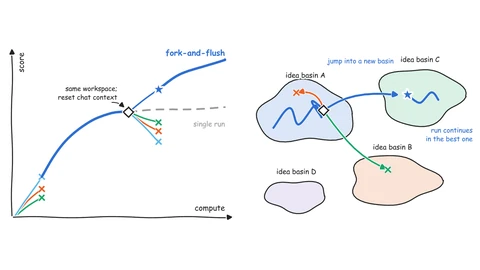
The obvious question is whether ideas are the bottleneck. Axios notes that Idealab.ai will be a real-world test of how much success comes from the idea and how much from the founder's drive, execution and network. A strong concept can still fail if the founder cannot sell, hire, raise money or reach the right customer. Gross himself told Axios that AI should not make strategic choices such as how much risk to take. AI systems that generate ideas have known failure modes too: Microsoft researchers found that long-running research agents get stuck refining one family of ideas, and an engine that hands the same list to many people risks crowding them into the same few markets.
The financial estimates on the briefs, such as capital needed and time to market, are labelled as drawn from sources, and they have not been tested against companies that were actually built. The company has not said how it checks the quality of a million generated briefs, what its error rate is, or how often two users receive the same top idea. Until founders start reporting what happened when they built one, the main evidence for the method is Gross's own track record.
Why it matters
Most AI products for founders help with tasks once a company exists, such as writing code, drafting marketing or handling support. Idealab.ai starts earlier, at deciding what to build, and gives that step away. If universities and accelerators adopt it, a large number of students and first-time founders could start from the same machine-generated pool of opportunities.
The launch also turns a famous serial entrepreneur's method into a product others can inspect. Whether it produces real companies will take years to show. The near-term things to watch are the agent tools promised for 2027, further partners after Cloudflare, and what Gross says about the system at his talks this week. AI Lookout will update this article when the company publishes results from its first cohort of builders.
Common questions
What is Idealab.ai?
A website launched by Idealab founder Bill Gross on 19 October 2026 that uses AI to generate business ideas from news, research, patents and customer complaints. The public ideas are free to explore and use.
Is Idealab.ai free?
Yes, the public ideas and briefs are free, and using an idea does not require paying for any Idealab.ai service. Paid tools for building and running a business are in beta, and a private corporate service runs the engine on a company's own patents.
What does Cloudflare offer Idealab.ai builders?
Idealab.ai says Cloudflare is offering $100,000 in free credits to anyone who builds their company on the platform. Cloudflare is the first announced commercial partner.
Sources & further reading
How this story was made
Written by Kristian Kostov with AI assistance and checked against the linked sources. Company performance claims are attributed to the company. Analysis reflects AiLookout’s interpretation; we have not independently tested the products discussed. Cover photography is illustrative and does not depict the specific announcement or product.
Our editorial standards