Announced 22 Oct 2026 · Sources checked
What Ant released
inclusionAI, the AI research arm of Ant Group, has published Ling-3.0-flash-Sante, an open-weights language model tuned for health and medicine. The weights are on Hugging Face and ModelScope under the MIT License, which allows commercial use, modification and redistribution with little more than keeping the copyright notice. The Hugging Face repository was created on 19 October 2026 and last updated on 22 October, and the model spread on X over the following days.
Sante is not a new model trained from scratch. It is a specialised version of Ling-3.0-flash, the general model in Ant's Ling 3.0 family, and the company describes it as further trained for medical knowledge reasoning, evidence-based retrieval and complex medical workflows. Ant says it keeps the general reasoning, coding and agent skills of the base model, so the pitch is a single model that can answer clinical questions, search the literature and call tools in the same session.
The release lands in a busy week for medical AI. Microsoft recently said its MAI-DxO diagnostic agent beat doctors in a study published in Science, and Google reported that its blind-sweep ultrasound AI matched expert sonographers. Both of those are closed systems. Sante is notable because anyone can download it, inspect it and run it on their own hardware, which matters for hospitals and researchers who cannot send patient data to an outside API.
What is under the hood
Ling-3.0-flash-Sante is a mixture-of-experts model with 124 billion total parameters, of which about 5.1 billion are active for each token. Only a small slice of the network runs on any given step, so it is much cheaper to serve than a dense model of the same size, though all 124 billion parameters still have to sit in memory.
The model card describes a hybrid linear design. It mixes Kimi Delta Attention, a linear attention method first used in Moonshot's Kimi models, with gated multi-head latent attention and sparse expert layers. Linear attention keeps the cost of very long inputs down, and the card says training was extended to 256,000 tokens of context. That is long enough to hold a full patient history, a stack of guidelines or dozens of papers in one prompt.
Thinking mode is on by default, so the model writes out its reasoning before answering, and it supports tool calls. The card ships recommended settings for both main open serving engines and a multi-token prediction head for speculative decoding, which speeds up generation by drafting several tokens at once and checking them in a single pass.
Ant's Ling line has moved quickly. Earlier this month it released Ling-3.1-flash, a 560 billion parameter open model, also under MIT. Sante is built on the smaller 3.0 flash base rather than that newer model, which keeps the hardware bill within reach of a single server.
The headline result: HealthBench Professional
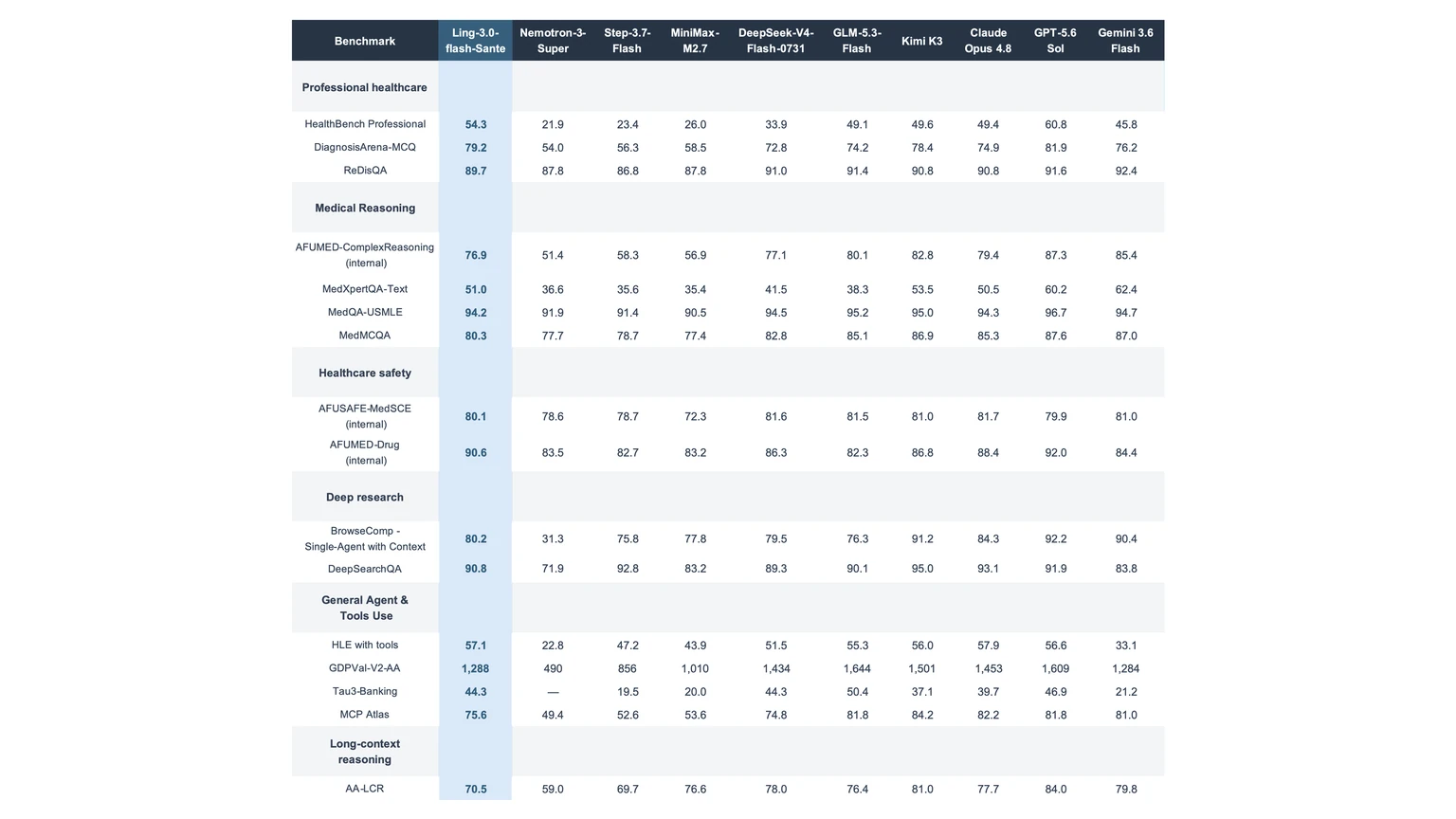
The number Ant leads with is HealthBench Professional, a benchmark of realistic medical conversations graded against rubrics written by physicians. In Ant's own table Sante scores 54.3. Of the nine other models it compares against, only OpenAI's GPT-5.6 Sol scores higher, at 60.8.
Everything else in the table sits below Sante on that test. Kimi K3 scores 49.6, Claude Opus 4.8 49.4, GLM-5.3-Flash 49.1 and Gemini 3.6 Flash 45.8. The other open models in the comparison are far behind: DeepSeek-V4-Flash-0731 at 33.9, MiniMax-M2.7 at 26.0, Step-3.7-Flash at 23.4 and Nvidia's Nemotron-3-Super at 21.9. For a model with 5.1 billion active parameters, beating much larger closed models on a physician-graded test is the strongest claim in the release.
Sante also does well on DiagnosisArena, a multiple-choice test built from published case reports, with 79.2 against 81.9 for GPT-5.6 Sol and 78.4 for Kimi K3. On AFUMED-Drug, an Ant benchmark on medication contraindications, it scores 90.6, again second only to GPT-5.6 Sol at 92.0. On AFUSAFE-MedSCE, Ant's medical safety test, the scores are tightly bunched: Sante reaches 80.1, while the best model, DeepSeek-V4-Flash-0731, reaches 81.6.
Where it trails
The same table shows plenty of tests where Sante is not near the top, and those deserve as much attention as the headline. On MedXpertQA, a hard exam-style medical test, Sante scores 51.0, behind Gemini 3.6 Flash at 62.4, GPT-5.6 Sol at 60.2, Kimi K3 at 53.5 and only just ahead of Claude Opus 4.8 at 50.5.
On MedMCQA, a large set of Indian medical entrance exam questions, it scores 80.3, below every closed model and below DeepSeek-V4-Flash, GLM-5.3-Flash and Kimi K3, which all score between 82.8 and 86.9. On the US licensing exam set MedQA it reaches 94.2, close to the pack but behind GPT-5.6 Sol at 96.7 and GLM-5.3-Flash at 95.2. On ReDisQA, a rare-disease test, it scores 89.7, while Gemini 3.6 Flash leads with 92.4.
Ant's own complex reasoning test, AFUMED-ComplexReasoning, is less flattering still. Sante scores 76.9, behind GPT-5.6 Sol at 87.3, Gemini 3.6 Flash at 85.4, Kimi K3 at 82.8, GLM-5.3-Flash at 80.1 and Claude Opus 4.8 at 79.4. The overall picture is a model that is very good at the open-ended, rubric-graded conversations HealthBench measures, and competitive but not leading on knowledge exams.
Search and agent tests
The second half of the table covers search and agent work, since Ant pitches Sante as a model that can look things up and act, not just answer. On BrowseComp, a test of finding hard-to-locate facts on the web, Sante scores 80.2 working alone, well behind GPT-5.6 Sol at 92.2 and Kimi K3 at 91.2. Ant also reports a multi-agent setting with up to 64 subagents, which its chart shows scoring higher.
On Humanity's Last Exam with tools Sante scores 57.1, in a near tie with Claude Opus 4.8 at 57.9 and GPT-5.6 Sol at 56.6. On the Tau3 banking agent test it scores 44.3, level with DeepSeek-V4-Flash and behind GLM-5.3-Flash at 50.4. On MCP Atlas, a tool-use test, it scores 75.6, below every closed model and GLM-5.3-Flash.
The weakest results are on long documents and general work tasks. On AA-LCR, a long-context reasoning test, Sante scores 70.5, near the bottom of the table, and on the GDPval-V2 work task rating it scores 1288 against 1644 for GLM-5.3-Flash. Ant's claim that Sante keeps general skills holds in the sense that it has not collapsed, but it is not the model to pick for general agent work.
How to run it and what it costs
The model card gives ready commands for SGLang and vLLM, the two most widely used open inference engines. Ant recommends four GPUs with about 141GB of memory each, H200-class cards, or eight 80GB H100s, using tensor parallelism. The vLLM recipe enables dedicated tool-call and reasoning parsers for the Ling 3 format, plus multi-token prediction for speculative decoding.
For people without that hardware, Sante is also listed on Vercel AI Gateway at $0.07 per million input tokens and $0.22 per million output tokens, with the full 256,000-token context window and function calling. That puts it among the cheapest models with a credible medical benchmark record, though teams handling real patient data would still need to check where the gateway's providers process requests.
At the time AI Lookout checked, the Hugging Face page showed 324 downloads and 49 likes, so adoption is still very early. Much of the attention on X came from near-identical promotional posts and reposts rather than independent testing.
Not a medical device
Ant is explicit that Sante is a research model. The model card says it is not a medical device, that its outputs may be incomplete or incorrect, and that it must not be used as a substitute for professional medical advice, diagnosis or treatment. It must not independently diagnose, prescribe, triage or make treatment decisions. The intended uses it lists include medical question answering with human review, literature search and evidence synthesis, long-document analysis, and building and testing healthcare agents.
That disclaimer matters more for an open model than a closed one. Once the weights are public, Ant has no control over who builds a symptom checker or chatbot on top of them. Any company that ships Sante to patients takes on the regulatory work itself, from clinical validation to approval as a medical device where the law requires it.
Recent deployments show what that work looks like. Google's tuberculosis X-ray AI now screens patients in six African countries, but only after years of trials and regulatory clearance for a narrow task. A general medical chat model with no clinical trial evidence is a very different product.
How to read the numbers
Every number in this article comes from Ant's own model card. Nobody outside the company has yet published a replication, and AI Lookout did not run the model. Two of the medical tests, AFUMED and AFUSAFE, are Ant's internal benchmarks, so outsiders cannot check how they were built or whether Sante saw similar data in training.
The comparison set also needs care. Ant says it set every model to its highest reasoning effort and ran Sante at temperature 1.0, which is a reasonable like-for-like setting, but it compared against Claude Opus 4.8 and Gemini 3.6 Flash rather than the newest models from those labs. The table is a snapshot of where an open 124 billion parameter model stands against strong rivals, not proof that it is the best medical model available.
Even so, the HealthBench Professional result is a useful signal. A model that anyone can download, run privately and inspect now comes within about six points of the best closed model Ant tested on physician-graded medical conversations. Independent tests over the coming weeks will show whether that lead over other open models holds.
Common questions
What is Ling-3.0-flash-Sante?
An open-weights language model from inclusionAI, Ant Group's AI research arm, tuned from Ling-3.0-flash for medical reasoning, evidence retrieval and medical workflows.
Can Ling-3.0-flash-Sante be used commercially?
Yes, the weights are under the MIT License. Ant says it is a research model and not a medical device, so clinical use needs its own validation and approvals.
What hardware does Ling-3.0-flash-Sante need?
Ant recommends four GPUs with about 141GB of memory each or eight 80GB H100s, served with SGLang or vLLM. It is also available through Vercel AI Gateway.
Sources & further reading
How this story was made
Written by Kristian Kostov with AI assistance and checked against the linked sources. Company performance claims are attributed to the company. Analysis reflects AiLookout’s interpretation; we have not independently tested the products discussed. The cover places the companies’ own logos, taken from public-domain or openly licensed files credited in the caption, on a plain background. It is not a product photograph, a screenshot, or an endorsement.
Our editorial standards