Announced 19 Oct 2026 · Sources checked
What Ant Group released
Ant Group's inclusionAI research team has released a family of open speech models called Ming-3.0, with weights and code under the MIT licence. The GitHub repositories for Ming-3.0-tts and Ming-3.0-asr went up on 19 October 2026, alongside an earlier-created repository for Ming-3.0-audio-flash, and the checkpoints are on Hugging Face and ModelScope.
There are five checkpoints across three jobs. Ming-3.0-tts-0.5b and Ming-3.0-tts-tiny generate speech. Ming-3.0-asr-tiny turns speech into text. Ming-3.0-audio-flash and Ming-3.0-audio-tiny are native audio-language models that take audio plus a text instruction and can transcribe, answer questions about what they hear and reply with synthesized speech.
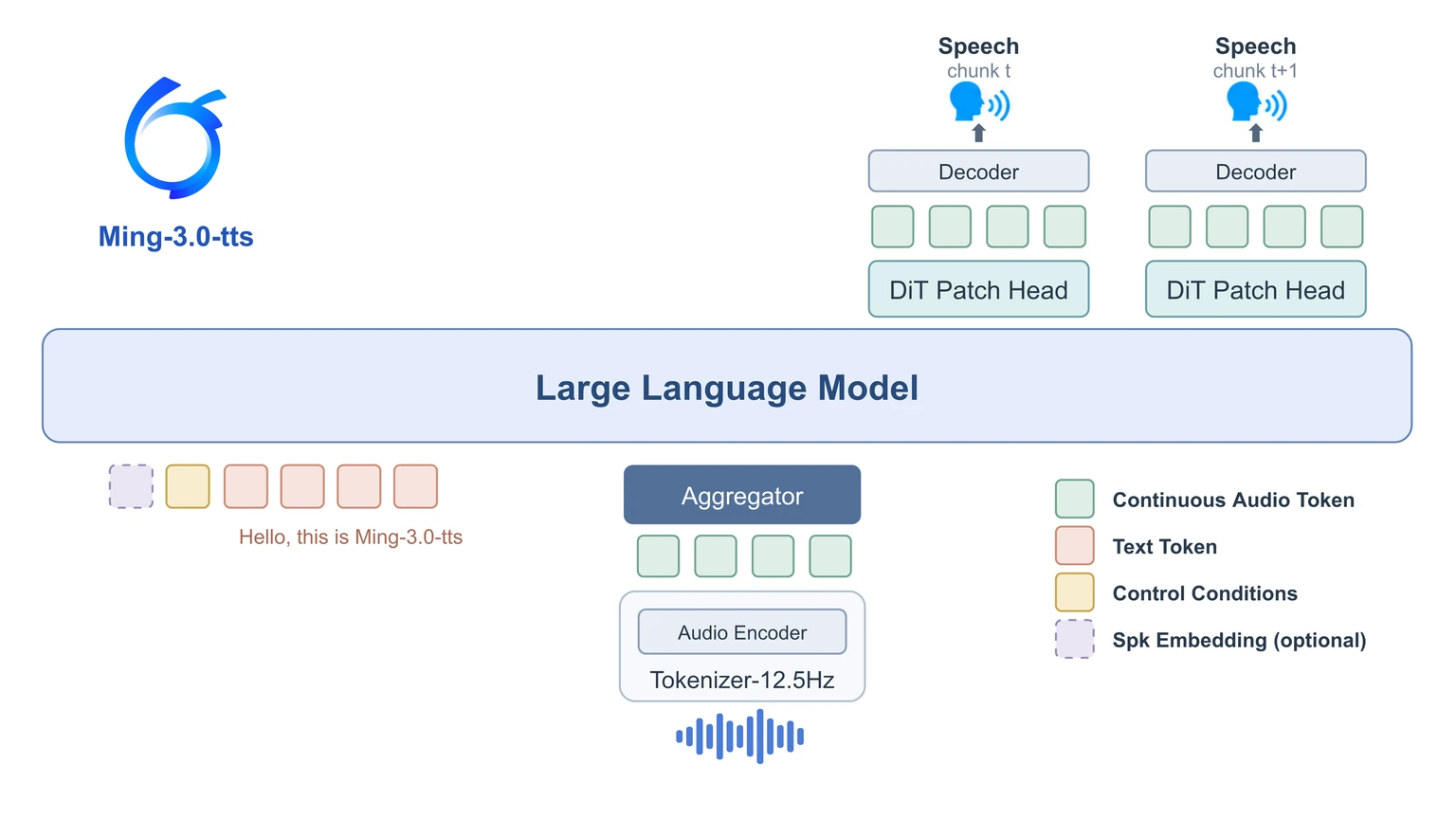
The sizes range widely. The 0.5b speech model is a dense model built on Qwen2.5-0.5B, according to its model card. Tiny is a mixture-of-experts model built on Ant's Ling V3 architecture with 7.9 billion parameters in total and 1.3 billion active for each step. Ming-3.0-audio-flash is much larger, with 126 billion parameters and 6.5 billion active, while Ming-3.0-audio-tiny has 9.3 billion with 2.7 billion active.
The release builds on the Ling language models Ant has been opening up, including Ling-3.1-flash, a 560-billion-parameter MIT model. The speech recognition model uses a small Ling language model, Ling-tiny-v3, under the hood.
How the speech models score
Ant leans on Artificial Analysis, the independent benchmarking firm, for its headline claims. According to the Ming-3.0-tts README, on the firm's October 2026 text-to-speech leaderboards the model ranks first among open-weights models on Controlled Voice, an arena where every model clones the same eight voices, with an Elo score of 1069 and a 13th place overall. It is listed first overall on Pronunciation Robustness, at 93.2 percent of highlighted spans judged correctly pronounced, and third among open-weights models on Provider Voice, where each model uses its own voices. Ant notes that ranks change as new models are added.
On open test sets, the numbers are Ant's own. On seed-tts-eval, the 0.5b model reaches a Chinese word error rate of 0.800 percent and an English rate of 1.584 percent, while tiny posts the highest speaker similarity in the comparison, 0.781 in Chinese and 0.728 in English. On a multilingual test set from MiniMax, tiny leads the listed models on German and Spanish error rates, at 0.325 and 0.971 percent.
Ant also claims top scores on all six single-tag measures of NVBench, a benchmark for non-verbal sounds, across the two models, and on emotion and dialect subsets. The README is careful in places: it says older results from its own Ming-omni-tts model still beat some new scores, and other systems' figures use their own reported settings rather than a single rerun.
Ming-3.0-asr-tiny and context-aware transcription
Ming-3.0-asr-tiny pairs the Ling-tiny-v3 language model with an audio encoder for Chinese and English transcription. Ant evaluated it on 15 Chinese dialect test sets, from Cantonese and Shanghainese to Hakka and Yunnan, and on chat, government, health and high-noise speech.
Its main trick is what Ant calls Context ASR. A request can include a topic and a list of hotwords, such as names, places or product terms, to steer the transcript. In the README's example, a clip about a film is transcribed with the wrong characters for its title until the title and cast names are passed as hotwords, after which the model gets it right.
The model is deliberately narrow. Audio is downmixed and resampled to 16 kHz, the output is plain text without word timestamps or speaker labels, and the published examples are single-GPU and non-streaming. That makes it a transcription engine to build on, not a finished meeting-notes product.
Ming-3.0-audio-flash: one model that listens and answers
Ming-3.0-audio-flash is the most ambitious of the five. Its model card describes a native audio-language model: an audio encoder and projector feed a mixture-of-experts language backbone, and an optional component Ant calls the Talker turns the answer into speech. It is built for speech recognition, long recordings, non-speech sounds and music, reasoning over audio and end-to-end spoken dialogue, mainly in Chinese and English.
That puts it in the same class as speech-to-speech systems from larger labs, but with open weights. Through the vLLM-Omni serving path it exposes an OpenAI-compatible API that can return text only, or text plus speech, and supports built-in voices or cloning from a reference clip with its transcript.
Ant publishes benchmark charts for recognition, audio intelligence and text tasks, evaluated in non-thinking mode. It warns that competitors' results were reproduced under its own setup and may differ from their official numbers. Like Mistral's open Voxtral speech models, the release gives developers something they can host themselves, which matters for privacy-sensitive call centres and assistants.
Running the models
The small models are easy to try; the flagship is not. Ant tested the 0.5b speech model on NVIDIA H800 and H20 data-centre GPUs, and recommends an H800 for tiny, which needs its own pinned Python environment. The Hugging Face checkpoints are for distribution only, so inference runs through the GitHub code.
Ming-3.0-audio-flash's reference profile spreads the model across eight 80 GB H800 GPUs to support a 128,000-token context; a four-GPU SGLang profile handles text output, and the tiny variant runs on one GPU. Direct inference loads custom model code with trust_remote_code, and the README tells users to review that code first.
The MIT licence allows commercial use with few strings attached, which is more permissive than many voice models. Ant's usage notice asks users not to impersonate real people without consent or deceive anyone, and to label synthetic speech where it could pass for a real recording. Regional players are moving fast too, as Sarvam's Bulbul v4 for Indian languages shows.
Limits and open questions
Ant lists its own weak spots. Speaker similarity in the five newer languages trails rivals, with French similarity at 0.675 for 0.5b and 0.733 for tiny. Tiny's Korean error rate of 6.000 percent ranks sixth, far behind 0.5b's 1.728 percent. Pitch is the least accurate control, emotion is harder to get right when the words carry no emotional cue, and several tags in one sentence are less stable than one.
There is no technical report yet; it is still unchecked on the TTS roadmap. Most benchmark numbers come from Ant, and the Artificial Analysis rankings are a snapshot that will move. Voice cloning under a permissive licence also raises the familiar deepfake concern, which a usage notice alone cannot solve.
For developers, the practical news is a set of MIT-licensed speech models covering generation, recognition and spoken dialogue from one vendor, with small versions that fit on a single data-centre GPU. Independent tests will show whether the leaderboard placings hold up.
Common questions
What is Ming-3.0?
Ming-3.0 is a family of open speech models from Ant Group's inclusionAI team, covering text-to-speech, speech recognition and audio-language models that can answer in speech.
Can Ming-3.0 be used commercially?
The code and weights are released under the MIT licence, which allows commercial use. Ant asks users not to impersonate people without consent and to label synthetic speech.
What hardware does Ming-3.0 need?
Ant tested the speech models on NVIDIA H800 and H20 GPUs. The flagship audio-flash model's reference setup uses eight 80 GB H800 GPUs; its tiny variant runs on one GPU.
Sources & further reading
How this story was made
Written by Kristian Kostov with AI assistance and checked against the linked sources. Company performance claims are attributed to the company. Analysis reflects AiLookout’s interpretation; we have not independently tested the products discussed. The cover places the companies’ own logos, taken from public-domain or openly licensed files credited in the caption, on a plain background. It is not a product photograph, a screenshot, or an endorsement.
Our editorial standards