Announced 20 Oct 2026 · Sources checked
What OVHcloud announced
OVHcloud, the French cloud provider that describes itself as Europe's cloud leader, is close to finishing its first large language model and plans to release it as open source. Founder and chief executive Octave Klaba told La Tribune on 20 October 2026 that the company is “finishing the training of the v1” and expects to publish it in open source at the end of November. He described it as different from other models and “very far ahead of its time” in its architecture.
The interview ran on the morning OVHcloud reported results for its 2026 financial year. In its results release, the company said it had “redefined” its AI strategy and would move into “the deployment phase” in 2027, with details promised at an AI Summit it is holding on 19 November 2026.
Klaba gave a slightly different timeline to Reuters. He said a pilot of OVHai Workspace, the company's AI productivity platform, would come shortly, followed by OVHcloud's first AI model in early 2027. The two accounts can both hold if the end-of-November date is an open-source research release and the 2027 date is a commercial launch, but neither source spells that out.
How the model is being built
Klaba gave few technical details. He told Reuters the model uses a mixture-of-experts design, which sends each part of a task to a smaller specialised sub-network instead of running the whole model every time. That approach, used by DeepSeek and many recent open models, lowers the cost of answering each request.
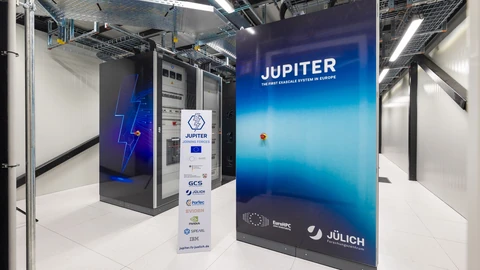
In June, Klaba had told Reuters that OVHcloud had started training its own models on JUPITER, the supercomputer at Jülich in Germany that Reuters describes as Europe's fastest. To La Tribune, he said the team had done a lot of research on how to build a model, citing attention mechanisms, the way tokens are processed, data compression and performance management. “The goal is to bring to market an LLM that is different from the others,” he said, in AI Lookout's translation.
He also argued that training has become much cheaper. The cost of training a model, he said, “has been divided by at least twenty in two years,” thanks to better hardware and new model architectures, and he credited DeepSeek with “brilliant ideas.” That cost curve is part of why open models now carry so much real traffic, as seen in Vercel's data on open-weight models' share of tokens.
No benchmark scores, parameter counts, context length or licence terms have been published. Klaba said customers will be able to judge the model's speed, memory use and answer quality once it is out, and that he does not want to oversell something the company might not be able to deliver.
Security, code and agents first
Klaba said OVHcloud picked three directions, though the first model will not cover all of them. The first is cybersecurity, both defensive and offensive. On the offensive side he described models able to break into systems by chaining together security flaws, which OVHcloud wants for testing its own defences and those of its customers.
The second is code. OVHcloud writes a lot of software and wants a model that codes as well as its own engineers and can then go further. The third is agentic AI for specific business functions: finance, human resources, legal work and supply chains, all jobs OVHcloud does internally.
He stressed that the models are trained first for OVHcloud's own use, on the company's own data rather than customers' data. If they work internally, he said, they can be released as open source and offered to customers with similar problems. He ruled out areas where the company lacks expertise or data, saying he would not do medicine.
The model sits inside a broader plan. Klaba wants OVHcloud active in five layers: GPUs in its own data centres, orchestration for training and inference, tokens sold as a service, tools for hosting AI-built apps, and end-user software such as OVHai Workspace. He said open models served on GPUs did not always give the token quality OVHcloud wanted, which is why it decided to build its own language, speech transcription, speech synthesis and text-recognition models.
Paying for it out of profits
OVHcloud is not raising billions to do this. Klaba told La Tribune he does not plan a capital increase, partly because he thinks the share price is still too low and dilution would be too heavy. He wants to invest money the company earns and to prove it can train an innovative model before committing large sums.
The results give him some room. OVHcloud reported revenue of €1,145.1 million for the year, up 7.2 percent like-for-like, an adjusted EBITDA margin of 42 percent and positive levered free cash flow for the first time since its 2021 stock market listing. Public Cloud revenue grew 18.9 percent like-for-like.
The company also has spare capacity. It says it has 250 megawatts of connected power, of which 140 MW is in operation, and Klaba told Reuters that leaves 110 MW ready for new business without building new sites. OVHcloud says it is studying ways to restructure its infrastructure for a ramp-up of its GPU business.
Three acquisitions this year feed the AI push, according to the release: Seald, an end-to-end encryption specialist, in January; Dragon LLM, which designs specialised models for regulated industries, in March; and Gladia, a voice AI company, in July. OVHai Workspace, first shown at VivaTech in June, was the first product to come out of those deals.
Where it leaves Mistral and Europe
Klaba was blunt about Mistral, the Paris model maker that has become Europe's best-known AI company. He said Mistral had declared itself a competitor to OVHcloud, but that the two are very different, and described Mistral's business as closer to an AI IT-services firm focused on integration work. Mistral's own chief executive has been arguing the opposite case for Europe, as in Arthur Mensch's call for Europe to build frontier AI.
Klaba also repeated his criticism of Europe's state-backed computing schemes. He told Reuters that funding split between the EU and member states pushes projects toward national initiatives, producing a race of national data-centre projects without customer bases to match. OVHcloud's earlier training on JUPITER, the same machine NVIDIA recently used for a 104-qubit quantum error-correction simulation, shows the company is still using that public infrastructure.
His deeper argument is about dependence. If OVHcloud relies on someone else's model to run its business, he told La Tribune, a provider could one day cut off access on the grounds that OVHcloud has become a competitor. Owning a model, in his view, is the only way to keep the company's jobs and data in its own hands.
What is still unclear
The release date is the first open question, given the end-of-November date in La Tribune and the early-2027 date in Reuters. The November AI Summit is the most likely place for OVHcloud to clear that up.
The second is what open source will mean. Klaba said OVHcloud comes from an open-source culture, but also that not every model it builds over the next decade will be open. Whether the v1 ships with full weights, a permissive licence and training details is not yet known.
The third is performance. OVHcloud has no published benchmarks, and claims of an architecture far ahead of its time will need independent tests. Until the weights are out, this is a company plan, not a product anyone can try.
Common questions
When will OVHcloud release its model?
Klaba told La Tribune he expects an open-source release at the end of November 2026, while Reuters quotes him saying the first model launches in early 2027.
Will the OVHcloud model be open source?
Klaba says the v1 should be published in open source. The licence, weights and training details have not been announced.
What will the model be used for?
OVHcloud is aiming at cybersecurity, coding and business agents for finance, HR, legal and supply chains, starting with its own internal work.
Sources & further reading
How this story was made
Written by Kristian Kostov with AI assistance and checked against the linked sources. Company performance claims are attributed to the company. Analysis reflects AiLookout’s interpretation; we have not independently tested the products discussed. Cover photography is illustrative and does not depict the specific announcement or product.
Our editorial standards