Announced 13 Oct 2026 · Sources checked
What does the lawsuit allege?
The 81-page complaint was filed on 13 October 2026 in the US District Court for the Northern District of California against four OpenAI entities: OpenAI Foundation, OpenAI OpCo, OpenAI Holdings and OpenAI Group PBC. It alleges that through ChatGPT, OpenAI “wrongfully has extracted vast amounts of highly sensitive and valuable data from millions of children” and used it to train large language models, build profiles of children and enrich itself.
The core of the case is consent. To create a ChatGPT account, the complaint says, a child only needs to give a name, say they are at least 13 and click “Continue.” OpenAI’s own terms say users under 18 need a parent’s or guardian’s permission, but the complaint alleges OpenAI never contacts parents and treats the child’s click as proof that a parent agreed.
The complaint also argues that ChatGPT’s design encourages children to share more. It lists features it calls manipulative: the chatbot speaking in the first person, mirroring a child’s style, flattering them, remembering details through its memory feature and asking follow-up questions that keep the conversation going. It alleges that training and memory are switched on by default for these users, while OpenAI does not train on business customers’ data by default.
Who is suing, and who is in the proposed class?
The plaintiff is a mother identified as Jane Doe, suing for her children, called MC1 and MC2 in the filing. According to the complaint and the law firms’ press release, MC1 is a 12-year-old girl in Hawaii who started using ChatGPT in February 2026, and MC2 is a 16-year-old boy.
The complaint says MC1 told ChatGPT she was 12, below OpenAI’s minimum age of 13, and that the conversation continued for months. Bloomberg Law reports that, according to the filing, she later sent selfies and discussed her looks, diet and body. AI Lookout is not repeating the chat excerpts quoted in the complaint.
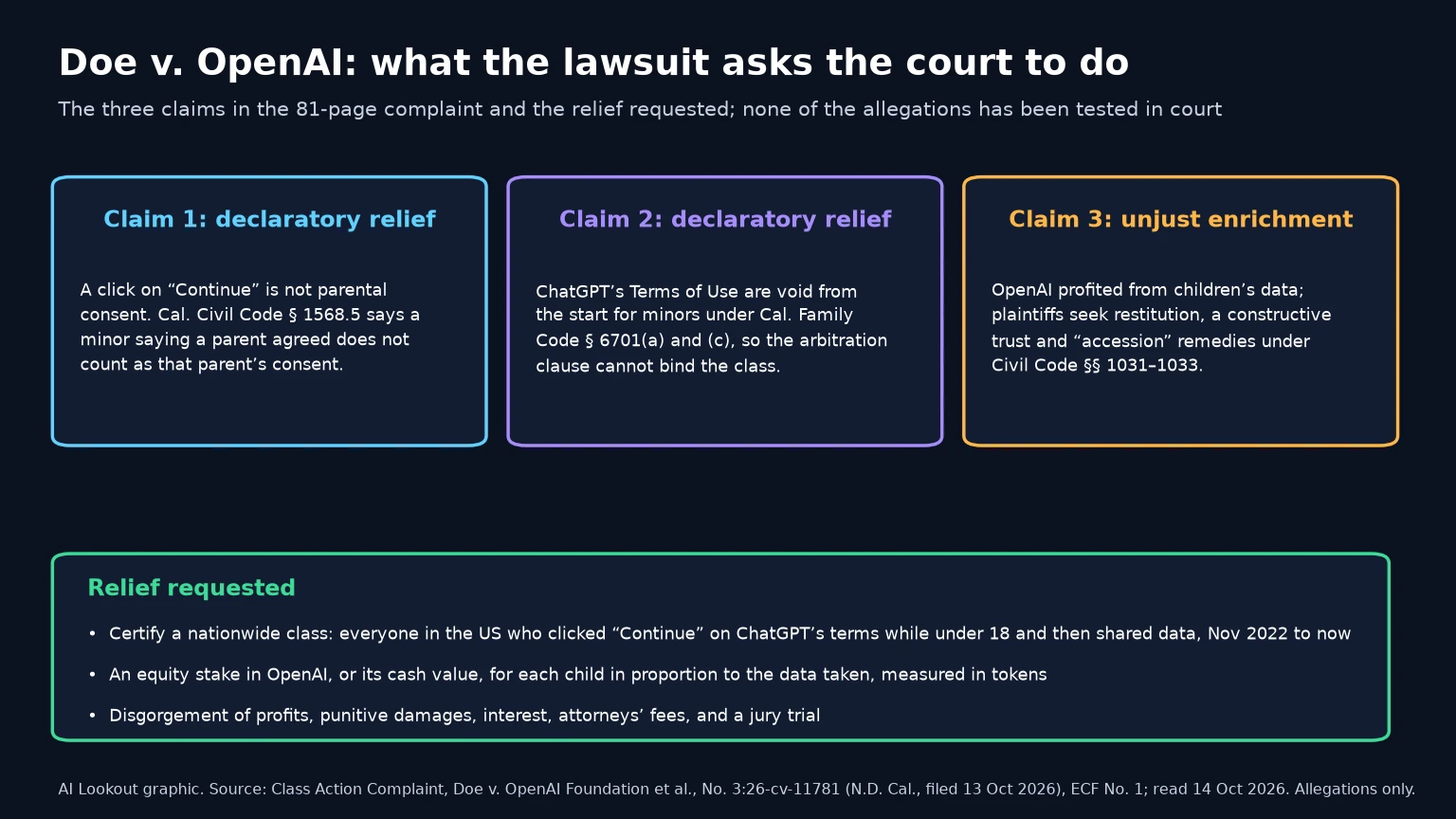
The proposed class is everyone in the United States who clicked “Continue” on ChatGPT’s Terms of Use while under 18 and then provided “one or more tokens of data” through ChatGPT, from November 2022 to the present. The complaint says this includes children who typed an older age, because it argues the California rule applies regardless of what the child claimed.
The plaintiffs are represented by Yetter Coleman, Sheeren Law, the EdTech Law Center and Umberg/Zipser. They demand a jury trial.
Why does parental consent matter under California law?
The complaint rests on two California statutes rather than on federal children’s privacy law. The first, Civil Code section 1568.5, says a minor’s statement that a parent has consented “shall not be considered to be consent.” The plaintiffs ask the court to declare that OpenAI’s click-through method is therefore legally ineffective.
The second, Family Code section 6701, dates back to 1874 and bars minors from making certain contracts on their own, including a contract that gives “a delegation of power” or that relates to personal property not in the minor’s possession or control. The plaintiffs argue ChatGPT’s terms fall into both categories, so they were void from the start, and that the arbitration clause in those terms cannot bind the children either.
The law firms say this is the first lawsuit asking a court to apply these long-standing rules to an AI company. If a court agrees, the consequences would reach beyond OpenAI: any AI service that relies on a teenager’s click for parental consent could face the same argument.
Why are the plaintiffs asking for OpenAI equity?
The remedy is the most unusual part. Under an unjust enrichment claim, the plaintiffs ask for restitution, a constructive trust over the benefits OpenAI gained from children’s data, disgorgement of profits and punitive damages. They also invoke California’s “accession” rules on personal property, which deal with someone who adds value to another person’s property.
The complaint explains this with an analogy: if someone stole grapes and made wine, the victim would be compensated for the wine, not the grapes. It argues that children’s data was turned into a company valued at over $1 trillion, and that children should receive a share of OpenAI’s equity, or its cash value, in proportion to what they contributed.
It proposes measuring that contribution in tokens, the units AI models use to process text, and says discovery will show how much of OpenAI’s valuation comes from children’s data. Bloomberg Law notes OpenAI’s valuation is up to $1.4 trillion. The complaint also quotes OpenAI’s stated wish to share the wealth its models create, saying “this lawsuit provides OpenAI a chance to do so.”
What does the complaint say about ChatGPT for Teens?
OpenAI launched ChatGPT for Teens on 18 August 2026 with parental controls, including alerts when a teen appears to be at risk of self-harm. The complaint says this changes nothing about the claims: it alleges ChatGPT for Teens does not require parental consent to sign up, does not change the terms of use, and keeps training and memory on by default.
It adds that teens can switch off the parental link and that parents cannot see their children’s chats. The complaint also cites Common Sense Media’s rating of ChatGPT for Teens as an “Unacceptable Risk”, which AI Lookout covered in our report on that rating.
Those points describe OpenAI’s product as the plaintiffs see it. OpenAI has said ChatGPT for Teens was built for learning and backed by protections, and it will have its chance to dispute the characterisation in court.
What are the weak points and open questions?
Several hurdles stand between this complaint and any payout. OpenAI will likely argue that its terms, including arbitration, are enforceable, and the plaintiffs will have to convince a judge that California’s contract rules for minors apply to a free online service and to every child across the country.
Class certification is another test. A nationwide class built on California law, covering millions of users with very different ages and uses, is the kind of class courts often examine closely. The complaint reserves the right to seek state-by-state subclasses instead.
The equity remedy is untested. Courts have ordered disgorgement and restitution before, but no court has awarded users a stake in an AI company in proportion to their training data. Valuing one child’s tokens against a private company’s valuation would also be difficult. Bloomberg Law’s report did not include a response from OpenAI, and AI Lookout found no public OpenAI statement on the case as of 14 October.
What happens next?
OpenAI will be served and is expected to respond, possibly with a motion to compel arbitration or to dismiss. Several of the plaintiffs’ lawyers still need court approval to appear from out of state, which the complaint marks as forthcoming.
The case adds to a crowded legal docket for OpenAI, which this week also faced an order to give Apple early discovery in a trade secrets case. Children’s use of chatbots is under pressure on several fronts, including the Character.ai bankruptcy filing that followed lawsuits over teen safety.
For parents and schools, the practical point does not depend on the outcome: a child can open a ChatGPT account by typing an age and clicking a button, and default settings determine whether those chats are used for training. Checking those settings, and the parental link in ChatGPT for Teens, is worth doing now. AI Lookout will update this story when OpenAI responds.

Common questions
Who can join the class action against OpenAI over children's data?
The proposed class is everyone in the US who clicked “Continue” on ChatGPT’s Terms of Use while under 18 and then shared data with ChatGPT since November 2022. The class has not been certified, and nobody needs to sign up at this stage.
Has OpenAI been found to have broken the law?
No. The complaint was filed on 13 October 2026 and contains allegations only. OpenAI has not yet responded in court, and no judge has ruled on any claim.
Why does the lawsuit ask for OpenAI equity instead of damages?
The plaintiffs argue OpenAI turned children’s data into a company worth over $1 trillion, so under unjust enrichment and California’s accession rules children should share in that value, measured by the tokens of data each child provided.
What to remember
A new class action argues that a teenager’s click can never stand in for parental consent, so ChatGPT’s terms are void for minors and OpenAI owes them a share of its value. It is a bold legal theory; arbitration and class certification fights will decide whether it gets far.
Sources & further reading
How this story was made
Written by Kristian Kostov with AI assistance and checked against the linked sources. Company performance claims are attributed to the company. Analysis reflects AiLookout’s interpretation; we have not independently tested the products discussed. Cover photography is illustrative and does not depict the specific announcement or product.
Our editorial standards