
Announced 12 Oct 2026 · Sources checked
What did Character.ai announce on 12 October?
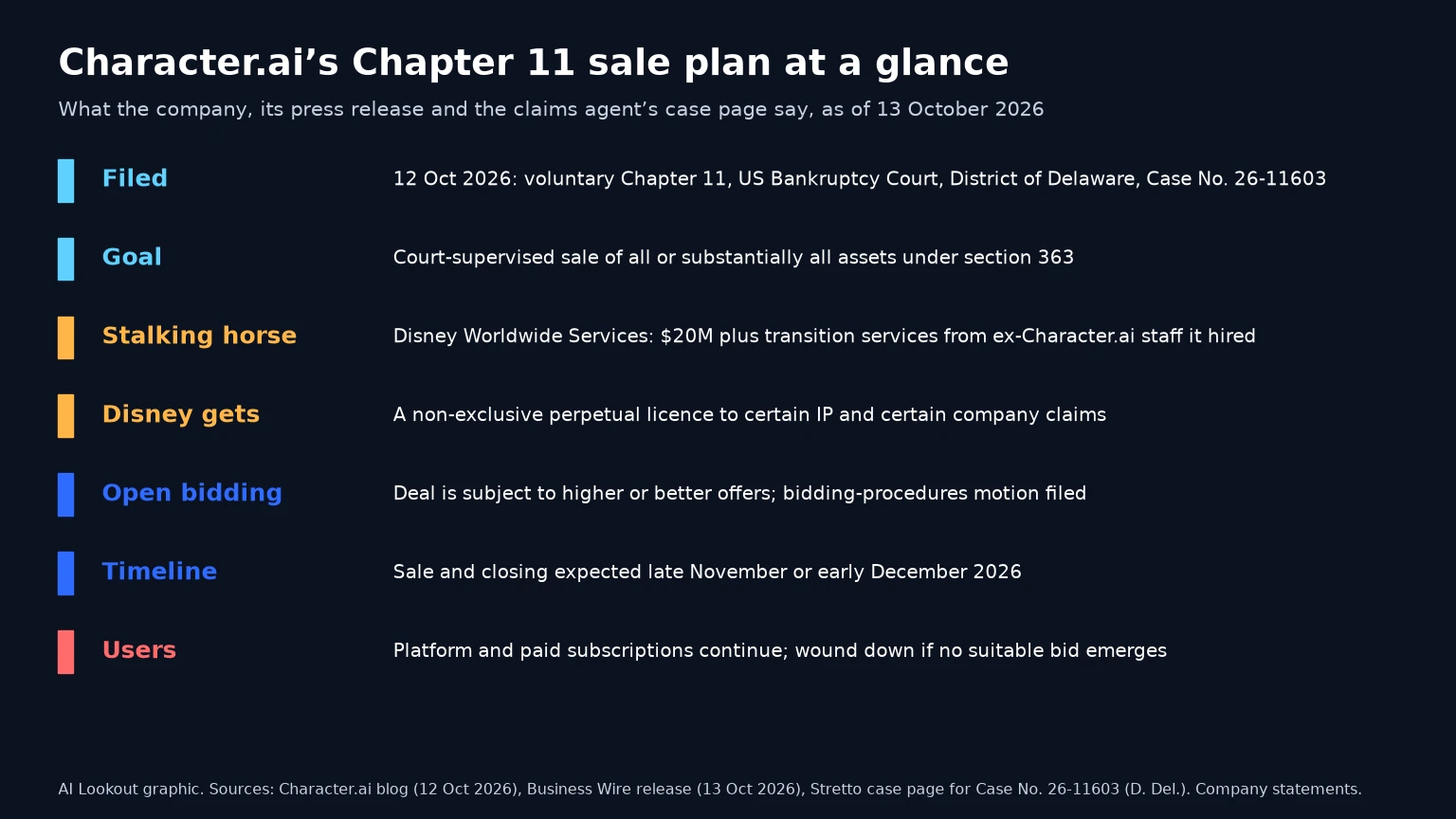
In a blog post dated 12 October, Character.ai said it had “initiated a voluntary Chapter 11 bankruptcy process to facilitate a court-supervised sale of the company.” The company’s claims agent, Stretto, lists the petition date as 12 October 2026 and the case as No. 26-11603 in the US Bankruptcy Court for the District of Delaware, under the debtor name Character Technologies, Inc.
A Business Wire release dated 13 October fills in the mechanics. The company wants a “value-maximizing sale of all or substantially all of its assets,” has filed a motion asking the court to approve bidding procedures, and wants to designate Disney as the stalking-horse purchaser for some of those assets. It has also filed the usual first-day motions so it can keep paying staff, honour commitments to users and pay vendors for post-filing work.
Chief executive Colin Adams blamed “significant legal, regulatory, and operational headwinds” and said the board chose a court-supervised sale after reviewing alternatives. TechCrunch and The Verge both report that the petition lists estimated liabilities of $50 million to $100 million; TechCrunch says assets fall in the same range. AI Lookout could not open the petition itself, because Stretto’s docket listing sits behind a CAPTCHA check.
The company has hired Wilson Sonsini Goodrich & Rosati as legal adviser, Areté Partners as restructuring adviser and Houlihan Lokey as investment banker. Disney is using Skadden, Arps, Slate, Meagher & Flom.
What would Disney get for $20 million?
Disney is not buying Character.ai outright. According to the release, Disney Worldwide Services agreed before the filing to act as stalking-horse bidder for “a non-exclusive perpetual license of certain Company intellectual property and certain Company claims.” In return it would pay $20 million and provide transition services “using former Company employees it has hired.”
Those services are meant to help Character.ai “safely operate using its platform for a limited period of time” while the sale runs. A stalking-horse bid sets the opening price in a section 363 sale: other bidders can make higher or better offers, and the court approves the winning deal. Because Disney’s licence is non-exclusive, other buyers could in principle still acquire the same IP.
The release does not say which IP or claims are covered. Claims can include a company’s rights to sue others, so the wording matters, but the public statements give no detail. The bidding-procedures motion should explain more once it can be read.
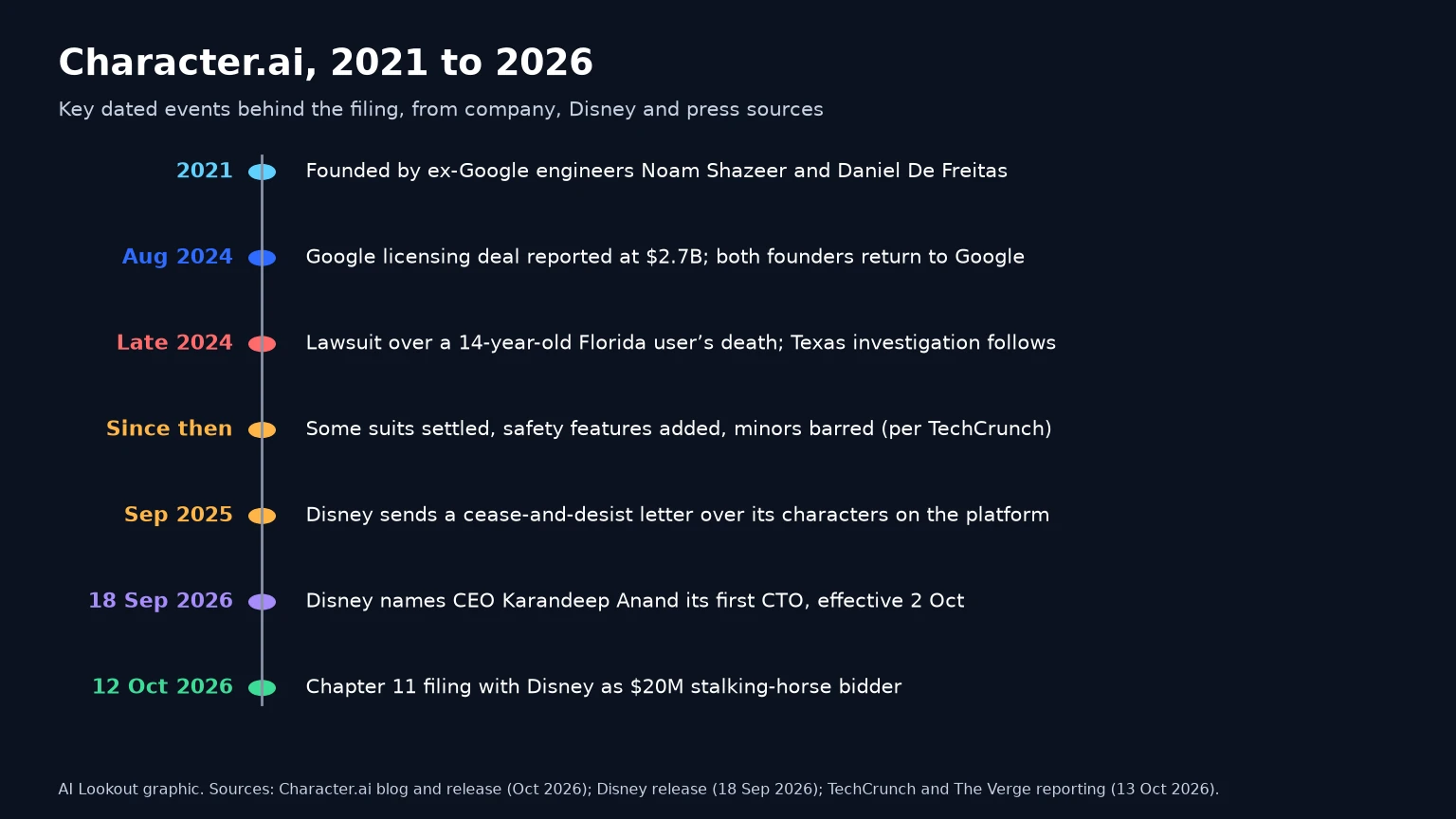
The Disney connection is not new. On 18 September Disney named Karandeep Anand, then Character.ai’s chief executive, as its first chief technology officer, effective 2 October, and said “a number of Character.AI’s technical team are expected to join Disney.” Those are the former employees whose work now forms part of Disney’s bid. TechCrunch reported at the time that Disney had sent Character.ai a cease-and-desist letter in September 2025 over unauthorised chatbots based on its characters.

What happens to Character.ai users and subscriptions?
For now, little changes. Character.ai’s FAQ says the platform “remains up and running” and that users can keep using every service. Paid subscriptions stay active and billing is unchanged; the company says it intends to warn subscribers in advance if paid features change.
On data, the company says chats and account information remain covered by its existing privacy policy and that security practices are unchanged. It reminds users that they can delete their account or export their data through the app or website.
The risk is in the outcome. The company says it hopes the sale will produce “an actionable proposal that will allow continued operations,” but “if such a bid is unavailable, however, the platform will be wound down.” A buyer could also keep the brand and change the product. If you have characters, stories or chats you care about, an export now costs little.
User data can also be an asset in a sale. In US bankruptcy cases, transferring customers’ personal information can require court review, so watch for privacy-policy updates and court notices on Stretto’s case site rather than assume today’s terms will carry over to a new owner.
How did Character.ai get here?
Character.ai was founded in 2021 by former Google engineers Noam Shazeer, a co-author of the Transformer paper, and Daniel De Freitas. It became one of the first breakout consumer AI apps, letting people create characters and chat or role-play with them.
Its course changed in August 2024, when Google struck a licensing deal reported at $2.7 billion and both founders returned to Google. The Verge compares that deal, and Disney’s hiring this autumn, to “acquihire” moves that take a startup’s talent and can leave the original company struggling.
The legal pressure followed. TechCrunch notes the lawsuit brought after a 14-year-old Florida boy’s death, whose mother says he became obsessed with a chatbot on the platform, and a Texas investigation into child privacy and safety. The company later settled some suits, added safety features and barred minors, according to TechCrunch. Child-safety concerns about chatbots have not gone away, as Common Sense Media’s ‘unacceptable risk’ rating of ChatGPT for Teens showed this month.
Under Anand the company moved into AI video, social feeds, interactive stories and microdramas. TechCrunch says it raised more than $193 million, citing PitchBook. Then, within a month, its chief executive and part of its technical team left for Disney, and the company filed.
What does the filing say about consumer AI chat apps?
Popularity did not save it. TechCrunch points out that Character.ai ranked among the top apps for time spent, citing Sensor Tower, and argues that high engagement cuts both ways: every extra minute of chat costs money in inference, which raises the pressure to monetise users.
That is the same squeeze pushing larger assistants toward new revenue, from subscriptions to visual ads inside ChatGPT image generation. A company that no longer trains its own frontier models and pays for each long conversation has less room to absorb legal costs and safety work.
Disney’s role shows a different strategy. Rather than buy a chatbot company with its liabilities, it hired leaders and engineers, then bid for a licence to selected IP. Studios are rebuilding how they make and license characters, as Epic’s reported move to AI-first development on its Disney shooter suggests, and owning the technology and people may matter more to them than owning a user base built on fan-made versions of their characters.
For other consumer AI startups, the case is a reminder that a court-supervised sale can move assets, staff and licences to new owners quickly, while user commitments last only as long as the buyer chooses to honour them.
What is still unknown?
Several basic facts are not yet public in anything we could read. The release does not say which IP Disney’s licence covers, how many users or employees remain, or what happens to pending lawsuits; Chapter 11 normally pauses most litigation against the debtor, but the filings will set out how claims are handled.
The bidding procedures, deadlines and any sale hearing are also not yet approved by the court. The company’s own timetable says the sale should be complete by the end of November or perhaps early December 2026.
Finally, beyond Disney’s licence bid, no buyer has been named for the platform itself, and the company only says it hopes one emerges. If you rely on Character.ai, or are weighing which AI assistant to use, treat the next seven weeks as a sale period with an uncertain end, and check Stretto’s case page for official notices.
Common questions
Is Character.ai shutting down?
Not now. The company says the platform remains up and running, with subscriptions and billing unchanged, during the sale. It also says the platform will be wound down if no suitable bid emerges, with the process expected to finish in late November or early December 2026.
Is Disney buying Character.ai?
No. Disney is the stalking-horse bidder for a non-exclusive perpetual licence to certain IP and claims, for $20 million plus transition services. Other bidders can make higher or better offers for the company’s assets.
Where can I read the court filings?
Character.ai’s claims and noticing agent, Stretto, hosts the case at cases.stretto.com/chartech. The case is No. 26-11603 in the US Bankruptcy Court for the District of Delaware, filed on 12 October 2026.
What to remember
Character.ai is selling itself through Chapter 11, with Disney’s $20 million licence bid as the floor and the platform running until a buyer is found. If you use it, export anything you want to keep and follow the court notices; the service survives only if a bidder wants to run it.
Sources & further reading
- An Update on Character.ai ↗
- Character.ai Initiates Voluntary Chapter 11 Proceeding to Facilitate Value-Maximizing Sale Process ↗
- Character Technologies, Inc. case information (Case No. 26-11603) ↗
- The Walt Disney Company Names Karandeep Anand to Newly Created Role of Chief Technology Officer ↗
- Just 5 years in, interactive chatbot platform Character.AI files for bankruptcy ↗
- Character.AI files for bankruptcy ↗
How this story was made
Written by Kristian Kostov with AI assistance and checked against the linked sources. Company performance claims are attributed to the company. Analysis reflects AiLookout’s interpretation; we have not independently tested the products discussed. Cover photography is illustrative and does not depict the specific announcement or product.
Our editorial standards