Announced 13 Oct 2026 · Sources checked
What did the judge decide?
In an order filed on 13 October 2026, Judge Edward Davila of the US District Court for the Northern District of California granted in part Apple’s motion for expedited discovery in Apple Inc. v. Liu et al., the trade secrets case Apple filed against OpenAI in July. Expedited discovery lets one side see documents and question witnesses before the normal evidence-gathering schedule.
The defendants are former Apple engineer Chang Liu, OpenAI chief hardware officer Tang Yew Tan, two OpenAI entities, OpenAI Foundation and OpenAI Group PBC, and io Products, the device company OpenAI bought. The judge decided the motion on the papers and cancelled a hearing that had been set for 14 October.
The ruling is a split decision. Apple asked for far more than it received, and the judge said its requests, even after narrowing, remained “quite broad” and would be “onerous” for the defendants. But he found good cause for a tailored set of documents and depositions, and TechCrunch reported the outcome as Apple winning early access to OpenAI’s hiring records.
What must OpenAI and the engineers hand over?
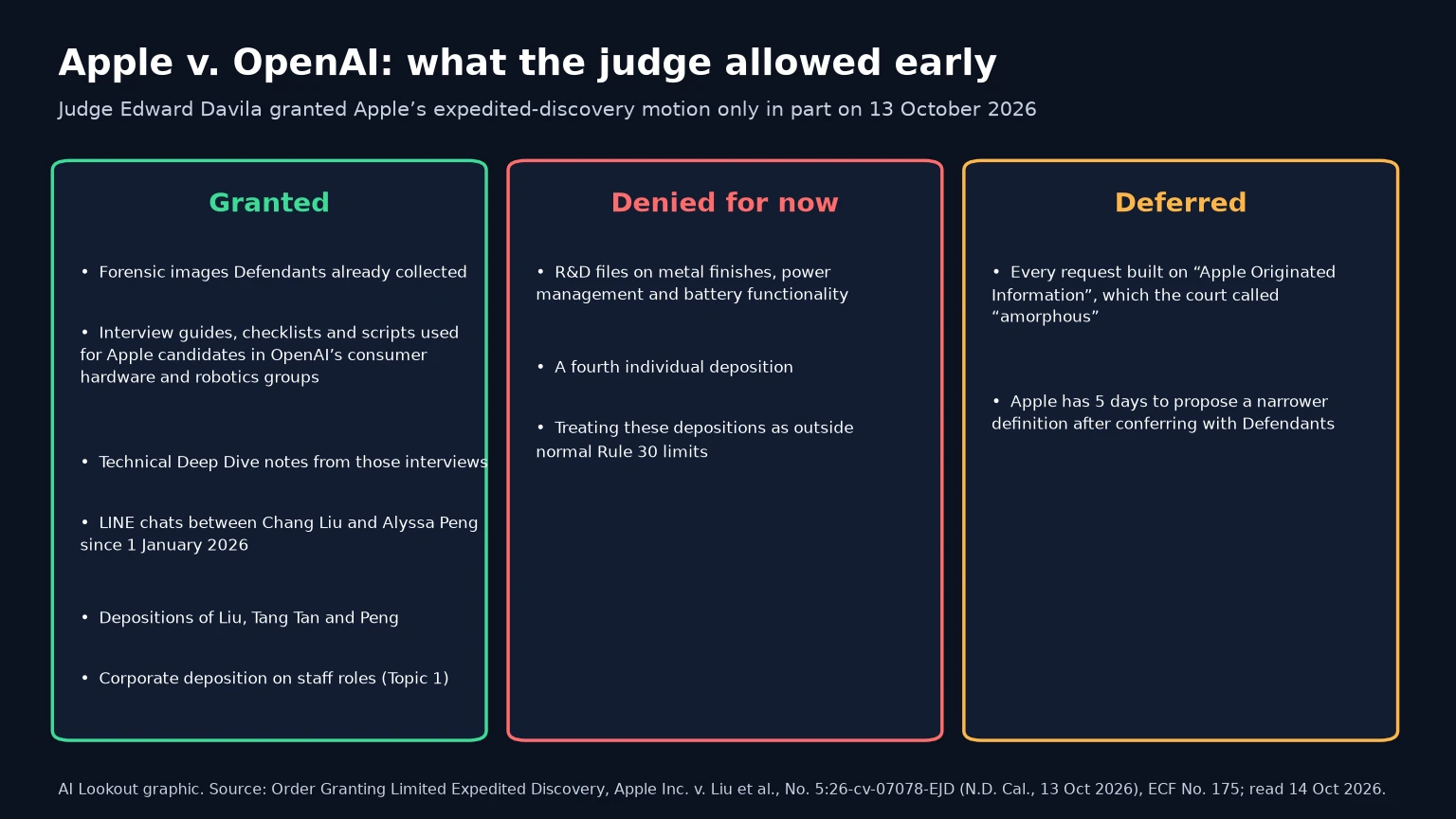
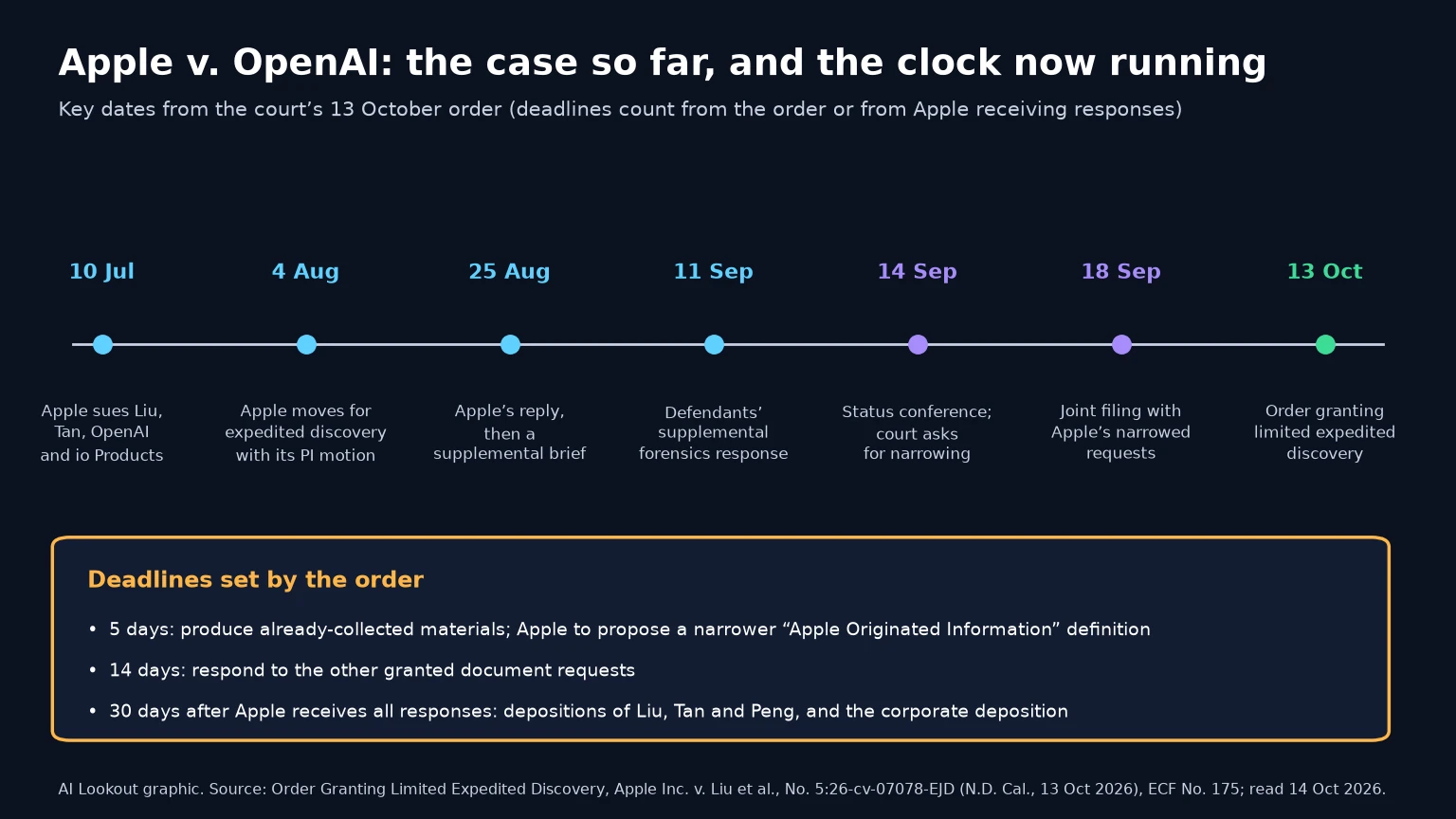
The order lists three categories of documents. The defendants have five days to produce material they have already collected for the litigation and 14 days for everything else in these categories.
First, all forensic images the defendants have already collected about the subject of Apple’s claims, including images relied on by their forensic expert. Images of Liu’s devices have become central to the case, and Apple wants its own expert to check them for flaws or signs of deletion.
Second, as modified by the court, all documents used to guide or conduct interviews of Apple candidates for OpenAI’s consumer hardware products group, including its robotics group. That covers checklists, guides, instructions, manuals and scripts, plus any “Technical Deep Dive” or other technical presentations that summarise those interviews or refer to Apple technology or parts.
Third, all LINE conversations since 1 January 2026 between Liu and Yu-Ting “Alyssa” Peng, including messages already cited in a declaration Liu filed in August. TechCrunch identifies Peng as an OpenAI employee.
The court also granted depositions of Liu, Tan and Peng within 30 days after Apple receives all the permitted responses, and a corporate deposition of OpenAI and io Products on one topic: the positions and responsibilities of the witnesses, of Tan and Liu, and of Peng and a person whose name is redacted.
What did Apple not get, at least for now?
The judge denied expedited access to “all documents related to OpenAI’s research and development related to metal finishes, power management, or battery functionality for consumer hardware products.” He said that belongs in ordinary merits discovery, which neither side disputes should move efficiently. He also denied a fourth individual deposition.
The biggest open item is a term Apple built into many of its requests: “Apple Originated Information.” Apple defined it as any non-public information created for or by Apple or learned while supporting any Apple business. The judge called the definition “amorphous” and agreed with the defendants that it was untethered to the injunction motion and could sweep in third-party information.
Rather than reject those requests, the court deferred them. Apple must confer with the defendants and propose a narrower definition within five days, which the judge will then evaluate. Interrogatories and deposition topics that use the term are on hold too.
Finally, Apple asked that this early discovery not count against the normal limits on depositions. The judge declined, saying he would consider motions to exceed the limits when needed.
Why did the court find good cause?
Courts in the Ninth Circuit allow early discovery when the need outweighs the burden on the other side. Judge Davila weighed five factors and found that most favoured a limited grant.
Apple’s preliminary injunction motion is pending, and the forensic images of Liu’s devices have become a prominent part of it. The judge rejected the defendants’ argument that Apple waited too long, The defendants had pointed to Liu’s January 2026 departure, but the judge said this case looks nothing like the long delays in the precedent they cited.
The parties’ forensic experts disagree. Apple’s expert says Liu used an Apple trade secret file in March 2026 and, in June, told Peng to have Apple-issued devices “restored” and to start using them more. The defendants’ expert found no evidence that Liu used the file with any AI platform, and the defendants note that Apple does not claim anything was actually deleted.
The judge declined to pick between the experts. He did accept Apple’s point that logs, metadata and usage records are transient, and agreed Apple needs early discovery before any secrets become “so deeply entangled” with OpenAI’s hardware work “that the harm cannot be undone,” in the words of Apple’s filing.
What is Apple’s trade secrets lawsuit about?
Apple sued on 10 July 2026, accusing former employees now at OpenAI of a pattern of trade secret theft and breach of their intellectual property agreements. According to the order, Apple alleges they used Apple’s proprietary information to help OpenAI develop hardware, to gain insider knowledge while interviewing Apple employees, and to coach new hires on avoiding scrutiny when leaving Apple.
TechCrunch’s July report adds detail from the complaint. Tan spent 24 years at Apple, most recently as vice president of product design for the iPhone and Apple Watch, and Apple accuses him of using confidential project code names in recruiting and asking candidates to bring Apple hardware components to interviews. Liu, a senior systems electrical engineer for eight years, allegedly kept an Apple laptop and downloaded confidential technical documents. Apple also points to a proprietary metal finishing technique it says OpenAI used.
Apple also accuses OpenAI, io and their partners of acting together as an enterprise to use Apple’s information to enter consumer hardware. OpenAI said at the time on X: “We have no interest in other companies’ trade secrets.” These are allegations; no court has found that anyone took or used Apple’s secrets.
What happens next in Apple v. OpenAI?
The clock is short. Already-collected materials are due within five days and the rest within 14. Apple has five days to come back with a tighter definition of “Apple Originated Information.” The three individual depositions and the corporate deposition follow within 30 days after Apple receives all responses.
What Apple learns may shape its preliminary injunction motion, which asks the court to stop OpenAI from using or disclosing Apple’s trade secrets and to require the return of confidential material. The judge left the door open for Apple to try again on the denied research requests through ordinary discovery, and the deferred requests could return if Apple narrows them.
Parts of the record are sealed, and the order itself has redactions. OpenAI is also facing other legal pressure on several fronts, from a criminal case against an engineer accused of bugging an executive conference room to a dispute over how it handled three departing safety researchers. Nothing in the court records links those matters to Apple’s case.
Why it matters for AI hardware hiring
The order goes to the heart of how AI companies hire hardware talent. Apple’s main theory is that OpenAI’s interviews were a channel for confidential information, and the judge has now ordered OpenAI to show exactly how it interviewed Apple engineers and what those interviews recorded.
That is a practical warning for any lab building devices. Interview scripts, technical deep-dive notes and casual chat logs between colleagues can all become evidence. Companies that recruit from a rival’s hardware teams need clean-room hiring practices and records that show what candidates were and were not asked.
Courts are becoming a regular venue for AI industry disputes, from trade secrets to bankruptcy, as in Character.ai’s Chapter 11 sale process. AI Lookout has read the 13 October order but not the sealed exhibits or the full complaint, and will update this story when the depositions or the injunction ruling add material detail.
Common questions
What did the court order OpenAI and the engineers to give Apple?
Forensic images the defendants already collected, the guides, scripts and technical deep-dive notes from interviews of Apple candidates for its consumer hardware and robotics groups, and LINE chats between Chang Liu and Alyssa Peng since January 2026, within five to 14 days.
Did Apple win the case?
No. This is a pre-trial discovery order. The judge granted part of Apple’s request for early evidence, denied other parts and deferred the rest. Apple’s trade secret claims and its preliminary injunction motion are still undecided.
Who will be deposed in Apple v. OpenAI?
Former Apple engineer Chang Liu, OpenAI chief hardware officer Tang Tan and Yu-Ting “Alyssa” Peng, plus a corporate witness for OpenAI and io Products on staff roles, within 30 days after Apple receives all permitted responses.
What to remember
A federal judge has given Apple a narrow early look at how OpenAI recruited Apple hardware engineers, while keeping OpenAI’s device research off-limits for now. Expect the depositions and the injunction ruling to decide how much of Apple’s theory holds up.
Sources & further reading
How this story was made
Written by Kristian Kostov with AI assistance and checked against the linked sources. Company performance claims are attributed to the company. Analysis reflects AiLookout’s interpretation; we have not independently tested the products discussed. Cover photography is illustrative and does not depict the specific announcement or product.
Our editorial standards